
Me and Borges

A couple weeks ago Google’s doodle celebrated the 112th birthday of Jorge Luis Borges, the Argentinian writer who wrote such fantastical modernist works of literature as Ficciones, The Labyrinth, and The Aleph.  I was introduced to his writing in college by my roommate, who was a student of Spanish literature, and while dense and difficult, found a certain strange attraction to the stories. Borges is one of the most influential writers of the 20th century — a shame he was never awarded the Nobel prize in Literature — on an order of Nabokov, Joyce, Barthelme and other modernist authors.

In 1985, when I was a cub reporter at a daily newspaper in northeastern Massachusetts, Borges visited Philips Andover Academy — the prestigious prep school — and gave a lecture there. The city editor at the paper wanted someone to interview the blind writer, but his name drew a blank in the newsroom except for me, who became very excited at the thought of meeting such an eminence.

He was staying at the Andover Inn on the Philips Andover campus, attended to by his assistant (and later wife) Maria Kodama. A photographer from the paper accompanied me, thoroughly bored and glazed over by my breathless attempt to convey the fame and impact of the little old man and his complex surrealistic stories that prefigured hypertext.

He was old (he died the following year in Switzerland of cancer), short, and dressed impeccably in a dapper suit. He shook my hand, welcomed me to sit on the bed beside him, and asked, in a heavy accent, if I would like a cup of tea or water. The photographer’s flash popped a few times, and Borges’ face was startled by the sound of the camera shutter, a little perturbed it seemed at the thought of being photographed without warning. He didn’t cover his blindness with sunglasses, and cocked his head slightly to better hear my questions.
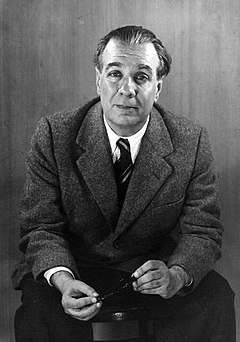
I knew instantly that there was nothing I could ask the man that he could answer and that I could then quote in a story of any possible interest to the 40,000 readers of the Lawrence Eagle-Tribune, most of whom were more engaged by the debate over whether the city garbage-men should continue to drag household trash barrels onto the street or if the homeowners should do it for them. It was, in a perverse way, like being in a Borges story, where the protagonist is lost in a library looking for knowledge that can’t be expressed.

We talked about his books, me expressing my fondness for specific stories, especially The Garden of Forking Paths, and his puzzling themes of labyrinths and diverging, non-linear thoughts. Keep in mind I was only three years out of  Yale, where my head had been filled with the Deconstructionist theories of Derrida by Paul de Man, J. Hillis Miller and Geoffrey Hartman.  We talked about Pynchon, Paul Theroux (who visited him and wrote about the meeting in The Old Patagonian Express) and my college writing teacher, Gordon Lish. I didn’t take any notes in my spiral reporter’s notebook. What was the use? And after 30 minutes his assistant gently interrupted to say Mr. Borges needed his rest.

I thanked him, posed for a picture of him that is probably in the Eagle-Tribune morgue somewhere, and after shaking his hand, made my goodbye.

I went to the newsroom with the photographer and wrote a brief, superficial 100 words about Borges’ visit. I regret not having brought a copy of one of his books for him to sign.

The Evolution of Corporate Communications

Monday Note.

Very interesting piece this morning by Frederic Filloux about the change in power between corporate PR and the press. The thesis is the changing nature of the news cycle — digital serfs churning content into the maw  as opposed to enterprising reporters developing their own leads and chasing them down — has shifted the power to corporate journalism: corporate content developed and handed over to the press for straight pass-through republishing.

“Contents are now tailored for the needs of digital media. As one of the renegade journalist recently told me – a fine female reporter disappointed by the trades’ evolution  –, corporate communication departments are switching from the usual press release to almost-ready-to-publish stories. She showed me compelling examples of product announcements treated in a variety of manners. The communiqué was largely ignored, but its transformation into a pre-packaged version showed up everywhere: internet, but also mainstream medias, newspapers, TV, radio.  The PR advisor was herself surprised by the efficiency of the process (and rather happy for her client): none of the media were eager to go outside the path she defined; reporters called the specialists she suggested, used the photo and video material she provided; no question asked whatsoever.

“The underlying facts: most journalists no longer have the time, the training, nor the motivation or even the management supervision to go beyond the surface. So, let’s feed them with what they need and we are in full control.  That’s the plan. And most of the time, it works beyond expectations.”

I suspect this will definitely be the norm, not the exception in business journalism, especially in the B2B trades, and put more of an emphasis on content creation and development skills inside of a PR agency or corporate communications team than the former model of stonewalling and spinning. In essence the creative side of journalism moves from the newsroom to the source.


The New York Times Paywall is Coming

Arthur Sulzberger, Jr. spammed me this morning to say that the NYT.com is moving to a subscription model very soon.

I blog about this topic only because I was once such an ardent front line promoter of the free-and-open model back in 1995 when Forbes.com launched and the traditional newsroom wanted the Wall Street Journal paid-sub model. I still maintain subscription content is a mistake in most cases, or at the very least, digital access should always be free to those antediluvian enough to continue paying for the print version.

Anyway, here’s the terms of the Times – of some interest as they surveyed me last fall with a lot of different possible scenarios and permutations. I’m moot due to the print subscription:

“On NYTimes.com, you can view 20 articles each month at no charge (including slide shows, videos and other features). After 20 articles, we will ask you to become a digital subscriber, with full access to our site.

On our smartphone and tablet apps, the Top News section will remain free of charge. For access to all other sections within the apps, we will ask you to become a digital subscriber.

The Times is offering three digital subscription packages that allow you to choose from a variety of devices (computer, smartphone, tablet). More information about these plans is available at nytimes.com/access.

Again, all New York Times home delivery subscribers will receive free access to NYTimes.com and to all content on our apps. If you are a home delivery subscriber, go to homedelivery.nytimes.com to sign up for free access.

Readers who come to Times articles through links from search, blogs and social media like Facebook and Twitter will be able to read those articles, even if they have reached their monthly reading limit. For some search engines, users will have a daily limit of free links to Times articles.

The home page at NYTimes.com and all section fronts will remain free to browse for all “

The local rag, the Cape Cod Times, went to a metered paywall late last year. Maddening as hell to pay into a tiered model that tells me I have used 7 of 50 story clicks in a month. Whoever the financial whiz was that came up with that complex tiering system needs to be spanked.

I pay because I used to work there and somewhat like their local coverage — but a lot of the locals around me have moved on and given up on the Cape Cod Times. A death sentence for a local product that can only survive with local impressions. And if the pricing is going to happen — go flat and keep the complexity out of it. Please.

The coming failure of digital periodicals

The best thing that can be said about the dead-tree era of publishing that sustained the world for a few centuries was the relative ease-of-use and standardization in operating the delivery mechanism — the book, newspaper, or magazine. Sentences began on the left, went to the right (in the West), eyes moved from to bottom, and when you finished the page you turned it. Need to remember a place? Dog ear the page or use a bookmark of some sort. Need to annotate? Scribble in the margins. Underline the text. Highlight the sentence.

The first digital versions of text tried to ape their paper antecedents. Zinio and other early e-mag technologies were basically smarter PDFs of pages, but they were proprietary, and it wasn’t until HTML provided a common framework and page description language that there was some semblance of standardization on how to read pixels.

Now that we are two years into the dedicated e-reader revolution — starting with the Amazon Kindle and now the notion of iPad apps, all hell is going to break loose on readers with very bad consequences. While others have bemoaned the end of the web as it moves off of standard platforms and onto proprietary ones, my beef is purely based on usability.  Today’s culprit is the vaunted New Yorker’s new iPad version, a “free” app that sticks a $4.99 gun in your ribs as soon as you decide you actually want to read something in it.

Jason Schwartzmann’s cute video instructions aside, the New Yorker is an utter failure as an online reading experience for several reasons.

  • Pages are turned by flicking up, not side to side.
  • The table of contents is impossible to find
  • The standard menu has no option to jack up the font size to make the thing elderly eyes compatible
  • It doesn’t remember your place automatically
  • It doesn’t appear to have any annotation capabilities
  • Getting out of the cute animation of how the cover was drawn was nigh impossible

New Yorker editor David Remnick needs to b-tch-slap his designers and start over. I will not buy an iPad version of the magazine again ($4.99 is a rip off what appears, thanks to the missing table of contents, to be a severely truncated version of the real thing). Whomever coded the thing and made their “enhancements” to the reading experience are the beginning of an ugly trend that is only going to get uglier as formats splinter and digital typographic designers decide to innovate the same way they managed to muck up web design over the years. Amazon enforces a modicum of standardization, so for now my allegiances will lie with the iPad’s Kindle app. But magazines and papers better settle on a defacto standard for tablet/reader publishing or we’re all screwed trying to find out where the table of contents is, the font adjuster and the virtual bookmark. I need to get smarter about these new tablet production tools.

What I’m Reading: Hitch-22

Memoirs are generally untrustworthy affairs, especially when penned or ghost-penned by retired politicians or athletes seeking to cash in on their glories with a fat advance and a chance to put onto the record their version of the past with no arguments or contradictions. But rare is the memoir of a man of letters, a literary autobiography as it were. Some writers, like Steven King, have written strong reflections on the craft of the writer, weaving in their own life’s plot as a framework, but for the most, the autobiography is at best an opportunity for we readers to be taken into the conspiratorial confidences of the tale-teller and given a version of events that at best is written with the same verbal grace as their non-Onastic work, and at worse whitewashes controversy and settles past feuds with the awesome singularity of the printed page.

Fitzgerald, Faulkner, Melville, Hemingway … few literary lions have written about themselves, indeed some like Pynchon are impressive in keeping their biographies off of the page, and limited to but a few cryptic paragraphs on the edge of the dust-jacket and end papers.  Literature resists critical psychoanalysis and the text is supposed to speak for itself, but yet the reader wants more insights into the dark influences behind the fiction: hence the cottage industry a few years back into tell-all biographies of John Cheever, the tortured alcoholic chronicler of Mad Men-era suburban New York and Westchester. The result was a bit embarrassing in the end.

I have not been a close fan of the political journalist Christopher Hitchens over the years. His work in Vanity Fair has occasionally come into view, but I haven’t been a fan in the sense of buying his books and seeking out his work in the Nation and television talking head-fests. For some reason I bought his memoir Hitch-22 and have been picking away at it this summer, slowly immersing myself into the life of what could be one of the last true British men-of-letters. That he has esophageal cancer didn’t come to my attention until I was half-way through the book, a relief as I am glad I didn’t come to the book with some morbid rubber-necking as a motivation. I had first become aware of him when he assailed my former employer, The Lawrence Eagle-Tribune, and my late colleague, Susie Forrest, for their first Pulitzer Prize for reporting the Willie Horton scandal during Michael Dukakis’ failed run for the presidency in 1988.   Then came this astonishing video of Hitchens undergoing waterboarding so he could report on the experience first hand.

The book is remarkable and opens with the type of astonishing development that any novelist would crave. Hitchen’s mother, a relentlessly self-improving English woman hiding her Jewish roots from the strictures of post-WW II English society, abandons her career naval officer husband and ends her life in a lonely Athens hotel room with her new lover. The effect, the development puts into place a foundation for the rest of the tale that never relents.

Hitchens intelligence and ambitions are unwavering. His mind is obviously astonishing. But it is is dogged refusal to back down from a life-long hatred of totalitarianism, to proudly wear the jingoistic labels of “Trotskyist,” to reject religion and faith and willingly face his attackers that makes this work a true profile in courage. His early calls for the overthrow of Saddam Hussein, his proud embrace of American citizenship despite an upbringing as the consummate Englishman, his love of the language and the fun of word play …. in the end it combines into what I have to declare is my favorite literary autobiography ever.

Jerry Flint 1931-2010

The greatest part of my journalism career will always be the people I met in the newsrooms along the way, the old timers and crusty senior members of the masthead who would consistently display some courage or curmudgeonly craziness to inspire a young reporter. One of the greats will always be Forbes’ automotive editor, the great Jerry Flint, who passed away on Saturday, August 7 at the age of 79.

Jerry was the king of Detroit car reporters, covering the beat for the Wall Street Journal and the New York Times before setting off on a 31-year career at Forbes. I best remember him for three things:

1. Convincing me in my first year at Forbes, when I was working out of an apartment in Boston as the “New England Bureau Chief” (a bureau of one, me), that I could expense my utilities and even a cleaning service through my monthly expense report. “Really? Gee!” and I took the bait, filing the receipts only to get called on the mat by my boss for being the Mark Hurd of Forbes in 1988. “But Jerry Flint said …”

2. After starting Forbes.com in 1995 the ad sales force was told to take me around to the big accounts to sell them sponsorships on this new thing called the World Wide Web. One of the first stops was Detroit, center of a lot of print ad pages back then, as GM was the magazine’s biggest account. I was hauled around the city (my first time there) by the ad guys and eventually taken to the offices of J. Walter Thompson to pitch the Lincoln account. Jerry was in town and used as a lever to get the meeting with the Lincoln execs. I had no idea the kind of clout he carried, but there I was, a “portable” projector in tow (the thing had wheels and a handle and weighed 50 pounds) and my Toshiba Satellite, and Jerry flies in, dapper as always, and the kow-towing began. I had no chance to make my pitch. We were taken into a windowless conference room, the table covered with ominous lumps shrouded in cloth.  Next year’s models were going to be unveiled to Jerry and the Lincoln designers were very nervous. As they unveiled one car after another, Jerry looked on, finally saying with a sarcastic smile, “Hell, they’ll always be cheap Cadillacs with big lumps on their asses, won’t they?”

3. On Nova, the PBS show, there was a documentary about America’s love affair with SUVs and minivans. Jerry made a cameo inside of some Soccer Mom Wagon, sitting in the back seat and popping open, one at a time, all the cup holders. When he got to 17 his point was made. “May drive like a shoe box but it holds a hell of a lot of Slurpees.”

Jerry was old school, but Jerry owned the car beat. As the New York Times obituary said this morning, he loved big noisy cars.  Here’s Forbes memorial.

NYT Pay Wall Survey

I tend to be a sucker for completing surveys from brands I love and the New York Times is one of them. This morning I invested 15 minutes in a lengthy survey on my willingness to pay for a variety of schemes to deliver NYT content to me via print and online. As a staunch hater of pay-walls, yet an inveterate paid subscriber of the Wall Street Journal Online (as well as a paid subscriber to the print editions of everything from Woodenboat to Baseball America, the Times and the Atlantic Monthly) I contradict myself when I say on the one hand that information should be free versus my practice of paying for stuff that I really want and prize.

The Times is obviously going to a paid model. But here’s my proposal to them. Segment your circulation in a pyramid model. At the top are print subscribers who cough up the big bucks to have a wad of paper dropped at the end of the driveway every morning. Those subscribers get carte blanche access to everything. iPad apps, smartphone apps, NYT.com. No questions, no up-charges, no nickle and diming. The rest? Well, tier it from a monthly model but don’t nag the user to death with micropayments and day passes.  I would rather be hit once and hit hard than suffer the death of a thousand cuts.

Gauging from the dozen or so pricing schemes offered up during the interminable survey, the beancounters at the Times are crunching through a lot of models, models driven by the panoply of platforms they have to deliver to: paper, PC browser, iPad, Smartphone, e-book readers. But what came through for me, as I tried to pick the best pricing scheme like a new set of eyeglasses at the optometrist – “Better this way? Or this way?” — is how much the Times is important to me and would rank, along with a handful of sources, as the only publication Iwould cough up $50 a month or more to read on whatever device I decide to read it on.

While I wish there was an advertising model robust enough to subsidize publishing and keep the paywalls down, the truth is the old display model of CPMs does not work, sponsorships are barely hanging on, and marketers will carry their ad dollars to volume ad networks and paid search for the foreseeable future. So, if keeping the reporters and editors of the Times employed means paying for digital access, then so be it. I will pay.

The one thing I may not pay for much longer is the print edition. Much as I love it, I seem to be the only one in the household who does. So … iPad get ready, you may be the preferred platform for the foreseeable future.

I miss being a reporter some days

Bloggers Be Warned: FTC May Monitor What You Say – Advertising Age – News

via Bloggers Be Warned: FTC May Monitor What You Say – Advertising Age – News.

AdAge reports this old news (which has been sent to me by enough people that I have to comment)

“Thinking about letting a big-name blogger test-drive your new hybrid in the hope he’ll post a glowing review about it, or maybe sending some beverage products to an influencer, hoping she’ll spread the word?

“You might have to think twice, if the Federal Trade Commission follows through with its proposed plan to start regulating viral marketing and blogs.”

Libertarian sensibilities and First Amendment misgivings aside, I’d support a truth-in-blogging disclosure policy. I’m sickened by the ongoing”twilight of objectivity” as the  traditional press fades away, and the online replacements — from review sites gamed by business owners, to payola agencies that build buzz for a fee — aren’t stepping in with any kind of ethical compass.

Those who play it straight will have no problem. I just want to make sure when I see someone raving about a product or service that I know the terms on how they came to try it. If they bought it themselves, all the better. If they took a test drive or loaner — then tell me. If they cashed a check for the “review” — they better disclose or I hope both them and the writers of the check get whacked for the deception.