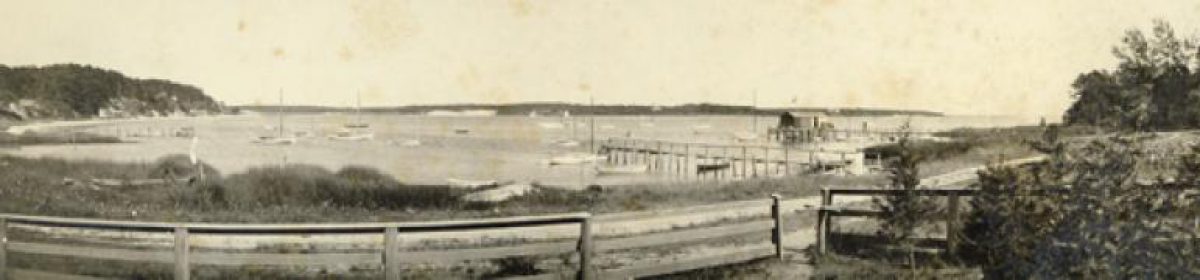
Musings on the beach

The cold snap that swept the eastern seaboard last week finally finished off the flowerbeds. A few brave nasturiums and snapdragons succumbed to the low temperatures, so yesterday I pulled them up put the stalks in the compost heap, replacing them with a few dozen tulips and hyacinths for some April color.

This morning, feeling a little creaky in the lower back, I decided to follow some good advice received here, and go for a walk by myself. Being low tide, the harbor beach seemed like a good route, so I walked down to the town dock and down the beach, ducking under piers with some difficulty but reveling in the strong breeze from the southwest that seemed more full of oxygen than usual.

I realized that it was the first time I had walked that stretch of beach in perhaps 35 years, having spent hours there as a boy, exploring and catching minnows with total freedom. What kept me away for so many years?

One day, while walking along the shore, a shrill voice from the bluff made itself known.

“You! You! Get off that beach! This is private property! I am calling the police right now!”

It was a terrible experience. A new family had bought one of the lots on the shore and built an ugly house on it. They didn’t understand that beach had been walked across by generations of villagers, so they eventually erected an ugly green chainlink fence across the dry part of the sand, making the entire route impassable at high water.

Beach rights and the question of where property rights end on the shore makes for an interesting legal debate. I don’t question that it is wrong for someone to camp out with a beach blanket and cooler in front of someone’s private property, but the laws governing passage — and the precise definition of where a property begins and ends on the interface between land and water varies from one state to the next.

In Massachusetts, passage along the shore is guaranteed to fishermen, hunters, shellfishermen and people engaged in the act of “navigation” below the mean low water mark. Does that mean you can only wade in front of private property? That you can only cross on wet sand and must stay off of the dry sand?

Whatever the definition, some waterfront owners are charitable and post signs that encourage beach walkers, while others erect intimidating no-trespassing signs. I have been in confrontations while clamming or fly fishing when a property owner has belligerently demanded I move own, and I calmly explain the laws guaranteeing my rights to perform those acts. A good conversation has followed. I empathize with someone who pays over $25,000 a year in property taxes for a water view, only to see their beach fouled by beer cans and bait boxes left behind by inconsiderate surfcasters, or pitted with deep holes dug and left unfilled by clammers.

It is a terrible experience to have a simple nature walk interrupted by a confrontation, and I think the situation will worsen as the old timers on Cape Cod move own and are replaced by “wash ashores” who don’t care for the traditions of the past. As the population expands and pressure increases on a very fixed, very valuable resource, the situation is going to get worst, not better.

A number of years ago a very powerful state politician, William Bulger, president of the Massachusetts State Senate, was walking on a beach when he endured one of those contributions I described above. He made it a personal vendetta to change the laws — which are ancient and date back to colonial times — but I don’t think any meaningful reform ever occurred.

As property owners continue to try to improve their lots with piers (which pose a problem for walkers because they are a difficult barrier to duck under), and conservation groups try to keep those piers from being built, the mood is worsening. This is an issue I’d like to get involved with. My great-great grandfather, Thomas Chatfield, was instrumental at the turn of the last century in getting the town to reserve paths and lanes — known as Town Ways to Water — so the public could get to the shore to make their living. Those ways to water are threatened, obscured by property owners who don’t want people walking past their homes, sometimes planted with bushes or covered with utility sheds and swingsets. Identifying them and getting them cleared in the priority of the local shellfishing groups.
At my other online home — Reel-Time: The Internet Journal of Saltwater Flyfishing, the topic of beach access is a perennial topic.

Here are some background links on the issue:

Vario Creative Blog » Online Marketing and Measuring Social Media

Vario Creative Blog » Online Marketing and Measuring Social Media

The omni-intelligent Mark Cahill on engagement marketing and measuring. A great post:

“Engagement is sexy, it’s fun, it’s altruistic. It’s marketing riding in on a white charger to save the damsel. Direct marketing is unsubscribe lists, frequency and walking a thin line with the dark side. “Luke, I’m your marketing manager…””Engagement is the thing that allows you to direct market. It helps to create an environment where the customer is willing to recieve your message, opt in for email, open print mail, click on targetted ads, sign up for RSS, etc. It’s the difference between an open email and a new spam filter rule with your name on it. This is purely perception on the part of the customer.”

Words that need to be coined

Paul Gillin, a very smart tech editor/journalist (PC Week, Computerworld, TechTarget) and consultant once coined a phrase for the type of person who enters the express checkout lane at the grocery story with more than the maximum number of items:

Expresshole

I need a word for the emotion you feel in a convenience store when the person ahead of you plays his or her paycheck on scratch tickets and lottery numbers, dooming you to five minutes of: “And I’ll take three Quick Pick Megabucks of Welfare and seven Scratch Slots and eight ….” This word is dying to be born.

And, I need a word for the guilt one feels on an filled-to-the-brim airplane, when someone else breaks wind, makes a stinky, and you worry that others think you did it.  I think the psychographic profile generally lays suspicion on a) men, b) big men, c) big men who are sleeping.

Whereabouts for the rest of the year

12.9-11: Cotuit

12.11-13: RTP

12.14-1.7.07: Cotuit (with some vacation in there someplace)

1.8-1.11: Arizona

Time to think about the year in review list …

The staple of end-of-year journalism, when reporters start banking copy so they can take some time off during the holidays, the year-in-review list is generally partnered with the forecast for the year to come.

I thought I’d get a head start on the season and celebrate my 11 month anniversary as a first-time marketer with some random bloviations on life inside a $14 billion startup.

  1. I thought, going in, that marketing was where the right-brained side of the MBA class ended up. The creative, non-quantitative types — Word versus Excel users — who thought up “whiter-than-white/brighter-than-bright” slogans and approved television commercials. Wrong. Marketing is extremely quantitative and creative and driven by the Four P’s — Product, Price, Place and Promotion. This is a challenge to me, the most un-quantitative man alive.
  2. The Four P’s don’t mean much to me. I don’t care. That doesn’t mean they aren’t crucial, they just don’t hit me as that relevant.
  3. Web marketing is the “plastics” of modern business. If you are thinking of a career, then think about Web marketing. It changes so fast that half the fun (and half the terror) is making it up as you go along.
  4. Corporate blogging went from a circus freak show in January (when Scoble and Israel published Naked Conversations) to a fact of life in December. If you and your company are still noodling over whether to do it or not then I feel sad for you. Don’t hire a PR firm to set your blog policy.
  5. It’s all about Search.
  6. Interactive/Digital marketing feels hotter to me in 2006 than Online Journalism did in 1994 in terms of potential impact and disruptive impact.
  7. Metrics are nothing without analytics. Metrics are what makes number 6 as hot as it is and is what makes number 1 so crucial. Analytics driving actions are hard.
  8. Web publishers who depend on display advertising for their growth strategy are very threatened. Don’t focus on what is happening to the print and broadcast side, (as the obituary writers would say, “donations in lieu of flowers”) the next big upset is in the 1.0 to 2.0 model of transformation that is coming down on the gross tonnage web models that emphasize eyes, clicks, and impressions.
  9. Customer service is the noblest manifestation of a brand and should be parented by marketing.
  10. Engagement marketing is where the action is but direct marketing is where the money is.

There … ten random bloviations.

Half of American Business PCs Can’t Run Vista

Half of American Business PCs Can’t Run Vista

Thx to Jim Leonard for the pointer to this eWeek piece:

“Ultimately, the rate at which the average business CPU’s MHz rating is increasing has not kept pace with Vista: The CPU requirements for Vista have increased 243 percent from those of Windows XP, whereas the speed of the average business PC’s CPU has only increased by 215 percent over roughly the same time period,” Williams said.

Question is this: will Vista drive massive refreshment in business PCs, or does the steep step-up mean it may take years before we see XP vanish and Vista dominate. I still see some Windows 98 and 2000 machines, so we are not going to see anything tsunami-like in the uptake numbers.

Personally — I’ll load it onto my X60 tablet to play with it, but I don’t feel the aching need to have it the way I may have felt with earlier Windows versions.

Sad

James Kim found deceased | CNET News.com

Condolences to the Kim family and his colleagues at CNET.

What he did was courageous.

Lenovo blog number two is rolling

Inside the Box » Blog Archive » The Most Useless Feature on a ThinkPad?

This has been a good day. We launched the second “official” Lenovo Blog — Inside the Box — with Matt Kohut, our worldwide competitive analyst at the helm. This marks the debut of the corporate blog template and the debut of our corporate blog aggregator at http://www.lenovoblogs.com.

OgilvyPR — John Bell and Veronica Oleynik — made the design and hosting happen. Without them …. we’d be using Blogger or WordPress.com and not living in the slick world we do.

Guess who figured out how to embed YouTube videos today?

Kind of cool. You register the blog with YouTube, provide the WordPress API and YouTube takes care of the rest. Duh.

I had been pasting the embed code into the WordPress write box — and that wasn’t working too great.