Goodbye Ned

Ned, our 12-year old Skye Terrier, died today. I had to ease his suffering from liver cancer and I knew it was time when he stopped eating and the shine went out of his eyes. With his passing goes a family fixture that has been a part of our lives since the Christmas of 2000, when my daughter and I flew to Nashville to get him after our previous Skye, Harry, had died in the street under a car the month before.

Ned was named “Stormy” when we met him, named because he was born during a thunderstorm. He was eight months old at the time, a problem puppy who was bullied by his brothers and sisters and picked on by his own mother. Where Harry was a canine genius, one of the most intelligent dogs I’ve ever known, Ned was simple, a bit slow, a shy dog that gradually came out of his shell and thrived on the couch and the yard here in Cotuit that was his domain for his entire life.

He liked sharp cheddar cheese, snapped at dangled pieces of spaghetti and earned the nickname “Pasta Shark.” He slept under the stairs in what we called his Harry Potter bed. He rolled in stinky dead things because he liked the way it made him smell. He hated fireworks and thunder and banged on the bedroom door every night for sanctuary at the foot of my bed.

He hated having his butt inspected for dingle berries and would flip out into circles of animated play-rage, a behavior known as “Kawa-Kawa.” He knew few tricks, liked riding in the car with his head out the window, and was a bit of a lazy slug on beachwalks, once falling so far behind that he returned to the boat where he stood, in the shallows, paws on the gunwale, looking hopefully into the hull for some sign of us. He was a dog of many names, including: Count Dookoo, Gabba, Apartment Bear, Seal Pig, Sewer Pipe, Nedly, and others that I can’t remember now.

Ned was my daughter’s dog from the very beginning. She came to Nashville with me, 13-years old, and helped me squeeze him into a dog carrier bag because the airline wouldn’t let dogs travel in the luggage compartment. We let him out in the terminal and he immediately peed on the rug, ears huge like radar dishes, and went into his first of his crazy kawa-kawa circles.  We let him poke his head out of the bag during the flight and fell in love with him then and there.

Skye Terriers are a rare breed, one of the least registered every year with the AKC and in danger of extinction in Britain. They are the oldest of the terriers — the ur terrier if you will — the basis for most modern terrier breeds. They are big hairy dogs — 30 to 40 pounds — with the legs of a dwarf, giving them the appearance of a large eared grey and black dachshund crossed with a sheep dog. They are stubborn but intensely loyal to one owner. One, Greyfriar’s Bobby, was renowned in 19th century Scotland for guarding his master’s grave for 14 years.

Dogs break our hearts and sometimes give us our first childhood exposure to grief. We’re better for having them in our lives, and I note how my life is punctuated by one dog after another.

No one said it sadder than Pablo Neruda in his poem, A Dog Has Died


The Art of the Note

With the United States Postal Service on the verge of bankruptcy, and the kind folks at the Cotuit Post Office telling me they need my business to stay open, I write this paean to the mail of snails in the hope that one of the last best things in the world — the handwritten note — survives.

I think Guy Kawasaki once wrote that a handwritten note sent in congratulations, condolence or commiseration is infinitely more heartfelt and well received than a ephemeral email, tweet or blog comment. I was never a big thank you note writer as a kid, but for over a decade I’ve tried to do my epistolary best by keeping at least a half-dozen blank note cards and stamped envelopes in my briefcase or bag. My handwriting sucks (so I print), but it only takes a minute or so to jot down a few words that will be remembered for a far longer time.

In the late 1980s, after writing a cover story for Forbes and winning a couple prizes for it, a friend of my late father wrote me a note that said, in effect, if the old gent were alive today he’d be very proud of you and how you’ve turned out.  I don’t think any praise has meant more to me in my life. Would I have the the compassion to put pen to paper and do the same for some other young person beginning their career and finding their first success? I hope I would.

In the mid-90s Henry Kissinger wrote me a sarcastic letter in the mistaken belief I was the editor in chief of Forbes because the magazine had somehow screwed up the facts concerning him, Richard Nixon, and a bottle of wine consumed in China. I hung onto that one too.

I write on notecards I order from Merrimade, an old WASP institution that used to be based in the Merrimack Valley and was owned by one of my neighbors growing up in Andover, Mass.. They sold the company to Crane years ago, but the quality is the same, and where else can you order note cards with your name on it, or the name of your country estate with a little yacht emblem? (I am stealing the idea of naming my future country estate “Morningwood” from my pal Ham Freeman)

I send them to friends when they get promoted or take a new job, when pets or grandparents join the invisible choir, or just to say thanks for helping me out. Takes but a minute, keeps the postman employed, sticks it to the email demons and can yield tweets like this one. My favorite note of all time, courtesy of Christopher Buckley is this unprintable gem.


Music solutions

With my music in the cloud and freed from the tyrannical clutches of iTunes, I next turned to the question of how to make it truly portable, especially how to get it on the boat. I juiced the memory on my HTC EVO smartphone to 32 gb with a miniSD card and find that I’m running either the Amazon Cloud Player when on the household wifi, downloading stuff locally for playback on the phone when I’m in the middle of Nantucket Sound and too far away from the cell towers, or streaming from Last.fm when I’m too lazy to deal with setlists of my own stuff.

When I was a iPod person I had one of those iPod dock things — an expensive Bose thing that required a wall socket. Battery powered portable speakers are generally terrible, but the New York Times recently reviewed a bunch of wireless Bluetooth speakers and I went with David Pogue’s recommendation for the Soundmatters FoxL unit. It’s not cheap — I paid close to $200 on Amazon — but it uses a rechargeable Li-Ion battery and cranks very loud volumes when needed. Oh, and did I say it’s wireless? This means no proprietary slot connector for the iPod/iPhone, just a discoverable Bluetooth connection that I can hit with my Thinkpad, iPad, the wife and kid’s iPhones or my Android EVO. The range is decent, but anything beyond 15 feet gives it some issues.

My favorite application for the unit is to tether it to my iPad while I’m watching Red Sox games when I’m on the road in NYC. I am tired of having ear buds jammed into my ears for hours and love the freedom to prop the iPad up and just watch it like the tiny television it was meant to be.

Three weeks and I am very happy with this portable sound solution. The unit is solid, small, and very easy to set up and use. The sound is excellent. This toy is definitely moving into the category of favorite things. Now to figure out cloud music in the car and life will be complete.


Guilty Pleasures – Electrocuting flies

This has transformed my life and ended the lives of hundred of flies. Talk about better mousetraps.

Winter in America: Gil Scott-Heron

One of the great voices of American poetry and music has passed. Gil Scot Herron. This song, Winter in America, has stuck in my head since first hearing it in the 1970s.


Happy May

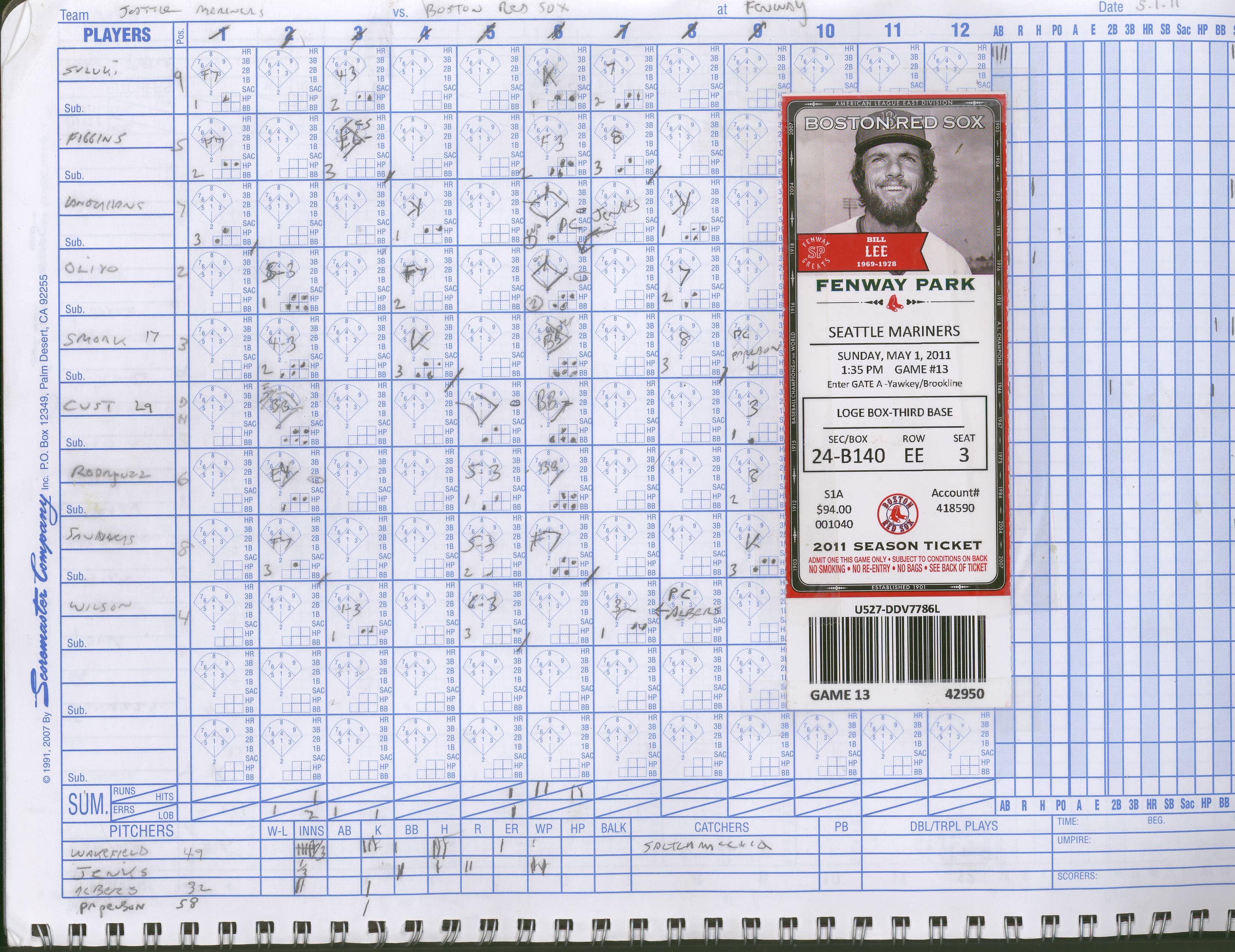
What better way to celebrate the First of May than a day game at that “lyric little bandbox” of  a ballpark, Fenway Park, aka the Shrine?

Surviving Grady put it best:

“It couldn’t have been scripted any better in Hollywood. The aging veteran pitching well in a spot-start. The aging DH coming up with a big hit. The much-maligned reliever…never mind, Jenks still sucked. And for the finale, the struggling free agent with a walk-off RBI single to win it.”


Taking it all in with my son at my side and fresh scorebook in my lap, to quote the cliche: priceless.


Driving down the dial

Three driving trips to NYC from Cotuit over the past month has taught me the importance of a decent car iPod dock — mine having failed and degenerating into weird behavior — or a decent set of FM radio presets to keep me from going insane on the long stretches through southeastern Massachusetts, southern Rhode Island and the interminable stretch between New London and New Haven. The trip is exactly 250 miles from the village to mid-town and I can do it in four hours, rush hour traffic and late summer road construction permitting.

Phone calls cut the time the fastest, interesting how interacting directly with someone cuts the sense of time. My second preferred form of aural entertainment is podcasts (remember those?), ranging from college courses downloaded from iTunes (I tend towards history and philosophy), cycling podcasts, and geek casts like the Gillmor Gang (if I can find it as it comes and goes). With the iPod dock in bad shape, I have devolved to the radio, and this past trip resolved to take one of the band of presets and once and for all organize a series of station pre-sets to coincide with the 250 miles haul.

One thing stands clear — I am a left-side of the dial guy. Why the crap stations dominate the 100’s is a mystery, but down in the 80s and 90s live the little college stations and NPR affiliates, places where anarchy and eclecticism rule the airwaves and the advertising is nonexistent.

National Public Radio can be a good thing. And I start the trip at 5 am in the dark listening to the BBC World Update — the Economist of the ether — catching up on the suicide bombings and coups in various banana republics as read by the prickly and sometimes sanctimonious Dan Damon. WGBH — one of the oldest public radio stations in the country, has a monster signal that reaches from Boston to the Cape. The joke locally is GBH either stands for Great Blue Hill (the location of the transmitter in Milton) or God Bless Harvard because the studios are so close to Harvard Stadium in Allston. Locally, the NPR affiliate is WCAI at 90.1. I like CAI (Cape And Islands) because its general manager Jay Allison was such an early force on The W.E.L.L. in the 1980s and their local programming, particularly the local food report, is generally excellent. What I cannot abide is John Hockenberry’s The Takeaway due to their pernicious belief that adding high-tech noises to intros and outros makes the news cool.

GBH and CAI could carry me through Providence Rhode Island and beyond, but once I get to Mattapoisset and Marion I switch over to theUniversity of Massachusetts Dartmouth station, WUMD (89.3) because I love student DJs and some of the very bizarre stuff they play in the early morning hours. UMD isn’t the strongest station in the world, and catering to the local Portugese population one can find a lot of Brazilian pop which — language issues primarily — is unlistenable after a song or two. Some of the more progressive programming is interesting though.

New Bedford at sunrise is a poignant place, recalling one November morning in 1978 when I was hitchhiking from the Cape back to New Haven to make classes after a sad weekend with my father. I stood in the breakdown lane across from the crematorium in the Fairhaven Cemetary, flapping my arms in my thin denim jacket, singing “Black Throated Wind” and swigging from a pint of blackberry brandy to keep my spirits up. Years later,  over coffee at Farley’s on Potrero Hill, I told John Perry Barlow, the writer of that song, about that morning, and how a capella I had managed to make BTW my favorite Grateful Dead song, even if it had first appeared on Bob Weir’s Ace album. He was, I think, flattered.

Then I was picked up by some teenagers in a fast TransAm and had to endure some head banging music which destroyed the mood until they were pulled over for speeding in Stonington.

In Fall River, as the car crests the eternally repainted Braga Bridge, I take advantage of Narragansett Bay and the strong signal beaming up from the south from the University of Rhode Island’s station, WRIU, 90.3, where on Thursday morning the DJ played a solid hour of Les Paul’s work, delving into interesting digressions about how Les Paul did not design the famous Gibson guitar bearing his name, but lent his name to it. That was awesome, listening to Les Paul and Fred Waring, and other stalwarts of popular radio from the late 30s, 40s, and 50s, the signal getting stronger as I plowed through Providence and down the long scrubby stretch of West and East Greenwich, Exeter and South Kingstown, site of the infamous massacre of the Narragansetts in 1675 by the combined forces of the colonia militias in what is known as the Great Swamp Fight.

WRIU can be my favorite station on the entire four hour trip, but it dies in New London where a huge void opens up in the dial space as there seems to be no great station there. I need to tune into WCNI, Connecticut College’s 2000 watt transmitter on the next trip, but haven’t dialed into it as of yet.

Coming out of New London, in the space between the Thames and the Connecticut Rivers — near Lyme, famous for the tick and the disease it carries — I tune to WPKN, 89.5, the University of Bridgeport station, which is one of the oldest and most progressive public radio stations on the coast. Yesterday I was pleasantly surprised to hear Jim Motavelli, on the air as the DJ. He interviewed me in the late 90s when I was at Forbes.com in a book he wrote about the impact of new media on the traditional press: Bamboozled at the Revolution and described my “droll, preppy demeanor.” PKN was in the middle of its fall fundraiser — usually a sure repellent that has me hitting the buttons for the next non-mendicancy station.

By Stamford, with NYC just a few dozen miles away, I switch to the final station of the trip, Fordham University’s WFUV, which is another NPR affiliate that plays a ton of good music. FUV, which is based in the Bronx and has a strong transmitter, stays with me down the FDR and into whatever mid-town garage is going to take me down for $50 in parking.

I’m sure my next car will have XM radio and stay tuned to the Grateful Dead station most of the time — a predictable shame given the delights of college radio.

The Year the Team Missed The Parade

Okay, so the Fourth of July water fight was getting a little out of hand but the baseball team started it, or actually the EPAC Grotto’s peeing clam float started it, but that’s my theory. The local landscape company towed a trailer the size of a tennis court behind a big dump truck and loaded it with the best college baseball teams in the country. Young men at the peak of their capabilities, armed with SuperSoakers the size of Iwo Jima flamethrowers and an endless supply of softball-sized water balloons, wreaking havoc down Main Street from the Kettle-Ho to the elementary school.

Someone was sure to get hurt. Some toddler diving for a piece of penny candy was going to get crushed beneath the trailer wheels like a fanatic hurling himself under the wheels of the legendary Juggernaut. Old ladies in lawn chairs were being rudely entered into a bad wet t-shirt contest that no one wanted to judge. We had to defend ourselves, and over the years the sidewalks were lined with garden hoses, pressure washers, water cannons and the war was on, escalating to the point that finally reason had to step in and say enough.

The Cotuit Kettleers sat out the 2010 Cotuit Fourth of July parade and the village was upset.

Would we take out our aggressions on the Mason’s Mariner Lodge, and do away with a dozen old men wearing white shirts and natty little aprons? Would the librarians get it next? What could be done? The omission of the boys of summer was the talk of the counter at the post office. We were mad. A ritual had been taken away from us.

The season had already opened in early June, when snowflakes still could be imagined in the rickety wooden bleachers in the shade along the third base line at Elizabeth Lowell Memorial Park, the gem of all the Cape Cod Baseball League’s ballparks, an oasis carved out of the pines and oaks a few hundred yards away from Cotuit Bay. Was this our year? Had coach Mike Roberts (UNC Chapel Hill’s coach from 1976 to 1998 and father of Oriole second baseman Brian Roberts) recruited a dugout full of superstars? It was impossible to tell. June was a difficult month, of rosters churned by the College World Series, the Super Regionals, Team USA try outs, and even the Major League scouts knew not to come with their radar guns as the college freshmen and sophomores made the wrenching transition from metal to wooden bats. The scouts would come, trying to answer the question we all asked:

Who would be the next major league superstars? They were out there, on the dusty basepaths and achingly green outfield. We knew they were out there, every summer revealed them to us. Chase Utley. Ron Darling. Mo Vaughn. Jason Varitek. Kevin Youkilis. Nomar Garciaparra. All had once stepped up to the plate, dove for liners, fumbled and stumbled for our ticket-free enjoyment on the hallowed grounds of Lowell Park. But who were they? We wouldn’t know for a few years, not realizing that the tanned pitcher who sold us our 50-50 raffle tickets in the stands would soon be standing on the mound at Wrigley or Petco or Fenway heaving heat on national television. What was clear was how blessed we were to be living in the town with the team that had won the most championships in the country’s most prestigious amateur baseball league, the league where the best of the best came to learn how to swing wood and get noticed by the scouts.

As the season progressed one learned to pick one’s place in the bleachers very carefully, to arrive precisely 45 minutes early while the basepaths were being hosed down and the coaches spraypainted new baselines. The musical cliches of the game blared through the PA – a weird playlist of country music, jump-around fist-pumping hip hop, and hair band anthems that we wished would just stop — and we all snickered at the interns behind the microphone who mispronounced “Cotuit” and referred to Cape Cod as “The” Cape Cod. Top row, back corner, brown paper sack of popcorn from the Kettleer’s Kitchen and a bottle of Poland Springs. Layout the scorecard, fill in the teams, the date, the names of the umps, the start time, and wait for the announcer to list the lineups. A few rows down, the founder of the dynasty, Arnold Mycock, for whom the Cape Cod Baseball League championship trophy is named, dean of the scorers, always presented early with the coaches’ lineups by an intern sent from the press box. Avoid sitting near the bozos — cell phone man who loudly calls his friends and always repeats the same silly cliches “…it’s the best wooden bat league in the country …,” anyone with kids under the age of ten, the Fountain of Misinformation who plaintively repeats over and over the obvious plea to the pitcher to “Throw Strikes.”

Rise for the National Anthem, cap over heart, as Nicky Chevalier takes the microphone out to home plate and we all look out to centerfield, the maroon (or is it Cranberry) uniformed Kettleers standing in a long line in front of their dugout, everyone’s eyes on the flag waving flaccid in the summer southwesterly breeze.

Play ball.

The pitcher superstitiously skips over the third baseline on his way to the mound. The umps and coaches swap line ups at home plate. The announcer reads the same script he’ll read at every game. The first pitch it thrown out by some account manager from Wells Fargo Private Wealth Advisors LLC. Their picture is taken with the catcher, they are handed the ball as a souvenir, the only one that will be given out as balls are too precious to give away blithely like they are in the majors. Shag a foul ball and return it to the red tent for a coupon to the Kettleer’s Kitchen.

And so it goes for 22 home games. The same routine, the same script, the same vista, the same rules, the same nine innings. But the players are all new. Few ever return for a second season. Yet instantly they become Our Team, their names gradually memorized through rote and repetition until they are as familiar as nephews at a family reunion.

Would this be the year? Cotuit hadn’t won the champs since 1999 and Coach Roberts didn’t have a title on his mantle yet. Bandy legged from years of hitting of swinging a fungo bat during batting practice, he gamely rises from the dugout and takes his place before us in the third base coach’s box, semaphoring hand signals and truly coaching his new charges in the art of Roberts Small Ball, a game of bunts and steals, and devious tricks like the mythical Hidden Ball Trick. His temper is wonderful to behold, a mixture of ferocious indignation and bewilderment over the genetic stupidity of umpires and the appalling rudeness of the visiting team’s fans, all philistines who should know when to sit down and shut up in the presence of his righteousness.

My scorebook gradually fills with the record of games won and lost. Exclamation points cryptically marking moments of greatness, moments uncaptured on film, lost in a park with no replay, no statisticians, no grotesque mascot dressed like a kettle. Sweat stains mark the heat waves. Mustard the hot dogs. Every page has a dogeared greasiness from the popcorn butter.

The girls in their summer clothes parade back and forth behind the dugout trying to catch a ballplayer’s eye. Vacationing bozos in Yankee caps self-consciously preen. Every foul ball into the parking lot where only a fool would park is greeted with a warning of “Heads Up!” and cheers as yet another windshield gets smashed with a spidery thunk and the line at the snack bar cowers and holds their hands over their heads.

The sailors from the yacht club arrive in the fourth inning, salt stained, barefoot and sunburned. “What’d I miss?” they ask. And I dutifully read back the highlights from the scorecard. “Bushyhead lined to third into a double play. Coach intimidated the visiting Meat into a balk. Yaz hit a dinger to center. And there’s a yellow jacket nest behind the the bathrooms that just attacked a herd of anklebiters and made them cry.”

The lack of a parade concerned us. Would it cast a dark cloud of bad luck on the home team?  Cotuit baseball fans fight all change. “The day they install lights is the day I stop coming.” But no parade? It was wrong. Something would happen and it wouldn’t be good.

It did happen. And it was good. Yesterday the Kettleers won the championship in a beautiful post-season run that saw them sweep their way into the finals against the Yarmouth-Dennis Red Sox. I missed it, obligated to attend a meeting, but the game played on my phone, a little window of video that suddenly saw a flood of cranberry colored uniforms rush the mound, silent with the audio muted, a clutch of bouncing hopping happy young men surrounding a weathered coach with tears in his eyes.

from the Cape Cod Times

There won’t be any parade this year. In the 70s, when the Kettleers won a consecutive string of championships, the fans would drive up and down Main Street for an hour blaring their car horns. But last night the village was quiet, chilled with a harbinger of the fall to come, silent except for the emerging crickets.

There won’t be any parade this year. The players have scattered back home or back to college. Soon the Volvos and Range Rovers will file out of town, pink children’s bikes on their racks, back to what seems to be an earlier and earlier start of school every year. The skiffs will be hauled. The yacht club dock dismantled and stacked in the bushes. And the town will go quiet for nine months, waiting for them to return.

I’ve quoted it before, but I must quote it again, Bartlett Giamatti, late President of Yale, former commissioner of baseball, quoted in this summer’s baseball sermon by my friend (who also has sadly moved away) the Reverend Jeremy Nickel, quite possibly the saddest obituary of summer and baseball that I know:

[Baseball] breaks your heart. It is designed to break your heart. The game begins in the spring, when everything else begins again, and it blossoms in the summer, filling the afternoons and evenings, and then as soon as the chill rains come, it stops and leaves you to face the fall all alone. You count on it, rely on it to buffer the passage of time, to keep the memory of sunshine and high skies alive, and then just when the days are all twilight, when you need it most, it stops.”


Hero worship and suspension of belief

The Tour de France kicked off yesterday — I watched the Rotterdam prologue off the Tivo last night — and caught Lance’s solo ride through the streets with mixed emotion, caught up the explicit allegations of doping leveled against him by his disgraced former lieutenant, Floyd Landis.  I have been a cycling romantic since the 1970s, when the movie Breaking Away inspired me to take my grandmother’s college graduation present and convert it into a classic Raleigh 12-speed racing bike that I rode all around New Haven and Cape Cod in a pair of sneakers and gym shorts. It was the European mystique of the sport, the wonder of what I think is arguably man’s most noble form of transportation, the sensation of flying down the rolling hills of the mid-Cape that addicted me to cycling forever.

In 2004, when Lance won the Tour, I was inspired to get back into cycling with a vengeance, pouring thousands of dollars into the helmets, shoes, gruppos I was ignorant of in the 1980s. Soon I was putting in hundreds of miles per week, hauling myself around the back roads of Cape Cod with my friends.

That all ended over Memorial Day weekend in 2006 when I was hit head on by a car and absolutely destroyed myself in a disastrous crash. So ended my cycling, forbidden by a wife unable to think about me out there in harm’s way, a would-be organ donor at the mercy of every teenage drive texting away behind the wheel.

Yet still every July I tune into the dulcet tones of Phil Liggett and Paul Sherwin calling the most extraordinary athletic contest in the world, one so brutal that yes, indeed, to survive the riders turn to testosterone patches, EPO, and blood transfusions.

And yes, I remain in awe of Lance, his comeback, his survival, his fighter’s spirit. It’s just very sad to see him in this, his last Tour, saying his farewell to a sport he transformed under the damning cloud of Landis’ specific and detailed allegations.

I don’t know if I will watch again after this.