Go Ride Boat

boating

Just a lazy cruise around Grand Island in the gloaming of an August evening and what do we see but this vision out of The Great Gatsby, the magnificently restored 104-f00t Trumpy Fantail, Freedom of Newport, RI (naturally). I gave her all the channel she wanted.


The Charles W. Morgan Comes to P-Town

I NEVER go to Provincetown in the summer. In 56 years the thought of driving a distance equivalent to a trip to Boston, down perilous two-lanes of distracting tourist drivers to visit the clogged streets of the zoo that is P-Town has never even crossed my mind. But yesterday, in lieu of beating over to Martha’s Vineyard in southwesterly breezes gusting to 30 knots, I easily agreed with the suggestion we show my daughter’s boyfriend the “real Cape” and head to the outermost tip of the peninsula. As we walked down from the parking lot behind the high school at the Pilgrim Monument I looked out over the harbor for the masts of the Charles W. Morgan, the oldest floating commercial vessel in the United States, the last of the wooden whaling ships, recently restored at Mystic Seaport and now on its 38th voyage, the first time it has sailed in decades.

“I knew there was a reason he agreed to do this,” said my wife, long ago having resigned herself to a lonely marriage of antisocial, agoraphobic behavior by me, the man-who-does-not-dance. There were masts abounding, but none of a New Bedford whaling ship. I had followed the progress of the Morgan from Mystic up to Buzzards Bay and then through the Cape Cod Canal, and knew she would be in Provincetown.  I’ve been aboard the ship a few times in the past at Mystic Seaport, where she has been the main attraction since 1941, but always assumed she was just an exhibit, too fragile to risk the sea.
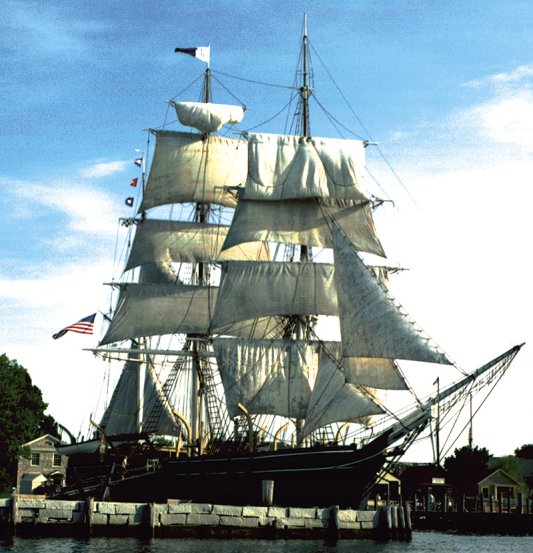
The six of us walked to the end of the town pier, bustling with little shops, visitors arriving from Boston on the fast ferry, charter captains hosing off their decks and getting ready for their next set of sports. At the very end of the quay was a replica of a merchantman from the 1700s — a Mayflowerish sort of thing — and a not very pretty schooner, but no Morgan. A big inflated sperm whale was tethered down, nose into the southwest wind pushing white caps out in the bay into the Wellfleet and Truro shores.

“There’s a ship,” my daughter said. Out of the harbor, on the other side of the little flat-sided lighthouse at the tip of Long Point, were the masts of a bark-rigged ship slowly sailing in from Cape Cod Bay.

It was the Morgan, returning from a day sail out to Stellwagen Bank, a fertile marine sanctuary a few miles north of Race Point where right whales and finbacks cavort all summer. The ship was in port for some sort of whale awareness event, and around the inflated whale on the pier stood an helpful young woman answering questions about the state of the whale preservation movement. The exhibit had a sense of apology about it, that yes, this was a magnificent ship that embodied a rich part of America’s maritime past, but all those whales the Morgan helped slaughter were, well…..in the past when people didn’t know any better and petroleum hadn’t been discovered yet.

The ship rounded Long Point and tacked around into the wind to pick up a mooring a half mile off the end of the pier. She was not coming dockside. I was a little disappointed, the sight of an actual whaler riding at anchor was such an anachronism I turned to my son and said, “Imagine hiding in the bushes in Samoa in 1850 and seeing that arrive and drop anchor.”

“With a crew of syphilitic, dregs-of-New-England sailors,” he cracked wisely. The rest of my entourage was profoundly bored by the fact that a piece of American history was riding at its anchor in front of them in the same harbor where the Mayflower arrived in the late fall of 1620. They headed back to the insanity of Commercial Street where a man in an orange skirt and orange cat-in-the-hat hat was riding bicycle hawking tickets to an appearance by Baltimore’s pencil-moustached auteur and director of Pink Flamingos, John Waters. My son and I sat on edge of the pier, legs dangling down, and appreciated the view. Being a pedantic bore, I started the history lesson of the Morgan.

She was built in New Bedford in 1841, at the height of the American whaling fishery, a time when Nantucket and New Bedford whaling ships were exploring every corner of the Pacific from New Zealand to the Arctic, from Baja to the Okhotsk Sea of Siberia. This was the world of Herman Melville which he captured in the two books that made him a best selling author — Oomoo and Typee — an account of his voyage to the South Pacific and desertion with another sailor to live among the Polynesians.  This was a time when New England whalers were the most well-traveled people in the world.  Pushing  into uncharted waters — literally — at huge risk and discomfort to fill their holds with whale oil, bone and baleen.

The ships were slow. Built big and heavy to hold a lot of barrels of oil, a crew of 35 men, and the brick fireplace — or “try works” — that sat amidships where the big blankets of whale blubber were cut into chunks and rendered over the flames into big iron kettles into oil like big blobs of fishy Crisco. The decks were soaked in oil: slippery, rancid, foul and treacherous.  Only the Captain and the officers got rich. They worked for the ship owners — the Coffins of Nantucket or the Howlands of New Bedford — and received a share, or fraction of the profits. The crews were drunks and petty thieves, sea sick farm boys, Wampanoags and Pequots trying to work off debts, escaped slaves, Irish immigrants, veterans of the War of 1812. The only things that kept them in line were the fists of the officers and their ignorance of celestial navigation. Oh there were mutinies, but for most whaling voyages — generally lasting three years — the biggest risk was falling overboard, being killed by an angry whale, or merely suffering an accident on deck in a pre-OSHA era.

The Morgan was of a classic type of ship; a couple thousand were built in Mattapoisett and New Bedford. This is the type of ship the Pequod — Captain Ahab’s ship in Moby Dick — was. Melville wrote in the novel, published in 1851 — ten years after the launching of the Morgan: 

… a rare old craft…She was a ship of the old school, rather small if anything; with an old fashioned claw-footed look about her. Long seasoned and weather-stained in the typhoons and calms of all four oceans, her old hull‘s complexion was darkened like a French grenadier‘s, who has alike fought in Egypt and Siberia. Her venerable bows looked bearded. Her masts…stood stiffly up like the spines of the three old kings of Cologne. Her ancient decks were worn and wrinkled, like the pilgrim-worshipped flag-stone in Canterbury Cathedral where Beckett bled. But to all these her old antiquities, were added new and marvellous features, pertaining to the wild business that for more than half a century she had followed…She was apparelled like any barbaric Ethiopian emperor, his neck heavy with pendants of polished ivory. She was a thing of trophies. A cannibal of a craft, tricking herself forth in the chased bones of her enemies. All round, her unpanelled, open bulwarks were garnished like one continuous jaw, with the long sharp teeth of the Sperm Whale, inserted there for pins, to fasten her old hempen thews and tendons to. Those thews ran not through base blocks of land wood, but deftly travelled over sheaves of sea-ivory. Scorning a turnstile wheel at her reverend helm, she sported there a tiller; and that tiller was in one mass, curiously carved from the long narrow lower jaw of her hereditary foe…A noble craft, but somehow a most melancholy! All noble things are touched with that.”

The Morgan escaped the fate of most whaling ships. A lot were lost at sea, sunk by storms, wrecked on uncharted reefs, driven onto lee-shores, unable to beat their way to the open sea. One, the Essex, was rammed and sunk by a pissed-off whale.  A bunch were lost in the arctic, done in by greedy crews who overstayed their welcome and were frozen into the pack ice. The Civil War took its toll when the “Great Stone Fleet” — about 40 whaling ships — were filled with rocks and scuttled by the Union Navy in an attempt to blockade Charleston, South Carolina. The end of the age of sail and the rise of steam did in the rest, but somehow the Morgan escaped the wrecker and even found a second career in the early silent movie era as a prop in three movies. She was rotting in New Bedford harbor in 1924 when a steamer caught fire and nearly destroyed her in the process. The fire — which was extinguished by the firemen of Fairhaven — raised awareness that the Morgan should be preserved, and eventually the one-legged Colonel Edward Howland Robinson Green, son of the notorious “witch of Wall Street,” Hetty Green, was persuaded to pay to have her restored and towed to his seaside mansion in Dartmouth, Mass. where she was pulled into the mud and put on display.
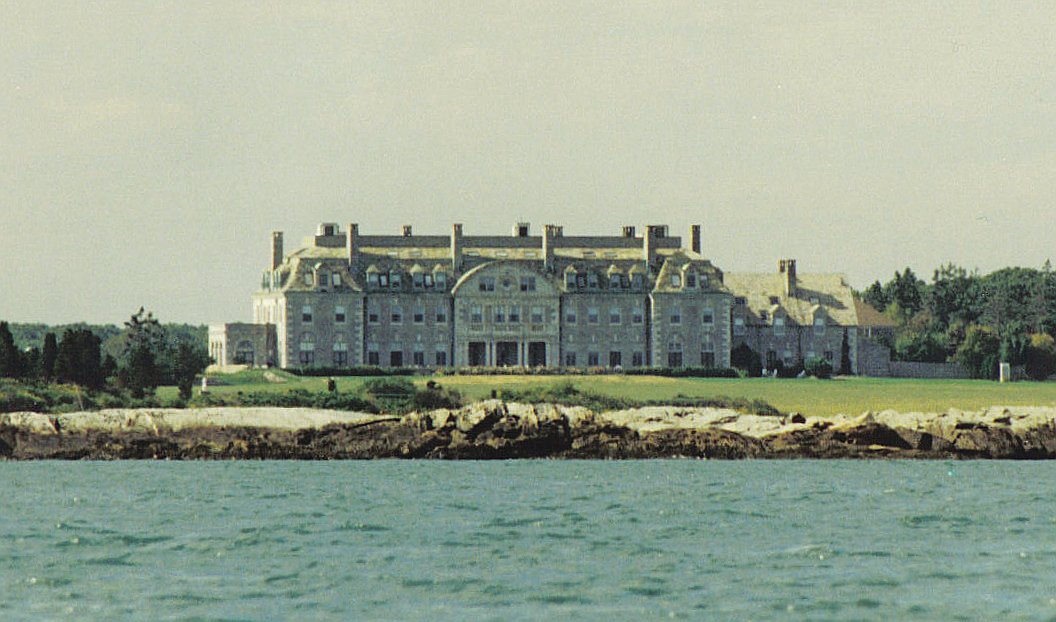
Green, who lost his leg in childhood when his miserly mother refused to pay a doctor to set a broken bone, was the heir to the great Howland whaling fortune and kept the Morgan in decent shape until his death in 1934. Four years later the Great Hurricane of 1938 demolished New Bedford and the Morgan was damaged.

In 1941 she was dug out of her mud and sand berth, towed back into New Bedford harbor, patched up, and eventually towed to Mystic, Connecticut to become the nucleus for Mystic Seaport, an amazing maritime museum (where I spent many month in the late 1970s while majoring in American maritime history at Yale).

She was patched up and put into another muddy berth, and over the years millions of visitors explored her decks and learned about the amazing history of whaling. But she never sailed again.

Occasionally they’d unfurl her big sails at the dock — sometimes one could see them luffing uselessly as they sped by in a car on Route 95 — but she was basically beached. I never expected the Morgan to sail again.  A few years ago, at the Coastweeks rowing regatta, my son and I explored the Seaport after my race. It was his first visit and we had a lot of fun exploring the exhibits, the old rope walk, the sheds of catboats and sharpies, skipjacks and pinkys. The Morgan was in dry dock to be rebuilt from the keel up. We were able to go aboard even though work was being done, and poked around the decks, me droning on about his great-great-great-grandfather Thomas Chatfield’s ship, the Massachusetts, and speculating what life must have been like for a Cotuit man in his early 20s to be given command of a 100-foot long ship and sail it from Edgartown to Siberia and back. And then do it four more times before the outbreak of the Civil War.

So yes, there’s an ancestral connection to these ships. A reminder that somewhere in my DNA is the stuff that made a man run away from home, go to sea, and live a life killing huge beasts in strange oceans on a floating fireplace.

The fact I actually saw one of those ships under sail yesterday — not being ceremoniously towed around like the USS Constitution is every summer  (the Constitution is the oldest floating American ship, the Morgan the oldest commercial one) but actually sailing— was very emotional and more than worth the long drive from Cotuit to see. I’d give a lot to experience such a thing. A few years ago I organized an expedition of a couple dozen friends down to Newport to sail a pair of America’s Cup 12-meters, and those five minutes I spent at the big wheel made me smile all over.

The Morgan heads to Boston, then back through the Canal. She’ll be n display at the Massachusetts Maritime Academy on July 26 and 27.
Getting underway

I launched the motorboat yesterday afternoon after two weeks of working on it in the middle of the yard. Some years the boat manages to go in early, other years it goes in late. This year was late because of the winter-that-wouldn’t-end. Some years the boat needs multiple visits to the mechanic, other years I get her running on my own. This year I tackled a few overdue projects and one nasty recurring problem which required a sledgehammer. As my Cousin Pete (who lives across the street in the western half of the Chatfield family compound) likes to to say, watching a Churbuck with an internal combustion engine (lawnmower, pressure washer, automobile, chainsaw, outboard motor) is like watching a monkey with a hand grenade. I know he likes to sit on his front porch with a cocktail and laugh at my best efforts to destroy anything that lives on gasoline and I am sure he noted my application of a sledge hammer to my Honda 40 horsepower outboard for future retelling.

Back in March, in a fit of optimism, I dragged the boat out from behind the garage, cut off the useless blue tarp that collapsed during the first snow storm, noted that the trailer’s ten year-old tires are still hanging in there (which is good because the wheels are rusted onto the axles forever), and started the familiar recommissioning process which is becoming second nature now that the boat is twenty-two years old and on engine #3.

springlaunch
The calm before the failure

The battery went onto the charger.  I grabbed a broom and swept out the sticks and leaves, sand and shells, dragged out the clam rakes and baskets, and winced at the beard of dried slime along the waterline and the crust of barnacles on the keelson — proof I didn’t do much of a job last fall when I yanked the boat for the season. I had a feeling my neglect would mean the boat would bone me so I drove up to see Dow Clark, my mechanic and asked him if he could tune things up. He pointed out that there was a blizzard coming (this was last month), and he wouldn’t work on the boat if the temperatures went below freezing because he needed to run a hose through through engine’s water intakes in the parking lot and didn’t want to turn it into a skating rink for the other tenants in the little row of garages behind Peck’s and the Domino’s Pizza place.

The blizzard came and went, I returned to the boat (glad I hadn’t launched her in time for an evening of 60 mph gusts out of the north), replaced the battery, and lowered the engine. The first boat problem of 2014 emerged immediately: the steering was frozen, a common occurrence which meant the push rod system that pushed and pulled the motor on the transom was seized. Inside I went to Google and YouTube, read about the problem, watched about a dozen different possible solutions, and returned armed with a propane torch, a hacksaw, a length of rebar, a cold chisel, a ball-peen hammer, a mason’s hammer, a grease gun, and a spray can of white lithium grease, another can of “PB Blaster, and finally, a can of carburetor cleaner. I disconnected the motor from the steering assembly, got rid of all nearby gasoline, lit the torch, and started heating the steering tube. For the next six hours I feebly tapped at the end of the stainless steel ram with the hammer, tried a 2″x4” lever, reapplied heat, sprayed various fluids, and finally, in a fit of total despair and destruction, broke out a sledgehammer and started whaling away at the end of the pernicious steering gear.

That did it. If it is stuck, whack it. A couple applications of the precision tool and the ram started to budge a tiny bit with every smack. I finally drove the thing all the way into the tube, then continued the brutal repair with a piece of rebar, clocking my knuckles so hard when the sledgehammer missed that I was convinced I’d broken my hand.  After countless attacks on the piece of precision Japanese machinery, the steering ram popped out and I performed a little Dave Dance of Happiness on the brown lawn. I reamed out the tube with brushes and carburetor cleaner, cleaned the ram piston off and regreased it, then reassembled the whole mess until the steering wheel spun back and forth with silken, greased ease. Success. I spared myself a new $125 steering cable and a trip to the mechanic.

A past winter launching which ended in a rescue after water in the gas killed the expedition.

Then to the greasy manual for a refresher in changing the engine oil and lower unit lube. I siphoned whatever water I could find out of last year’s gas and drained the fuel lines, changed the fuel-water separator, and tightened the drain holes on the three carb bowls. New spark plugs followed, a change in the fuel filter and I was ready to test it. Professional mechanics use these “headphone” sort of clamps that attach to the water intake of the motor and then run a hose through them so they can work the running motor on dry land. The last time I did that I melted the water pump. This year I hooked the trailer up to the car and drove the boat down Old Shore Road  and backed the trailer in deep enough to lower the motor without launching the boat (I have learned that launching prematurely always means the boat will not start and will need to be paddled back to the trailer, winched back on, and taken up to Dow Clark two miles inland on a trailer with no lights and an expired registration that is one flake of rust away from collapsing.

I climbed aboard, lowered the motor, inserted the key, said a prayer, and started cranking. It astarted after 15 seconds, a feeble, barely combusting ignition that I nursed to life like a freezing man lighting a fire in a Jack London story. I let it strangle and shudder, then dared to give it a bit more gas, let go of the choke and it LIVED! Do another Dave Dance of happiness, feel like a master mechanic.

I let it run for 15 minutes on the trailer, relishing the opportunity to hog the entire boat ramp by myself on a Saturday afternoon ; a ramp that in three months would have a line of impatient boaters waiting for their turn to launch or haul their boats while some ass clown clogged things up by deciding to clean his Bayliner while everyone waited and honked their horn. The off-season in Cotuit is the season of the Townie Prerogative: when those of us stupid enough to live here from January to April get to put out our dinghies on the prime spots, get to hog boat ramps for as long as we want, drive fast in areas of the harbor usually confined to 6 mph, and then clam in places that get closed on May 1.

I let the motor run for a quarter hour because the second rule of Churbuck Outboard Failure is that a motor that runs well near the beach will fail as soon as it is about 500 feet away from the beach — generally because of water in the system, or a failed water pump that sets off the dreaded alarm sound which means a $500 repair bill is coming soon. A sub-rule of Churbuck Outboard Failure is that failure in the off-season means there aren’t any other boaters around to come to one’s rescue and the possibility of being stranded and having to swim in 40 degree water is very real. These are the lessons learned over 22 Cape Cod Springs, proof that wisdom is nothing more than the accrual of repeated failures.

I resisted the temptation to back off of the trailer and bomb around the bay. The bottom was unpainted and there was more work to do. Driving an unpainted boat would definitely draw the curses of the Gods of Maritime Failure and I only get superstitious when I am on the water.

Back to the yard and then off to the marine supply store for the annual BOHICA* (nothing will trash a bank balance faster than a can of bottom paint or any sort of marine hardware). The harbormaster nearly wrote me a ticket last August for being on the water without navigation lights.  I had to invest in a new sternlight and green-and-red bow light, wire, connectors, switches, etc.. Back to the boat and my favorite liquid after a smoky peaty single malt scotch — Hull Cleaner — an evil solution that is swabbed around the waterline of the white hull which turns brown over the course of a summer like a smoker’s lungs. Hull cleaner must be washed off, so down into the cistern under the grape arbor I go — through a manhole cover into a dank dirt floor chamber under the birdfeeders to turn back on the outdoor faucets. Then back into daylight in search of the hoses, replacing washers and finding a working nozzle while the birds act inconvenienced because I dare interrupt their springtime binge diet.

Hull Cleaner magically bleaches everything  away like a blessing from the Pope, but it also eats into the trailer’s galvanized frame one whiff of the stuff and the disconcerting sensation of burning lungs makes me believe it is an evil fluods. I hose it off, get the bottom wet, and drag my 55-year old ass under the boat with a scrub brush and scraper to vanquish 2013’s barnacles and slime. This results in my being crippled later in the evening, forced to lay on my back on the floor while watching 60 Minutes and moaning that I have strapping sons who should be crawling under boats on wet grass littered with stinky evicted barnacles.

The next day my son thoughtfully volunteered to crawl under the boat wearing a set of disposable Tyvek overalls to paint the bottom with antifouling paint while I masking-taped the boot top line. When we were done the boat looked about as good as it did the day in 1992 when I picked it up from the builder in Vineyard Haven (the best $7500 I have spent in my life).

The wiring of the lights was a sobering reminder that I am a terrible electrician. My first attempt succeeded in turning the new lights on, but my mis-wiring also  turned the circuit into one big electric stove top that started to turn red, smoke and melt the plastic insulation off of the wire. Back to the Internet for assistance, but finally I figured out enough 12V electrical wiring theory to get the job done correctly.

By this point in time it is noon on Easter Sunday. Easter dinner starts at four pm. I look for volunteers to join me for the maiden voyage and a  quick clamming expedition to secure enough littlenecks for appetizers. No takers, everyone is occupied with deviled egg construction. So I break out the new waders, find the VHF radio, cellphone, clam license, buckets, oarlocks, oars, temporary mooring float, throw it all into the boat, insert the drain plugs, connect the gas tank, back up the trailer hitch, and off I go under bluebird skies and a nice spring day.

The boat started on the first try. I backed off the trailer, brought the boat into the beach and left it there while I parked the trailer on the side of Old Shore Road. Back to the boat, off the beach, restart, back away and head for the winter stick that marks my mooring near the yacht club’s beach to tie on a temporary painter until the mooring guy can get out there and swap the wooden winter stick for the regular rode.

The alarm horn goes off just as I pull up to the mooring. SHIT! Off with the engine before heinous amounts of destruction occur. I tie the boat onto the winter stick before addressing yet another spring launching spoiled by Honda. I turn it back on. No alarm. I note the engine “pisser” is not squirting water. Proof the water pump isn’t work. Off with the engine, find the hidden paper clip, tilt up the engine, and ream out the little piss-port under engine cover. Restart, long satisfying stream of pee and no alarm horn.

I headed off to Sampson’s Island to clam, and opened up the engine all the way as I skipped across the chop of Cotuit Bay, the wind chill plummeting the temperature and bringing wind blown tears to my eyes. No alarm horns No surges in power as the carbs drink in water. Just a well working boat on a sunny day. One month of weekends and one boat is in the water in time for the first stripers, squid and bluefish. Now to start on the big sailboat and another month of messing around.


*Bend Over Here It Comes Again

I Guano Kill Em All

There’s this bird called the cormorant, also known as the “shag”, which has been a part of the local wildlife for the last decade or more, arriving from the south and taking up residence along with the gulls, terns and ospreys. They are big black birds with long necks and cape-like wings they hold open to let the breeze dry them off. They feed on the bottom on mussels and crabs, popping to the surface to shake their heads and paddle along until spooked, at which point they windmill and run over the surface until they achieve escape velocity and can get airborne.

I want them all dead.

Cormorants exist to shit on my boat. I have strung up old CDs on strings like the rearview mirror of a teenager’s first car to scare them away. I have spent a hundred dollars on bird spikes for the spreaders on my mast. I have festooned my boom with old plastic grocery bags until the poor boat looks like a tree on the Grand Central Parkway in Queens.

But they shit and they continue to shit. And then they shit some more. They deposit prodigious amounts of fish-imbued filth all over the decks, the wheel, the cleats, lines, seats, dodger, windows, spars, winches and lifelines, coating the boat with a thick coat of white guano mixed with undigested mollusks, pebbles, and some sort of toxic waste that is impossible to remove. Flies love the stuff and the whole affair is just an invitation to salmonella, shigella, giardia, diarrhea, MRSA and whatever other flesh-eating bacteria you care to contract.

Yesterday was pull-the-boat day, so Sunday I put-putted out in the motorboat with my son to get things ready for the pulling of the mast at Town Dock. My buddy Tom K. was standing on the shore and bore the bad news. “Good luck with the guano” he said. Sure, I knew they had found a little gap in the bird spikes on the lower starboard spreader and one had managed to spackle the dodger with a blast of ass vomit, but that was okay, I saw that mess the weekend before as I returned triumphant with a bucket o’tautog, but like an idiot I didn’t clean it up. Leaving it there was tantamount to declaring the Bald Eagle was now a designated cormorant port-a-potti and they took advantage of the invitation. It’s a matter of dwindling opportunities, sort of like musical toilets where as the days go by the music stops and they take away another boat to poop on. Stay in past Columbus Day and the ratio of bird butts to available boat toilets get worse and worse until the last boat standing is a heaping, stinking mess of avian fertilizer.

It reminds me of the islands off the coast of South America in the Pacific Ocean that were so coated in bird shit that fortunes were made mining the stuff and shipping it back to the world as fertilizer. Guano was big bucks. But not my guano. No, my guano is my cross to bear.

So I get the boat into the town dock and start calling around for a power washer in the belief that I can use the dock’s faucet and some high pressure blasting to tidy things up before the kibbutzers and bored amateur wharfingers of Cotuit can point out the obvious and tell me it looks like birds have taken a massive dump (why are all dumps “massive?) on my yacht. I tie up. Test the faucet. Dry. The powers-that-be in the Town of Barnstable evidently believe the world stops on Columbus Day and have disconnected the pipes for the winter. Another boat arrives, also frosted with a nice layer, the owner asks me “Is the water on?” Nope. The term “shit out of luck” is invoked and I tie the end of a poo-covered jib sheet to the handle of a bucket and start hauling five gallons of sea water aboard every thirty seconds to try to soften it up and sluice it over the side.

The first helpful rocket scientist arrives with a cock-a-poo or a labra-dump on a leash and says, “Hey, someone got hit hard.” Ha ha. Very funny. Really? No fooling? You think? Scrub, scrub, scrub. Flies going up my nose. Backsplash in my mouth. The other boat owner has rubber gloves on. Not me. I just start rolling in the stuff and compose my obituary: he died a coprolagniac.

Six hours later and the sails are off, the turnbuckles on the rigging are loose, the neutral stop-switch in the throttle is fixed and the engine is running but the boat is still smeared with stalagmites of cormorant. I have been told to use lime remover, Comet, warm soapy water, screw-it-let-the-rain-wash-it-off, and to-hell-with-it–just-shrink-wrap the whole mess and pretend it didn’t happen. Being a nice day the dock was busy with spandexed cyclists, panting joggers, shoulder season tourists, local wise guys and friends and neighbors. Every single one of them expressed some rueful condolences over my messy boat.

Only one said anything that made any sense. I salute him.

“Next time put out mousetraps. All it takes is one and they get the word and won’t come back and if you’re lucky, you might see one trying to shake a trap off it’s claw.”

Thank you. I shall have my revenge.

The America’s Cup is Actually Interesting

I may be a traditionalist when it comes to racing sailboats — I like them wooden, leaky and gaff-rigged — and I have bitched about how the America’s Cup needs to come back to Newport, Rhode Island and be raced in those oh-so-elegant 12-meters of my youth. But after spending a rapt half hour on the couch with my tablet and a half-hour of coverage from San Francisco Bay I take it all back. AC-72 catamarans are amazing things.

Catamarans have the reputation of being the jet-skis of the sailing world. The people who sail them tend to be adrenaline freaks who zip back and forth looking for speed and little else. The boats point into the wind like square-riggers, require elbow and knee pads and a crash helmet, and beg to be sailed while yelling “yee-hah.” They entered the America’s Cup under desperate circumstances in 1988 when Dennis Conner showed up in one to kick New Zealand’s ass after they showed up in a 90-foot mega yacht and convinced a judge to uphold the move away from 12-meters as perfectly legal under the terms of the “Deed of Gift” — the rules that govern the strange and venerable competition. Dennis and his catamaran sailed circles around the New Zealanders, the credibility of the America’s Cup hit an all-time low, and all semblance of dignity went out the window. But catamarans were in.

Not that the America’s Cup was ever a fair fight. As my buddy Charlie points out, the name of the game has been getting a technical edge from the very beginning when the American’s sent an overpowered schooner over to England to kick the best butts in the Royal British Yacht Squadron. Half the battles have been in the courts, with challengers and defenders contesting the ambiguous rules every chance they get and giving full credence to the cliche of the “sea lawyer.” Winged-keels,  crews of ringers from foreign countries, billionaires with more bucks than brains … what’s not to love?

Whatever. I tip my hat to Larry Ellison for making it a total tech fest on Silicon Valley’s home waters. These boats represent the cutting edge of aquatic technology, use nothing but the wind to scream along at more than 35 mph, and thanks to overlaid graphics, helicopters, onboard Go-Pro helmet cams, and crazy color commentary that would be more in place in a UFC cage match, finally putting to rest Mark Twain’s old tired complaint that watching yacht racing is less exciting than watching paint dry or grass grow.

The US is behind — docked two races for cheating — and it’s do-or-die with them needing to win all of the remaining race to stay in the game.

Sterling Hayden: An Appreciation

One of the most influential books in my youth was Sterling Hayden’s autobiography: Wanderer.  For a young writer restless to get out of the confines of college and into the “real” world, his life’s story was an inspiration of boot-strapped pluck, luck, and determination to find some meaning on the deep blue sea. That he was a leading man during Hollywood’s Golden Era, married to starlets, called before the Communist witch-hunts of the House Un-American Committee, then revived in  the 60s and 70s as an actor’s actor in Dr. Strangelove and the Godfather was mere trim and icing on a life spent before the mast on a Gloucester fishing schooner and tall ships. Sterling Hayden was the real deal, a manly man who deserves a revival.

Hayden wrote two books: Wanderer is still in print and a very worthwhile read. His one and only novel, Voyage: A Novel of 1896 is out of print, but worth tracking down from a used bookstore. It is one of the better maritime novels on my bookshelf. As for his films, other than Strangelove and Godfather, his other big contemporary film was The Long Goodbye. His early stuff — beginning in 1941 after he was discovered by Hollywood on the deck of a Gloucester schooner because of some newsreel footage shot at the annual schooner races in Boston — is pretty obscure, B-movie stuff. He hated the studio system which cast him as a pretty boy/beefcake but he put up with it to finance his expensive tastes in wives and boats. Hayden was a self-admitted bad actor.

He spent World War II in the OSS, working behind enemy lines in Yugoslavia with Marshal Tito’s band of resistance guerrillas fighting Nazis. That built some admiration for the Communists which got him into hot water after the war during the Hollywood witch hunts, a period in his life he long regretted after he uncharacteristically named names.

I met him once, in Sausalito, California in the early 80s, shortly before his death in 1986, when I was tending bar in San Francisco and writing as the Bay Area stringer for Soundings, a weekly boating newspaper. I read a profile of his first mate, Spike Africa, in the San Francisco Chronicle, learned Hayden was in Sausalito and tracked him down. I was 22 and the two interviews I had with him were my first experience with true hero worship. I never wrote the profile, the editors at Sounding weren’t interested and I was too flaky to freelance the piece elsewhere, a mistake I kick myself for.

There is a great appreciation of Hayden, the sailor and writer, by Captain Paul Watson at Sea Shepherd International’s blog. I’ll borrow his quote of Hayden’s because it was the kind of sentiment that fired me up as a confused and rudderless young sophmore:

“To be truly challenging, a voyage, like a life, must rest on a firm foundation of financial unrest. Otherwise, you are doomed to a routine traverse, the kind known to yachtsmen who play with their boats at sea… cruising, it is called. Voyaging belongs to seamen, and to the wanderers of the world who cannot, or will not, fit in. If you are contemplating a voyage and you have the means, abandon the venture until your fortunes change. Only then will you know what the sea is all about. I’ve always wanted to sail to the south seas, but I can’t afford it.” What these men can’t afford is not to go. They are enmeshed in the cancerous discipline of security. And in the worship of security we fling our lives beneath the wheels of routine – and before we know it our lives are gone. What does a man need – really need? A few pounds of food each day, heat and shelter, six feet to lie down in – and some form of working activity that will yield a sense of accomplishment. That’s all – in the material sense, and we know it. But we are brainwashed by our economic system until we end up in a tomb beneath a pyramid of time payments, mortgages, preposterous gadgetry, playthings that divert our attention for the sheer idiocy of the charade. The years thunder by, The dreams of youth grow dim where they lie caked in dust on the shelves of patience. Before we know it, the tomb is sealed. Where, then, lies the answer? In choice. Which shall it be: bankruptcy of purse or bankruptcy of life?”

– Sterling Hayden

My Personal America’s Cup

When I grew up in the sixties and seventies I was into the America’s Cup the way most kids are into the Superbowl. It was one of those things that comes with growing up in New England and racing sailboats. The America’s Cup was the pinnacle of the sport, an event that the United States had never lost, in what I still think are the most beautiful boats ever designed and sailed by mankind: the 12-meter sloop.  The names of the skippers were like the names of famous race car drivers to me. Some people were into Sterling Moss, I was into Bus Mosbacher, Ted Hood, Ted Turner and Dennis Connor.

12-meter yachts were the standard class of sloop in which the America’s Cup was raced from the 1950s into the 1980s. The “12-meter” has nothing to do with the length of the boats, but is the result of a formula involving various measurements to arcane to delve into here.  The boats were made out of wood until the 1970s, when the rules were changed to permit steel, and eventually Fiberglas. By the 1990s they were gone, replaced by the gross over-commercialization of the sport that turned the boats into billboards and make the event an arms race for billionaires with bigger egos than souls.

Here’s the current state of affairs:

Once we had this:

Now we have this:

I blame it on RedBull, marketing departments, branding experts, and over-Adderalled dickheads who pay to watch technology and not sportsmanship. Now it’s called the “AC World Series” and the crews wear helmets. Bring back Charlie Barr and the J-Boats and ban the logos.


The beginning of the end came with  the infamous winged keel that the Australians snuck into the 1982 series (and won it, breaking the American hold on the Cup and threatening to rename it “The Australia’s Cup”), and suddenly the “purity” of the 12-meters was threatened (the rules that govern the America’s Cup, the “Deed of Gift” are beyond weird and were constantly changed by its longtime sponsor, The New York Yacht Club, however it pleased them) a threat that was realized in the stupid series of 1987 when New Zealand showed up with a monster maxi-yacht and the American skipper Dennis Connor countered in desperation with a speedy catamaran. Thus ended the 12-meter era, setting off a round of silly court cases, and today the Cup is raced in ridiculous (to my eye) extreme catamarans which require their crews to wear helmets and pads.

Thankfully, the 12-meter fleet of yesterday lives on in Newport, Rhode Island, the traditional battle ground for the Cup.  Last winter, while spending a weekend in Newport with my wife, I muttered something about wishing I could have sailed on a 12-meter. She told me to Google that thought, and a few dayss later I was spamming the Cotuit Mosquito Yacht Club’s email list with the suggestion that a dozen of us charter one of the boats for a sail in September. Twenty-four people signed up, trusted me with their deposits, and over the spring and summer I pulled together a half-day of sailing aboard the Columbia (winner in 1958) and the Heritage (a contender for the defense in 1970).

We carpooled to Newport on Saturday morning, our arrival coinciding with the annual Newport Boat Show, gathered on Bannister’s Wharf under grey skies, and counted heads until all were accounted for.  I called out the names of the two crews, having been advised by counsel to have the boats selected before arriving, and flipped a coin to choose which crew would sail which boat.  Then we split up for a day of match racing. Meredith from 12-Meter Charters herded us aboard a launch for the short ride out to the two  boats moored in the lee of Goat Island.

The skipper and two crew members stowed our stuff below decks, delivered the obligatory Coast Guard approved safety lecture, and within ten minutes we had the sails up and were gliding across Narragansett Bay towards Jamestown. Everyone started exchanging glances of surprise as the boat took off in the light air. This wasn’t like sailing a typical sailboat, this was more like sitting on top of a floating locomotive with the potential to turn into a bullet train.

I was disappointed it wasn’t windier and sunnier, but there was still hope as it was only 11 am. The front had already blown by and there were hints of sun peeking out to make things encouraging.

We raced informally by crossing each other’s sterns and then beating up to windward into the northwesterly breeze under the Jamestown Bridge to a bell buoy up by Gould’s Island where the Navy used to test fire torpedos. Heritage won the first race, credit taken by Judge Swartwood who had the privilege to steer the boat over the finish line. We taunted the Columbia in the best Monty Python and the Holy Grail sense of taunts , and then broke for a relazed lunch sail out into Block Island Sound. The sun came out. The box lunches came out. The wind started blowing, and we each took our turn at the wheel.

Here’s the picture that says it all: Heritage has the natural, vanished hull; Columbia is the white hull in the foreground. That’s me standing on the Heritage leaning against the boom.

The full photo set is on Flickr: http://www.flickr.com/photos/churbuck/sets/72157631559789026/

Having a chance to steer Heritage was like being a Formula One fan who gets to drive a classic Grand Prix car.   Here is me trying to look all nonchalant about the experience. I wasn’t. I actually got a little choked up thinking about my old writing teacher John Hersey, and his making me feel very jealous in 1978 when he told me about the time he got to steer Intrepid and used the locomotive simile.

The best part of the day? That actually happened the day before the sail when a taxi pulled into the driveway and my daughter stepped out, a surprise arrival from San Francisco thanks to her godfather Charlie Clapp’s incredibly thoughtful generosity. Charlie is a serious 12-meter junkie. As a kid growing up in Barrington, Rhode Island, the America’s Cup was literally happening in his back yard. This was his fourth sail aboard the boats. Hell, he even owns the shirt.

I’m definitely doing this again.

Death, taxes and boat trailers

My skiff, the Tashmoo, was looking a little disheveled these past few weeks, ignored by me and never even taken out for a spin to keep her bottom clean, her engine purring and her various weak links not-so weak. Being ashamed of the beard of barnacles that rimmed the waterline, I pulled her out of the water on Sunday in between rain showers, rowing out for the first time in a month to see how she was doing.

Everything had gone to hell. The barnacles were merely a clue to the real neglect that lay within. The steering was frozen. The bilge pump had failed and nearly a foot of rain water sloshed over everything. The power tilt that raises and lowers the motor wasn’t working either. I was a bad owner and I had to pay.

So I bailed the rain water out, let the motor drop down into position, fired it up and let it cough and stutter for a few minutes while I whacked the steering rod with a clam rake and wrestled with the wheel until finally the salt and corrosion let loose and the motor would steer again. I cast off the mooring, backed away from the dinghy, and ran down the little channel out into to the harbor to open up the throttle (making sure Jared the harbormaster wasn’t around to bust me for making a wake). I pulled the transom plugs and put the boat up on a plane to drain the rest of the rainwater, noting that it didn’t take more than one weekend and a couple of tropical squalls to drive everyone off of Cotuit Bay for the season. I had the place to myself.

Water drained, I put the plugs back in and returned to the landing to haul the boat and deal with its ailments. I horsed the motor up without the power tilt, tossed out the little danforth anchor and backed the trailer down the concrete ramp with the Polar Bear Drowner, my wife’s bizarrely over-sized SUV. The trailer bounced over the cracks in the ramp, submerged itself with a gust of bubbles, and when the rear tires were in the water I stopped, put the car in park, and set the emergency brake.

Back to the skiff, back to the balky motor, and out I  drove into a tight circle to line up the bow with the license plate of the car for a gentle slide up onto the 12 year-old trailer’s rollers (which I had to rebuild at considerable cost of many bloody knuckles two years ago).  The barnacles crunched as the hull slipped up the rollers. As I listened with some satisfaction as the parasites-with-the-world’s-longest-penis-in-relation-to-their-body-size got flattened. Of course the Karma God decided to bend me over and teach me a lesson for my barnacle murder. An immense fart bubble surfaced from the general vicinity of the starboard trailer tire. It had gone flat. Ruptured. Deflated. Punctured.

Now a long digression on boat trailers. First you spend $1000 to $2000 dollars for a galvanized frame equipped with a winch, a hitch, a set of rubber rollers and an axle bracing two wheels, two bearings, and two big old-fashioned looking leaf-springs.  Add a pair of red brake lights,   safety chains, wiring harness, and you end up with a recipe for perfect failure. Murphy in Murphy’s Law makes his home inside a boat trailer. He comes out when the trailer is rolling at 60 miles per hour through the South Station tunnel in Boston, the Cross Bronx in New York, or the middle of a crowded boat ramp on Labor Day.

Trailers are meant to humiliate men in many ways. First is the ass-backwards way they have to be backed up. This is a serious test of one’s saltiness here on Cape Cod. I have seen Federal judges fail at trailer backing. Turn the steering wheel one way and the trailer goes another. If you don’t back up trailers for a living then every time you do it you have to rewire your brain, craning your gaze backwards over the seats and out the back window at the barely visible end of the trailer which swings wildly one way and then the other as you spin the steering wheel to and fro.

Now submerge this contraption in saltwater and watch it slowly die. The first thing to go are the brake lights. They submerge, flood and short out almost instantly (which is why the commercial clammers rip them off and rewire them onto a 2×4″ that they strap on top of the boat where the electrics will stay dry. You can assiduously rinse your trailer off with fresh water each and every time you use it, but that won’t stop the cancer.

So now you get your boat onto the trailer. My cousin Pete says his YouTube guilty pleasure is trailer bloopers. I strongly recommend the genre as a leading example of man’s penchant for public humiliation and failure. There are many ways to screw things up. You can gun the boat onto the trailer in what we locally call a Bass Master Exit; you can clean, wax and preen over the boat while parked on the ramp and a dozen other trailers wait their turn, or you can be intoxicated and drive away with the wife and kids still sitting in the boat like beauty queens on a Rose Bowl float.

Driving a trailer with a boat on it is a total sphincter-clenching hell. I have seen boats bounce right off the trailer because the driver didn’t secure it with tie-down straps. But the real devil is the hubs, where the ball bearings let the wheels spin around the medieval axle. Trailer owners are told to be very  paranoid about their hubs. My trailer, which is a dozen years old, has never had any hub maintenance. Why should it? I only use the thing three times a year to go from my yard (behind the tin shed known as Little Jamaica) to the launch ramp at the bottom of Old Shore road (an even 400-meter round trip). The first round trip is in February after the ice leaves the harbor so I can go clamming, the second is in September to clean the bottom after the messy summer, and the third is in December to get the boat out before the ice. I don’t drive the boat to New Jersey, New Hampshire, or even Barnstable. I just haul it up and down the Ropes Hill to and from my yard. In those 12 years I would estimate the trailer has done maybe 50 miles of driving. So why worry about the bearings?

Why worry indeed. My friend David Rickel had saved a phone message from my other buddy Doctor Dan, who borrowed Mister Rickel’s old trailer to fetch a new Cotuit Skiff he had built from New Canaan back to the Cape for its maiden voyage in Cotuit. There are many things wrong in that previous sentence.

First: Cotuit Skiff. Cotuit Skiff’s are where trailers go to die. There is still a 100 yard groove in the hill on Putnam Avenue from Old Post Road to Lowell Avenue because one eager Skiff owner lost their trailer wheel and decided to forge onwards and dragged the stub of the axle through the pavement like a plow. I have seen skiffs fall off of trailers. I have seen 30 of them get hauled in a single afternoon to beat an oncoming hurricane, and each and every time some trailer fails under the pressure. Skiff trailers are particularly neglected to the point that only one or two are known to be trustworthy thanks to the care of their owners. The rest are failures waiting to happen.

Second: “Borrowed.” A trailer which can be borrowed is a trailer that is unloved, un-maintained, and likely to fail once it gets a mile away from the thicket of briar and golden rod where it rusted for the years before the borrower arrived looking for a favor.

Third: Route 95. Combine a skiff with a questionably maintained trailer with an interstate highway …. the result is the phone message from Doctor Dan to Mister Rickel. This recording occurred one afternoon in June in 1993 and was made in the breakdown lane of Route 195 on the old elevated highway that used to twist through Providence, Rhode Island. The bearing had seized, overheated and eventually caught on fire, forcing Doctor Dan to pull over and throw handfuls of road sand onto it.  The phone call, if transcribed, roughly went something like this (add in the sound of semis barreling past in the background at 70 mph).

“DAVID RICKEL. IT IS DOCTOR DAN. YOUR TRAILER IS ON FIRE! WHAT SHOULD I DO? ARE YOU THERE? PICK UP!”

Mister Rickel eventually called Doctor Dan and told him to strip off the license plate (which had expired anyway, no one ever remembers to register their trailer in Cotuit) and abandon the wreckage where it lay. This was done, and doubtlessly the Rhode Island State Police will read this and track Dan down to collect their fine for abandoning a menace to the public safety on their highway.

Back to last Sunday. So I see the big stale air bubble float up from the rough area of the punctured tire, sigh, and do what every good Cotusion would do, I forge on and drag it up the hill to the house anyway. The plate is expired. The brake lights don’t work. The only thing good about the situation is there isn’t a swarm of yellow jackets living inside of the trailer like there was six years ago, a swarm that got very annoyed when I backed their nest into the bay and ruined their lives.

I got into the Polar Bear Drowner, and dragged the mess up Old Shore Road, watching the flat tire shred itself in the right rearview mirror. A quick left onto Main Street, 50 yards to the drive way and I was home, safe and unobserved by the Barnstable Police Department.

I unhooked the hitch from the ball, listened to the beard of barnacles gasp and sputter in the air, and examined the disaster before me. Here was 2000 pounds of Fiberglas and Honda sitting on 12 years of corroded Karavan trailer, with a flat tire. So off to the hardware store I went for a jack, a lug wrench, a can of Fix-A-Flat, some Liquid Wrench and a lot of false hope.

Once equipped I spent an hour in the gloaming banging and squirting and swearing at the five lug nuts that were so corroded they had blossomed into fat little roses of rust. After scaling off that rust, I was left with little lug-nut ghosts that weren’t going to budge for any man. Stymied, I broke out a scraper and a rubber mallet, spread a blue tarp under the hull, and knocked off about 20 pounds of barnacles, cleaning up with an application of that lovely substance called Hull Cleaner.

Yesterday Cousin Pete came over with an electric impact wrench and was able to get two of the lug nuts off. The third sheared off, leaving a stub of half a bolt. So now it was time to call in the professionals. I phoned Peck’s Boats and John Peck came over, inspected the sad wreck, and told me to buy a new trailer. Sure, I said,  my new trailer is spending its Freshman year in college, and that doesn’t solve the dilemma of what to do with the boat still sitting on the broken one. John asked me if I had used heat on the lugs. Sure, I said, brandishing my new propane torch. He sneered — for John builds his own trailers, big monsters that can haul 50 foot sailboats from Cape Cod to Florida and back again — and said he would be back with a real torch.

Soon enough he bounced over the lawn in his Subaru. In the back were two huge cylinders and a torch. He hooked it all up, sparked it ablaze and set to cutting the frozen nuts off with pure hissing acetylene, sparks popping and snapping over his head while I looked on stupidly trying not to look at the light. Five minutes later and the wheel was on the ground, the lug bolts banged out, and I was ready to go wheel and tire shopping.

Rust


I suppose, once the boat is back in the water, I could consider doing away with the concept of a trailer altogether, and do what this brilliant jet-ski owner has done.

Time for a boat operator’s license?

Two weeks ago the local yacht club invited the harbormaster and fire department to speak to the sailing instructors about how to handle emergencies on the water. The assistant harbormaster — who has personally and justifiably pulled me over and chewed me out in the past for speeding across the harbor while running a race — made a great comment that started me thinking: “You go in, you pay your money, your check clears, and they hand you the keys and that’s it. No license, no training, no nothing … and you’re boating.”

What isn’t funny is the Fourth of July tragedy on Long Island that left three children dead after an overloaded boat (Silverton 34) swamped and sank in 20 feet of water. Obviously that accident has me thinking about a licensing system for boat operators.  I have no knowledge of the person who owned that boat and allowed more than 20 people to crowd onto it, but a system that permits that kind of negligence is one that sets people up to fail in the first place.  There are no regulations governing the passenger capacity of a boat that size, according to the New York Times (there are Coast Guard passenger limits in effect for smaller boats), but there are for commercial vessels such as ferries and launches.

I’m as libertarian as the next person and need another government issued license or registration like I need more taxes and bureaucrats, but the reality is that bad boaters not only put themselves and their passengers at risk, they can also wipe out an innocent swimmer or a rule-abiding mariner in an instant.  The old barriers to boating were considerable. Boats were wooden, expensive, and too heavy to easily trailer in and out of the water.  Today we have “PWCs” — personal watercraft — from jetskis to strange hybrid boats made by skimobile manufacturers. The waters are more crowded, the speeds and blood alcohol contents are both higher ……

If you consider the difficulty a commercial captain faces in getting a Coast Guard license — hours of classroom study, memorization of navigational light patterns, navigation, safety regulations — then why isn’t there anything in place for the average recreational boater?  I can’t go out and buy a Piper Cub and start flying it without a license. I can’t drive a car without one. Why should I be able to fire up a big powerboat, load it up with 30 people,and drive it around in the dark without someone giving me a simple test?

I hate legislators who want to make the wearing of lifejackets mandatory. Every so often some poor kayaker flips and drowns and a local state rep files a bill to make lifejackets a requirement. Yet I wear one because I don’t want to be that guy they find with his zipper down, drowned a mile off the beach because I went over the rail while relieving myself during a moonlight sail.  The majority of boaters abide by the rules, take courses from the Coast Guard auxiliary, and make sure their boats are equipped with the proper lights, flares, PFDs, and other safety equipment. But all it takes is one idiot and headlines are made.

I’ve been on boats that have gone wrong and seen how bad things can get. I laugh at the pictures of the boats stuck on jetties after their clueless owners run into them in the darkness, find YouTube videos of boat ramp bloopers as amusing as the next guy, but a lot of it could be avoided if states would start to extend their boating licensing laws to cover adults. Most have a requirement that underage operators complete a boating safety course and get a safety certificate. But in New York, page 39 of the Safe Boating manual states:

“Adults 18 years of age and older may operate a mechanically
propelled vessel without an approved boating safety certificate.”

I think it’s time to license adult operators as well.