My dear friend Paul Noonan passed away at home in Cotuit yesterday, Sept. 20. As the arrangements for his memorial come together I’ll share them here, along with my memories of the man. My condolences to his brother and sisters and his many friends.
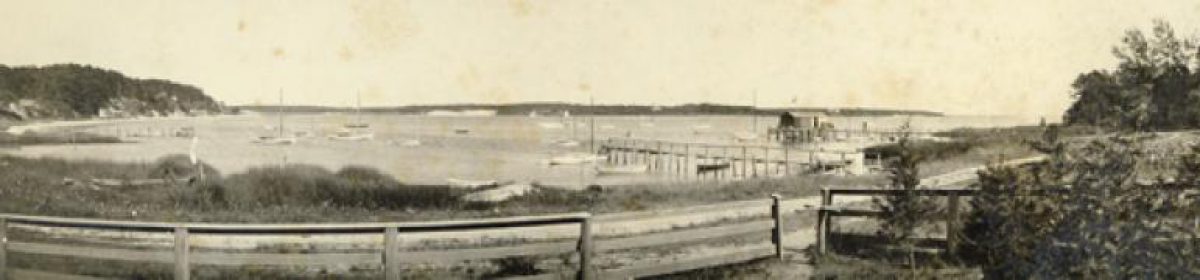
Like most people I googled his name and found this fitting tribute to Paul in a cruising guide to the New England Coast. This was doubtlessly back in early 90s when he was driving the red jeep with the “Friends Don’t Let Friends Vote Republican” bumper sticker, clam rakes hanging out the sides because he was off to perform A Blessing of the Rakes in Waquoit Bay for his pal Chiefy. That was just before he totaled my Volkswagen Fox at the corner of School and Main — essentially Cotuit’s Time Square — when the “brakes went beserk.”
Rest in peace you old salt.
By Paul Fenn and W. Wallace Fenn in A Cruising Guide to New England Including the Hudson River
Tom Burgess’ Eulogy
I’m indebted to Marylou Noonan, Sally Noonan Ratchford, Janie Hayden Uyenoyama, Sally Hinkle, Alex Lowell, and David Churbuck for help in composing the obituary that formed the basis of this Eulogy to which I have added what Paul might have termed the “juicy bits.’
Tom Burgess
Paul David Noonan, 71
We are gathered here today to celebrate the life and to mourn the passing of a colorful Cape Cod character, Paul David Noonan. Both locals and tourists knew him as the eccentric and witty man behind the counter at the Cotuit Grocery during the 1990’s and later as the erudite advisor to those looking for old and interesting volumes at the Parnassus Bookstore in Yarmouthport, where he worked from 2001 to 2013. But perhaps a majority of us are here to say a final thank you to Paul because we owe him a debt of gratitude for some act of charity, gesture of support or bit of wise counseling that he offered us over the past half century.
He was born on January 19, 1943 in Marblehead, Mass. and was the son of Paul J. Noonan and Bernice (Lucey) Noonan, whom he cheerfully called Bernice “Banshee” for her continual and fruitless attempts to make him toe the line during a boozy and conflicted adolescence. He grew up in Marblehead and later in West Bridgewater, Mass., where he attended public schools. His family summered in Cotuit, and Cape Cod eventually became both his spiritual and physical home. I first met Paul at the Loop Beach when I was 13 or 14 and Paul occupied a permanent position at Janie Hayden’s, the Lifeguard’s, feet from dawn to dusk. He seldom if ever went in the water and seldom if ever stopped talking. A few sunny afternoons listening to him converse on the beach with the late Ray Smith was the equivalent of a course in liberal politics and theology 101. His predilection for dressing totally in black in his period of his teens attracted the bemused interest of our parents and foretold his life long interest in the clergy. He attended Tabor Academy and graduated from Cape Cod Preparatory School in Santuit, Mass. in 1962.
Paul started his career with books with the Harvard University Libraries where he worked first at Lamont Library and later at the Fogg Museum Library from 1964 to 1978. Here began his interest in local history.
Born and raised a Catholic, Paul was from the first a both a reformer and a deeply spiritual person, who looked both inside and outside the church for inspiration and fulfillment. While in Cambridge, he began working with needy, addicted, and homeless as a lay volunteer under the auspices of the Episcopalian Cowley Fathers, driven in part by his own work as a recovering alcoholic, which began in 1967, and then in the late 70’s as a member of the monastic community of Oblates of the Incarnate Word, where he donned the black monastic robe for which he had been modeling for the years of his youth. Paul’s decision to become sober was for him rather like Saint Paul’s conversion on the road to Damascus. It coalesced his energies outside of himself and impelled him to think of others, while he maintained a complete resistance to attempts to reform or change him by friends and family.
He entered the Order of the Most Holy Trinity following his departure from Cambridge. While in Baltimore, Maryland as a novitiate, he became deeply interested in the history of Afro-Americans in the tidewater area and later throughout the country. This became one of several life long passions. However, he found the tenets of the Catholic Church too confining and left the Order in 1979.
He returned to Cape Cod and settled in Provincetown, working off and on as a fisherman and attending St Mary’s of the Harbor, Episcopal Church. From his late teens he had been unabashed about his sexuality often declaring that he was “as gay as the Christmas goose.” Of course, he settled happily in Provincetown, where he once exulted to us that “even my laundryman is gay.” But Paul’s sexuality was very much subordinate to his thirst for social justice for all. He administered to the needy, recovering alcoholics and those suffering the then scourge of AIDS while going about his day to day life, which was punctuated with more than occasional fireworks of political activism. He served as Town Clerk of Provincetown for several years until he chose to depart to reside with his elderly father. This characterized his life from then on, in which the political was often public whereas the charitable was personal and often private.
Upon his return to Cotuit, he worked for the Barnstable County Registry of Deeds, where the work appealed to his interest in local history. It is rumored that this employment terminated when he attempted to unionize the employees – a testament to his equal desires to be a force of social justice and a very annoying gadfly to those in charge.
Soon after his return to the mid-Cape, he joined the Society of Friends, and eventually became Clerk of the Sandwich meeting. In this capacity he was instrumental in enlarging the meeting and opening the meetinghouse for year round worship. He became an authority on the early history of the Quakers on Cape Cod and lectured on this topic frequently. This proved to be perhaps the happiest time in his search for spiritual fulfillment as the patience and pacifism of the Quakers cooled the flames of 60’s radicalism and brought Paul to new methods of helping others.
During his sojourn in Provincetown, Paul had made close friends with some members of the Wampanoag Tribe. Upon returning to Cotuit, he became a vigorous ally of the tribe in the quest to achieve recognition of tribal status from the Federal Government. From this time onward, he counted many of the Wampanoag elders and their kin as close and dear friends, which is why we are here in this Meeting House today. In his office of clerk of the Sandwich Quaker Meeting, he spearheaded a joining of hands between the Cape Cod Friends and the Mashpee Wampanoag Tribe. For his numerous works on their behalf, he was the first non-native-American to be awarded the Lew Gerwitz Spirit Award by the tribe. Until a month or so ago, he regularly visited elderly companions of his in the tribe to offer them his friendship, companionship and solace.
Paul’s reputation as a character was fueled by his acerbic wit and twinkly-eyed cynicism. When he left the Registry of Deeds, he worked first at the Kettle-Ho Restaurant in Cotuit and later as the regular holding down the cash register at the Cotuit Grocery. Here and later at the Parnassus he found a secular pulpit and a continually changing congregation. His love of banter and repartee earned him special mention in the Cruising Guide to the New England Coast. If I may quote: “In behind the Town Dock is the Cotuit Grocery, with a colorful employee named Paul Noonan in residence. The Grocery carries a nice selection of liquors and food and does deliver. Mr. Noonan, if you run into him, won’t service fiberglass boats or Republicans. So don’t call if it bothers you to be scrutinized for your choices. […] Take your chances with Mr. Noonan. It’s worth it.”
Many of the younger generation did take their chances and learned gradually that “What can I get you, you wretched little child?” was a term of jesting endearment from a softhearted curmudgeon. A life-long Democrat, he particularly enjoyed sending up members of the opposite party when they were across the counter. When a local Republican gentleman opened the grocery door one day and asked if his dog could enter the store, Paul replied that the dog was welcome but he had the gravest doubts about the possibility of entry for the dog’s master. Age seemed to bring about even a grudging camaraderie to this combat, and only last week he was chatting to my Republican brother – deemed “the archfiend” by Paul. My brother, of course, always knew Paul as “The Shining Path.”
During late 80’s and early 90’s, Paul continued his work informally with the needy and deprived and formally as an elected representative to the Barnstable Town Meeting and later as Town Councilor for Precinct 7, the village of Cotuit, in the years 1991 and 1992. He engaged himself continually with village and town organizations.
Beginning in 2001, as the indefatigable “clerk” of the Parnassus Bookstore, Paul returned to the books he loved. He was an excellent salesman and a learned commentator who earned mention in the Cape Cod Times and local guidebooks: “Visitors were happy just to wander through the stacks in search of whatever, perhaps hoping for some banter with the store’s idiosyncratic employee, Paul Noonan. Clearly a frustrated comedian in search of an audience, Paul’s quick one-liners and snappy retorts are equally as fun as finding a dusty tome among the chaos.”
A decade ago, Paul left the Sandwich Quaker Meeting during a period of dissension and turned back to the Episcopalian Church, attending St. Barnabas in Falmouth and St John’s in Sandwich. A great believer in the power of prayer, he lately sought and gained admission to a contemplative prayer order. I believe he saw himself in many ways as a latter day mendicant monk.
He continued his interest in Afro-American History and was called upon by the local chapter of the NAACP to research topics on their behalf. This led him to establish a relationship with the Sisters of the Holy Family in New Orleans, with whom he corresponded frequently and to whom he was devoted. In the past year, he donated his collection of books on Afro-American History to the Zion Union Heritage Museum in Hyannis.
Paul was also devoted to his longtime housemate, Gary Gifford, a commercial shell fisherman in Cotuit, who died in 2010, with whom Paul worked from time to time. This relationship inspired Paul to revive the “blessing of the shell fishing fleet” in the Three Bays and to lobby hard for the interests of shell fishermen in the town of Barnstable.
There are a lot of us here who particularly remember Paul as the foremost unofficial representative of the Lord God on Cape God, for whom Paul often donned the very black robe that hung in his closet and married, buried and baptized those who counted him as a friend, an advisor and a counselor and their offspring. I know of this first hand as Paul married our daughter, and buried my son and my son-in-law within the space of three months. I remember very little of those black days except that Paul’s reassurance somehow led me to believe that neither I nor the world had gone mad.
A very sound appreciation of Paul in the late ‘90’s was lately given to me by Christina Kelley.
“Paul Noonan revels in his self-inflicted image of rebel and non-conformist. A true radical, he always finds some injustice to lash at. Mellower now (the once-brown beard is white) than some years ago, his has become a more gentle radicalism. Don’t expect to find Paul tossing rocks that might hurt people at the barricades. His criticism is more of ideologies and collective actions, less of individual people. He will allege and skewer the abuse of police power, then say he finds it an honor to live in the same village as an Officer […]. He has an abiding passion for social justice, but he exercises it within the group of most patient and tolerant people, the Quakers. He embraced their teaching after years in the church of those of his ancestors who were Irish. And, yes indeed, as Brother Paul David during part of the 1970s, he wore a friar’s black robe with a blue cord or cincture, a member of the monastic community of Oblates of the Incarnate Word, in Cambridge.”
“You can say - and this is a compliment – that for the 32 years of his uninterrupted sobriety, Paul Noonan has been drunk on life. It exhilarates, turns him on. His laughter rings in large rooms. A Well-flavored Life.”
It is said de mortuis nil nisi bonum, that one should not speak ill of the dead, but no one is entirely without failings – and I would have to say that, when pressed or lectured by well meaning friends and family on matters of his own health, his finances, and lately his eclectic mode of attire, Paul developed what I might term a tangential relationship with the truth. This often created stormy relationships particularly with us miss-guided well-wishers. And, he treated his “motorcars” abominably.
Lately, He suffered more and more as time went on from bouts of anxiety, depression and even agoraphobia – perhaps as he intimated his own demise. That said, we all remember that he did draw his sword enter the battle with alcoholism from which he emerged victorious. Now, we mourn that late in life he lacked the energy and strength to do the same against tobacco with the lamentable result that we are here today far earlier than we should have been.
In sum, all of us here took a chance on Mr. Noonan and it was worth it. It is his manifold virtues have brought us here, and we all seek to emulate them. We can be firm in our knowledge that Paul’s virtues in the scales of life far, far outweighed his failings, and we can be confident that in the final judgment he has been deemed a valiant Christian Soldier, who, like the Saints who so nobly fought of old, has finally won his cross of gold.
In the annals of native/colonist relations, little can be objectively known about the true nature of the interactions between the English settlers of Eastern Massachusetts and the tribe that “welcomed” them, the Wampanoag. The record is one-sided and dominated by the English and their system of deeds, genealogies, written records and literature. This has led to the perpetuation of the pleasant myth of Wampanoag welcoming and cooperating with the Pilgrims, a myth created in the 19th century in a burst of American patriotism and nostalgia which lives on in the quaint concept of Pilgrims and Indians sharing a Thanksgiving feast.
The Wampanoag now regard Thanksgiving as a day of mourning, and, thanks to recent scrutiny of the actual historical record, it’s apparent the tribe are the forgotten first victims of the American “dream.”
If, as Churchill said, “history is written by the victors,” the Wampanoags left little in the way of a written record of their relations and feelings towards the colonists. They had no written language, only their Algonquin dialect, and no historical tradition beyond the spoken word and creation myths.
The discovery and re-publication of a unique account written by a member of the Connecticut Pequot tribe, William Apes (Apess), has revealed the earliest autobiography in American literature by a native, as well as cast some light on a little known incident that took place 180 years ago on the Wampanoag “reservation” or “praying town” of Mashpee, near its border with the village of Cotuit, is a little known historical incident that occurred 180 years ago, in a wood lot near the Santuit River between a group of angry Wampanoag natives, two brothers from Cotuit, and an alcoholic activist preacher, Apess.
Variously known as the Woodlot Revolt or the “Quarrel” (as Cotuit historian Jim Gould refers to it), it has been dusted off by historians and held up in recent years as the first significant expression of sovereign rights by a native tribe since contact with the colonists occurred more than 200 years before. The preacher, William Apes (who preferred the pronunciation “Apess”) was an eloquent and graceful writer, who’s work, “A Native of the Forest” has been republished in recent years and is regarded as one of the most important pieces of literature penned by a native writer.
Before I rush to an account of the events that happened that hot July day in 1833, let me set the historical table with a quick summary of how Mashpee, our conterminous neighbor to the west, came to be, and attempt to convey a sense of what relations were between the whites of Cotuit and the natives of the Plantation of Marshpee.
Before the English, with their love of deeds and records and certificates of birth, marriage and death, came to these shores, the history of the Wampanoag tribe — which means “Children of the Eastern Light” in their Algonquin dialet, Wopanaak — was purely an oral one, with no record left except the traditions and stories told by one generation to the next. Like their comprehension of private property, boundary lines and fishing rights, the Wampanoag sense of history was passed from one generation to the next through word of mouth and shared understanding.
In 1643, the Pilgrim’s military “muscle”, Captain Miles Standish, came to Cape Cod to buy land from the natives for the colonists. Land was everything to the Europeans. Land meant status, land meant class, land conferred rights that serfs and peassants could only dream of. In Europe land was inherited or conquered, rarely bought and sold, and the allure of the virgin forests of New England must have been breathtaking to the first settlers who saw before them as limitless wilderness that was theirs to take for a mere kettle and a ho.
Yes, Standish negotiated the transaction with the Wampanoag leader Paupmunnuck that gave the English the rights to settle Cotachester (modern Osterville) and Cotuit for the price of a kettle, a ho, and a promise to build a fence around the Wampanoag camp which may have been located on Oyster Harbors or Point Isabella according to Jim Gould.
The borders were blurry.. Surveyors were a luxury and boundaries and limits were rough descriptions of streams and boulders, landmarks and limits. Little was written down and put on file, and indeed, Paupmunnuck and his people may not have comprehended what such a transaction meant, especially when it came to concepts such as trespassing to a people accustomed to moving from camp to camp with the seasons, moving inland in the winter for shelter and to the coast in the summer for the same reasons we prize the shore today.
The western border between Barnstable and the Indians was set along the banks of the Santuit River and Santuit Pond. Such “rivers” or streams were incredibly valuable sources of protein when the herring run happened every spring, and were also potential sources of power to drive grist mills for the grinding of corn.
The settlers may have regarded the Santuit River as a convenient source of these things, but the Wampanoags told the story of how it was created by a frustrated giant man-sized trout named , who upon hearing the siren song of a beautiful Wampanoag maiden singing on the shores of Santuit Pond, thrashed and wriggled his way through the forest from Popponesset Bay to find her, only to die just yards from his doomed love. She was also transformed into a fish, but died of grief and both of them buried together in the Trout Mound which stands today a short distance to the south and east of the herring ladders at the southern end of Santuit Pond.
This area of Mashpee and Santuit is where the rest of this story is focused so let’s focus on the map for a moment.
Mashpee was formed in the 1660s by Richard Bourne of Sandwich, a prominent lawyer and minister who was part of the early missionary movement led by John Eliot — the minister who translated the Bible into Wopanaak — and which led to the founding of Harvard College as a so called “Indian School.” The conversion of the savages was an immediate priorty of the first settlers, and Bourne acted as a liason between the whites of this area and the tribe, administering to them during an epidemic where his survival conferred some god-like attributes in the eyes of the natives, and working on their behalf to acquire land in around the area to establish a “plantation” for their benefit.
In 1660 Bourne completed the purchase of the 16 square miles that roughly comprise Mashpee and established a deed which granted the land to the Wampanoags with restrictions on their ability to sell that land to the English who were always hot for land and indeed, were beginning to trespass and poach on the lands Standish didn’t buy in 1648. Bourne addressed the fuzziness of the western border between Barnstable and Mashpee, and at his insistence the boundaries were re-set to move the line around the “ancient Indian” village at the southeast corner of the pond.
In 1661 a meetinghouse for the tribe was built on Briant’s Point on the southern end of Santuit Pond. This was replaced by another structure in 1670 , the same building that was eventually moved in 1770 to its present site on Route 28, the Old Falmouth Road.
In 1670 tensions between the settlers and the tribe deteriorated — with the Wampanoag leader Metacomet, or “King Philip” as he was called by the colonists, leading the Wampanoags from their headquarters on Mount Hope Bay near modern Bristol, RI on a three year war of burnings, kidnappings, and terror that swept eastern Massachusetts and Rhode Island but never involved Cape Cod.
Mashpee was viewed as the prototypical “Praying Town” — one where the influence of the missionaries and the conversion process into Xhristianity was sufficiently advanced that the tribe could be trusted. One can only assume the level of tension and emotions that ranged along the border of Cotuit and Mashpee during those tense years, marked in American history as perhaps the bloodiest per capita according to the historian Nathaniel Philbrick in his excellent history, “The Mayflower.”
Post war, as the colonists enacted a terrible retribution against the Wampanoags, resettling large numbers on Bermuda, while permitting alcohol to further erode their numbers, the missionaries resumed their conversions and ministrations, using the institution of the Congregational Church and the Society for the Propagation of the Gospel as the civilizing center of life in Marshpee. Because the focus of the Harvard Indian College was the training and ordination of native ministers, the college played an integral role, a very paternalistic one, in overseeing the affairs of the village.
This paternalism persisted throughout the 1700s, manifesting itself in a combination of church and state — in this case church and colony — oversight consisting of a board of white overseers who looked after the affairs of the tribe, raised money to pay its expenses and provided the funds to pay the salary of the minister, the parsonage and meetinghouse.
Looks like another night without electricity. The gas stove and range are keeping the pipes thawed. Shoveled out from underneath this morning, cruised the beaches, and took the dog to the dock. Life has come down to eating, reading, and listening to the radio. We broke out the Strat-o-matic and are going to play the 09 Red Sox against the Yankees. I picked the wrong weekend to start watching the West Wing on Netflix.
On my late morning stroll to the Town Dock with the dog, leaning into a strong southerly breeze that felt like a Swiss foehn, I saw a clutch of clammers working the shallows off of Lowell (or is it Lowell’s?) Point. Being a Tuesday, it is either a bunch of commercial quahoggers or the volunteers from the Barnstable Association for Recreational Shellfishing performing one of their relay projects. Recreational clammers like yours truly are permitted to clam on Wednesday and weekends, while the commercial license holders get the other days (and sometimes clam off their personal recreational licenses on their off days).
Relays are the process where clams are harvested from polluted waters — usually up high in the estuary where the tidal flushing is very slow and the nasty bacteria make the clams inedible — and relayed to clean beds near points of public access, or Town Ways to Water. This is back breaking work, performed by volunteers from BARS under the supervision of the town’s Department of Natural Resources. Relays in Cotuit are located at Handy’s Point, Cordwood Landing, Lowell’s and in the cove behind Uenoyama’s and the lane behind the Stucco Cottage at the corner of Oceanview Avenue and Main Street.
The clams clean themselves out after a few months, during which time the relay area is closed. Most of the relay beds local to Cotuit are accessible by foot. I don’t know of any around Dead Neck/Sampsons Island.
Apparently some commercial clammers hit the Lowell Point bed pretty hard last year, hard enough that complaints were made and fingers are being pointed at some Wampanoags clammers. I saw them at it last year — they seemed like nice enough, hardworking guys and I assumed they were Wampanoags because they had a tribal bumpersticker on their pickup truck — but now there is a sign on the beach saying the beds are closed to commercial clammers. The volunteers who broke their backs relaying the quahogs are upset, the town is considering changes to its regulations to stop the commercials from hoovering up clams, and talks are underway with the Mashpee shellfish warden to see if it can be stopped from happening again.
The issue of native American fishing rights is an interesting one that has been played out in the courts over the years. The issue comes down to the sovereign riparian rights of a recognized member of the tribe to fish and hunt without license or regard to the regulations of whatever town they clam in.
The issue has been in the courts before. In 1984 a precedent was set in [Commonwealth v. Hendricks, et al., Barnstable D. Ct. No. 84-3415]. Quoting a page on Wampanoag fishing rights hosted at the University of Massachusetts:
“A court decision in October, 1984, [Commonwealth v. Hendricks, et al., Barnstable D. Ct. No. 84-3415] had decided in favor of Wampanoag Indians’ rights to hunt and fish, holding specifically that the Wampanoag have the right to hunt and fish in order to sustain themselves, without obtaining any permits from the towns or the state. That decision became the basis for a consensus among Wampanoag people and most law enforcement agencies not to interfere with Wampanoag fishing and hunting.”
The 1984 ruling was tested when two Wampanoag clammers were fined for clamming on a “closed day” in Bourne. They were fined $50 but appealed, their case making it to the state supreme court where their “aboriginal” rights were upheld.
The situation is murky in the case of this recent contretemps due to the alleged commercial interest of the Wampanoags and whether or not “sustain” as quoted above applies to the harvesting of shellfish for resale. The Cotuit-Santuit Civic Association discussed the issue at their December board meeting:
“Tom Burgess noted that he had been contacted by State Senator Dan Wolf’s office concerning alleged over-harvesting of relay shellfish. This was in response to letters written to the Governor, State legislators for our district and the Chairman of the Mashpee Wampanoag Tribal Council. The Senator’s office will contact Kris Clark, the Mashpee Shellfish administrator, The Tribal Chairman, and former congressman Bill Delahunt, who works with the tribe to try to open up a dialogue on this concern. Meanwhile the Town of Barnstable may be exploring legal avenues to establish relay areas as Town owned grants, so Jessica Rapp Grassetti mentioned.”
Declaring the relay areas “grants” is akin to fencing off a section of public property for private use — aquaculture grants abound on Cape Cod — there are at least three in the Three Bays complex, some very old such as the Cotuit Oyster Company’s. I suppose by calling the relay beds “grants” then the town could impose a different set of regulations. Anyway, nothing like a clamming controversy to help pass a Cape Cod winter.
On a related note regarding the Dead Neck dredging proposals. I didn’t make the Conservation Commission hearing on Tuesday but watched a replay via the town’s website. I’d say the Three Bays Preservation/Mass Audubon application is in for a hard fight — this is not a popular project gauging from the public comments, which ranged from socio-economic concerns to some interesting biological/habitat preservation policy issues. Shellfish are a big concern as past dredging projects have had a negative impact with water borne sediment gunking up the bed, especially in West Bay. One commercial shellfisherman from Cotuit arrived at town hall with a five-gallon bucket and pulled out a nasty blob of slimy algae he attributed to the recent dredging around Cotuit’s Town Dock. I know exactly the slime he’s talking about — it’s pretty much everywhere and another harbinger of a dead harbor but I don’t know if I would tie it to the dredging.
And on an unrelated note — Lowell Point has the remains of an old concrete seawall in front of it which has broken apart, revealing some iron rebar rods that have corroded into nasty sharp points. I have nightmares about stepping on one of those fangs. The armoring of the bluff with rock has also resulted in a lot of small, “non-native” sharp rock, to scatter over what was once a nice sandy beach. In general the entire beach front is a mess — partially due to erosion, but also past construction sins. If the town wants to declare the place an important shell fish grant/relay zone t should think about a restoration project as it gets more and more use as time goes by.
Final digression: It’s called “Lowell’s Point” after Abbot Lawrence Lowell, the late president of Harvard who lived in the grand mansard roofed (now covered perpetually by blue tarps) mansion on the bluff above. It has the best views in Cotuit in my opinion and should be bought by the town and turned into a park as the current owners seem to be content to let the place sink into decrepitude. He was pals with my great-great grandfather, encouraged him to write his reminiscences, and even had his secretary type up the manuscript. He was also on an advisory committee appointed by the governor to review the Sacco-Vanzetti case, a role that according to Wikipedia “dogged him for the rest of his life.”
The definition of melancholy came to me last night in the top row of the home side bleachers at Cotuit’s Elizabeth Lowell baseball park: it’s watching 30 college freshmen and sophmores dressed in white and cranberry pin-stripes hug each other goodbye at the end of their first summer swinging a wooden bat in the Cape Cod Baseball League.
The last game started at 4:30, a half-hour earlier than usual due to Cotuit’s wonderful lack of lights and inability to play ball deep into the gloaming. I arrived on time, scorebook in hand, and staked out the top row for myself and my two kids while they bought t-shirts and caps from the Kettleer’s Store with my credit card. For some reason I thought Cotuit had a shot at making the playoffs, but alas, that was not the case. The team that won the championship in 2010 was finishing the western division of the CCBL in fat last and yesterday’s game was the swan song, the final act, curtains on an all-too-brief season that began in early June, seemed to never end in July and suddenly, like the day after Christmas, was over and done.
The worst part for me is February, when bored out of my mind and numbed by the black and white colorless movie that is Cape Cod in winter, I eventually turn my car into the parking lot and and idle in front of the home plate gate, staring through the chainlink backstop at the blue tarp protecting the pitcher’s mound and the stand of pines arced behind the outfield fence.
“Somehow the summer seemed to slip by faster this time,” wrote A. Barlett Giamatti in his famous sad ode to the game. It’s been accelerating for years it seems. Where summer used to end in a procession of station wagons with bikes strapped to the roof on the afternoon of Labor Day, sad faces pressed to the windows in the line of traffic waiting to cross the Sagamore Bridge, it now peters out in mid-August, as the schools open ever earlier, pre-season soccer eats into sailing, and hurricane season lurks off the coast of Africa waiting, making me fret: “Will this be the year of the big one?”
Cotuit went out with a win over Brewster. A crisp 3-0 win where all went well, no major dramatics, some heroic catches and the usual eccentricities of Cape baseball. I ate a hot dog and popcorn. My children were next to me, their friends next to them. A friend I hadn’t seen since 1974 introduced herself and her children and I think we both felt older because of it. Ivan Partridge, the ageless booster of the Kettleers, who stands steadfastly at the chainlink fence and yells “Have a Hit!” at every Cotuit batter, stood before us in the stands and exhorted us to make some noise and “let the boys know how much you appreciated them this summer.” And so we cheered, dropped our bills into the plastic kettles passed out by the children, bought our 50/50 raffle tickets from the players working the stands, and scurried to the snackbar when the announcer declared it was two-for-one time as the concession owner tried to empty the shelves before lowering the shutters and locking up for the next nine months.
I started to regret every missed game, those lost chances to sit in the stands for three free hours and watch the timeless game, a little maudlin that this team would vanish forever, to be replaced by a new one next year, in the same uniforms but all different young men. Some would become stars in the big leagues. This year’s designated hitter, Victor Roache, was a pleasure to watch every time he came to the plate, and yesterday he received the top prospect award from the major league scouts who prowl the games looking for talent. So one never knows looking at the rosters which few will go on to become the next Chase Utley, Buster Posey, Jacoby Ellsbury, Nomar Garciaparra — but some will, and knowing that makes the process of getting acquainted with every year’s new team so worthwhile, so that someday you’ll be able to say: “I remember when he played for Harwich in 2008 …..”
Regret is a silly thing, so I stood and applauded while the boys hugged each other out in the middle of the diamond, stuck my pencil behind my ear, collected my trash, and headed for home.
“I need to think something lasts forever, and it might as well be that state of being that is a game; it might as well be that, in a green field, in the sun.” A. Bartlett Giamatti, former commissioner of Major League Baseball and president of Yale, The Green Fields of the Mind, from A Great and Glorious Game: Baseball Writings of A. Bartlett Giamatti
The more I cook the more I realize I have never gone wrong with Marcella Hazan‘s cookbooks, especially my well worn and falling apart copy of Essentials of Classic Italian Cooking. On Saturday night I found myself with a lot of quahogs and about four dozen beautiful littlenecks I dug with my son on the falling tide. Littlenecks generally get opened and eaten raw on the half-shell, but I wanted a white clam sauce and some pasta so I turned to Marcella’s bible of Italian and made her version of the classic spaghettini con vongole.
The clams came from a very special spot that I won’t disclose because it’s my go-to spot for littlenecks. Quahogs are graded by size. and the most delicate and tasty are the small ones, about the size of a silver dollar, called littlenecks. A step bigger, the right size for clams casino, are cherrystones, and above them come a sort of neither here nor there middle ground that really doesn’t have a name — save perhaps “clams” — and at the high end, for stuffed quahogs or making chowder are the eponymous “chowder” clams about as big as a big man’s fist.
The smallest clams have to be run through a steel gauge to make sure they are legal. The basket on my Ribb rake is also allegedly spaced correctly to let juveniles drop through, but I use the gauge just to be sure. Any babies get tossed into deeper water where the gulls can’t forage them and they can grow up to become chowders.
The spot is good because it is a small river — a stream really — that has a lot of water velocity with the rising and falling tide and that means the clams are fresher than the ones in stagnant water. They live in sand, not black mud, and are easy to clean and usually deliver a chewing experience without sand or grit. I also have a respect for funky clams, the kinds that give you 36 hours on the toilet or a permanent case of hepatitis. Let’s just say I don’t eat August littlenecks.
We took all we needed in 10 minutes, coming up a few times with rakes filled with six, seven littlenecks. These are not littlenecks in the picture below, but cherrystones.
We wore waders because it is April after all and waders made a day on the water a lot more enjoyable — no filling of boots, no shivering in the windchill of the speeding motorboat, the air temperature on the water in the early spring feels at least ten degrees colder than it does on land, in the yard, out of the wind. We took our littlenecks, measured them, then set off for another spot to look for bigger clams for an Easter Clams Casino and some chowder base to freeze up for the summer when there is company.
The bigger clams are a little harder to harvest, but in 15 minutes we had our limit, coming up with multiple clams on every pull of the rakes.
We packed it in, climbed back onto the boat and went for a brisk spin around Grand Island to see if Dow Clark the mechanic had success in clearing the clogged carburetor jets on the old Honda. We flew through West Bay, under the drawbridge, and past the boatyard, still in hibernation under a shroud of shrink wrap.
So the recipe? Steam the clams on high heat until the shells pop, then pluck them out and shuck them into a bowl, saving the clam juice. Saute in 6 tbsp. of olive oil about six big garlic cloves sliced very thin and a big shallot. Throw in two diced plum tomatoes, a cup of dry white wine, two tbsps of red pepper flakes, three tbsps. of chopped parsley and reduce it down. Turn that off, boil a big pot of salted water, cook a box of thin spaghetti until it is almost done — drain, throw in the saute pan with the tomatoes, garlic, oil, etc., toss over high heat until all the liquid is evaporated. Turn off the heat. Throw in the clams and their juice, a dozen torn up basil leaves and eat. One of the better uses of four dozen littlenecks I’ve ever tried. Tomorrow – clams Casino and chowder before the Easter feast.