
The real opening day is today, Wednesday June 12 in Cotuit. I’m clearing the calendar and hitting the road from NYC a lot earlier than usual so I can cover the 250 miles in time. I found this little gem of a promo on the Kettleer’s website.
Category: Baseball
2013 Cotuit Kettleers Unofficial Schedule
Not finding a digital version of the 2013 Kettleers’ schedule on the team’s website, I manually made a simple one in Google Calendar.

The XML version is here: https://www.google.com/calendar/feeds/iokp41b1c1s8djcsd999ic1t40%40group.calendar.google.com/public/basic
The iCal version: https://www.google.com/calendar/ical/iokp41b1c1s8djcsd999ic1t40%40group.calendar.google.com/public/basic.ics
and the HTML version for access through any browser: https://www.google.com/calendar/embed?src=iokp41b1c1s8djcsd999ic1t40%40group.calendar.google.com&ctz=America/New_York
The official version can be found on kettleers.org here.
Opening Day is Wednesday June 12 at Lowell Park.
In a baseball state of mind
I painted the bottom of the boat yesterday and realized as I got more and more woozy from the fumes of the bottom paint (nothing like a lungful of a substance designed to kill barnacles and slime to make one feel good about one’s self) that it’s one of my favorite chores — not because of the satisfaction of the job well done — but because of the simple pure pleasure of listening to a baseball game on the radio.
Even though the radio broadcast a terrible game as the Red Sox went down in flames on Mother’s Day, listening to them do so, while outside on a splendid May afternoon, paint brush in hand, is one of those quintessential multitasking things that make me happy.
Then, this morning, in a grand birthday gesture, the Red Sox ticket office phoned to let me know my patient stint on the season ticket waiting list was over and I am now an official season ticket holder. I decided to start small and took seven games in the bleachers — where it all began for me so many years ago — and must confess to a feeling of personal real estate ownership out there by the Pesky Pole in right field in section L43, Row 32, on the aisle in seats 1&2. This is my view more or less.

At the hardware store yesterday — on one of three trips for screws, nuts, washers, etc. — the guy behind the register saw my Cotuit Kettleers hat, the nasty sweat-stained one I use for painting, and asked when the season was going to start: “June 12 at home against Orleans,” I replied, a Wednesday I will make sure I am in Cotuit for and not behind my desk in New York City.
The Kettleer newsletter arrived this weekend with the good news that the Cotuit Athletic Association has renewed Coach Mike Roberts’ contract for another three years. He’s been with the Kettleers since 2003 and is a genuinely wonderful man, the kind of guy who appears out of nowhere on the morning of the Library’s annual book sale to help lug boxes of books out of the basement and onto the tables set up on the front lawn. Coach Roberts is a baseball legend. He coached the Tarheels for a very long time, is the father of Baltimore second baseman Brian Roberts, and headmaster of the Roberts School of Cape Cod Small Ball, his annual training camp for the best collegiate freshmen and sophomore ball players in the intricacies of the hit-and-run, sacrifice bunts, the double-steal, and even, swear to god, the hidden ball trick. One of his proteges, Vanderbilt’s Mike Yaztrkemski, was the subject of a great Tyler Kepner profile in the Sunday New York Times.
With a new snackbar and restroom, the ball park is looking sharp for the 2013 season, testimony to the CAA’s fundraising efforts and the loyalty of Cotuit’s fans.
Opening Day and All is Right With the World
1:05 PM is the first pitch of the 2013 season, kicking off in New York in the stadium we know in Boston as “The Toilet.”
The slate is clean, there are no sinners, no saints, just nothing but smooth sailing from here to October. After this winter of blizzardry and grey nothing is better to lift the sodden hearts of New England than a new season of baseball with a new manager and some new faces.
So Tyler Kepner in the New York Times yesterday predicted the Sox will finish second to last in the American League East, one bit better than the Yankees. Okay. Whatever. At least the complaining that no teams other than the Yanks or the Sox have a chance in the AL East seems to have subsided. And a crappy season means I might move up on the waiting list for season tickets. I am not one for predictions but I came close last year in calling for Detroit. Something tells me Kepner is kind of correct in calling for an off-season for the Sox and Yankees. Neither team made any jaw dropping acquisitions over the winter and the heroes of the last decade are all getting on in years. So much so that the New Yorker has the Yankees posed with walkers and canes.

Now closer to home, the Cotuit Kettleers’ opening day is June 12 at home vs. Orleans. The Cotuit Athletic Association has been busy all winter building a new set of bathrooms and a new snack bar behind the home grandstand and big campaign drive signs exhorting the village to “Have a Hit” are up on the corners of Lowell Avenue. The 2013 roster has been posted for a while now, but I’ve learned from past analysis not to put much stock in the team which always changes due to the whims of the college championships, Team USA selection, and the host of other distractions that siphons players off of the roster and elsewhere on the collegiate baseball circuit.
I may be all serene and spring feverish this fine April day, but by October I doubtlessly be in full Keitel mode (NSFW):
Hall of Infamy
Mike Albrecht is a good buddy and fellow baseball fiend who called me out yesterday for not ranting over the fact that no was elected to the Baseball Hall of Fame this year. I don’t put much stock in the Hall and am not much of a baseball historian, but the news comes down to this: the voters decided not to put anybody up for immortality on a bronze plaque because so many of the candidates were admitted dopers from the Steroid Era. Will some of the big names eventually find redemption and get elected? Sure. Forgiveness comes with time and they 15 years to find it.
Baseball players aren’t known for being the paragons of athleticism. You can be a fat f%&k and have a successful career swinging the bat and ambling down the base paths like a bear chasing a cart covered with cookies. A few mediocre players discovered the wonders of steroids in the 1990s, went from skinny to ripped, knocked the cover off of the ball and made the American Pastime a joke. When Barry Bond’s baseball that broke Hank Aaron’s home run record was put up for auction, the buyer gave the fans a choice of possible fates for the souvenir, one of which was to brand it with an asterix of infamy, or blow it up. I was a blow-it-up vote.
The concept of clean sport is a joke and went out the window when the English Etonian concept of amateurism died with the death of WASP establishment in the 1970s. Sailing used to have a rule that no logos other than a little sailmakers badge was allowed on a boat. Today the America’s Cup boats have big BMW and Red Bull logos on their synthetic sails like luffing billboards. Rowing kicked Grace Kelly’s father out of the Henley Royal Regatta because he was a bricklayer and it was thought that blue collar rowers had a manual labor training advantage. Baseball is just a pack of good old boys who were late to the drug party and decided to ass some growth hormones to their steady diet of Chick-Fil-A and Burger King. Any one who looked at cycling before Lance came along, and thought it was a clean sport in some romantic Greek Olympian ideal of pure competition is a romantic stoner. The Tour de France has a noble history of cheating, lying and stealing with competitors hopping trains, throwing tacks on the road, and taking The Cocaine to get themselves up and over the mountains.
Doped vs. clean classes of competition is the only way to go. Let science and Big Pharma sponsor the Tour of California (oh, wait, that’s right, Amgen, the makers of EPO already sponsors the Tour of California) and put their best chemicals on display and let the no-logo, my-body-is-a-temple crowd have their own pure competition.
But for baseball, a sport of inches, let me point out that the miracle of Red Sox in Game 3 of the 2004 ALCS between the Sox and the Yankees came down to a matter of inches when Dave Roberts stole that base and beat Posada’s throw to second. The timing, the distance, the margin of error could easily have been influenced by any dope in Posada’s arm or Robert’s legs and yet, those inches, the most miraculous inches in the history of the game, a margin of miracle so tiny that it’s a wonder the people of Boston don’t march on City Hall and demand a statue of Roberts be erected in the Common, will always carry a question of whether they were delivered by man or materials.
On the nobility of Last Place
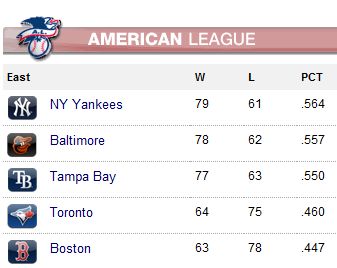
The Red Sox are in last place and all is right with the world. Why is this right and proper and not cause for lamentation? Letme count the ways:
- Tickets: Now I will starting moving up the waiting list for season tickets a little faster.
- Pain builds character: After suffering through the special circles of hell in 1967, 1975, 1978, 1986 and 2003 (I had to completely block the team out of my consciousness from 1986 to 2005: a dark and angry 19-year walk in the wasteland) this season and the last feel right and proper. All is now as it should be.
- After the binge comes the purge: Ownership took a $250 million salary dump last month and that feels good. Hell, the salaries of our disabled list is bigger than most team’s entire payroll.
- They are the “Boston” Red Sox: screw the concept of the “Red Sox Nation” — Red Sox country starts in potato country up in Aroostook County, Maine and ends in Waterbury, Connecticut. I don’t need to see a yuppie in a Red Sox hat in Istanbul’s Tahir Square to know the team has global brand recognition. Stick to your own team please. That’s why the league expanded to your city in the first place.
- The End of the Pink Ass-Hats: I’ve said it before and I’ll say it again. Do away with the Wave, the pink caps, Wally the Mascot, Sweet Caroline, and stop calling it the “Green Monstah”: it is the “Wall.”
- Bring back Tito: okay, he got spanked with a year in Bristol, Connecticut for losing control of the 2011 team, now it’s time to bring back Francona and get things back on track.

And on to the playoffs
The Kettleers finished the regular season last night at home against Falmouth, coming from behind to win 8-7. This has been a remarkable team this summer — they have the best record in the league, clinched first place in the West — and look very strong going into the playoffs which start tomorrow Thursday (I am looking high and low for a schedule).
After the usual shaky start in June, the team won something like 20 out of its last 24 games, clicking together in an amazing way with five players hitting over .300 and one, Patrick Biondi the center fielder maintaining a .400+ batting average going into this week.

The Perfect Game has named the Kettleers the best college league team in the country:
“As teams from some 30-plus summer college leagues around the country continue to navigate through the most critical stages of the 2012 schedule, the Cape Cod League’s Cotuit Kettleers remain the No. 1 team in Perfect Game’s weekly ranking of the nation’s Top 30 summer clubs.
“Cotuit continues to play at a fast pace with 20 wins in its last 24 games, and has both clinched the Western Division regular-season title in the Cape, along with the league’s best record overall. The Kettleers have just two regular-season games remaining before the first round of the Cape’s eight-team playoff kicks off Thursday.
“If the Kettleers continue their hot pace in post-season play and win their second Cape League title in three years, it may be difficult for any other summer club to overtake them in the chase for No. 1. But it has been four years since the last Cape team with the best regular-season record went on and won the league playoffs.”
I’ll predict Cotuit vs. Harwich in the finals. Harwich, the winner of the Eastern division will be tough, very tough they looked very strong last Thursday when they beat Cotuit 11 to 5 at home.
PS: lest I forget, Lowell Park has some seriously good mojo working this summer, as the local Barnstable American Legion Team, Post 206, won the state championship this summer and is going to fight for a place in the American Legion World Series against Old Orchard Beach in Maine. I caught one of their games at Lowell Park when the Kettleers were on the road and I needed a baseball fix. Says the Boston Herald: “They seek become the 20th team from the Bay State to reach the American League World Series since the inception in 1925.”
On keeping score
Once again I find myself compelled against reason to score Cotuit Kettleer games with my trusty spiral-bound faux-red leather covered C.S. Peterson’s Scoremaster: Official Baseball and Softball Scorebook.
While I feel self-consciously nerdy and obsessive doing this in public, I find I can’t enjoy a three-hour ball game without making little chicken scratches on a paper grid. Nothing comes from it. No results are tabulated, statistics calculated, or reports issued. The only pleasure comes from knowing the record is accurate, the tallies correct, and every so often I’m able to answer a random question from a fellow fan in the bleachers about how many pitches the pitcher has thrown, or what the batter has done in his previous plate appearances.

I try not to score. I tried to visit Lowell Park without the scorebook and just try to sit and enjoy the game like every other normal person, but something was missing and so I wound up going to the next game with the old hand-softened book in my hand, festooned with the free Red Sox bumperstickers that come inside of the programs they sell at Fenway. I feel a little self-conscious, and end up answering questions like:
Q: “Why?” A: “Force of habit. It helps me concentrate on the game. Actually it’s kind of fun ….” (then I feel pedantic and shut up)
Q: “What do you do with it afterwards?” A: “Nothing. Sometimes I add everything up and see if it agrees with the official scorer’s version, but usually I just stick it in a drawer.”
Q: “Are you a scout?” A: “I wish. Scouts get to sit right behind home plate with their radar guns.”
And yes, when I go to Fenway the scorebook comes with me, and I always dutifully tape the ticket stub to the pages for that game. I see more scorers at Fenway than I do at Kettleer Games. Arnold Mycock, the general manager emeritus, scores from the stands sometimes, using the free Kettleer scorecards they hand out at the press box. Because of his eminence he is also handed a copy of the lineups before the game, something I wish I could get because getting the lineups down correctly is half the battle.
As I have written here in the past, baseball is a sport uniquely suited to scorekeeping, because the pace and rules as well as the statistical tradition of the game lends itself to being recorded with pencil and paper better than any other sport. One can simply tick off hits, outs, and runs, or one can get very focused and record where hits landed, where pitches were placed, how many pickoff throws the pitcher made, how many fouls were hit …. the output of all this record keeping is the raw data necessary to calculate key statistics such as batting average, runs batted in, earned-run average, and many many others quantitative measures made more popular in this era of Sabermetrics and Moneyball.
It used to be the case that the average fan in the stands would score games. I’ve heard people reminiscence about their spinster aunt sitting in the back yard on a hot summer day listening to Curt Gowdy call a Red Sox game and keeping score while sipping lemonade and swatting mosquitoes. Find an old black and white photos of the crowd at the Polo Field in New York, or Forbes Field in Pittsburgh, all natty in their fedoras, the men wearing ties, the ladies little hats, and there is a blizzard of white score cards. In the old days, when scoreboards were manually updated and only showed the inning-by-inning box score (runs, hits, errors), a fan relied on their scorecard to tell them how the batter at the plate had fared at his previous two plate appearances, or which fielder booted the ball and earned an error in the fourth inning.

Today I only occasionally spot a fellow scorer. My theory is the practice died off with the rise of the Jumbotron and the instant availability of stats and replays and other data on the big outfield monitors.
It’s been said that a good scorecard should be able to be handed to a person with a reasonable knowledge of the game and on its own provide all the information needed for that person to recreate the action in their mind — inning by inning, pitch by pitch — of the entire game. The ultimate test of a good scorer would be his ability to capture the precise conditions there were on the field at the moment that game was suspended so, in the future, the game could resume with every player in their proper spot, standing at the same base they were when the game was suspended, the batter facing the same count of balls and strikes.
My scorecards are nowhere close to passing that test for I am usually in a state of befuddlement by the act of scoring despite having done it now at least 100 times. My motto is: Thank god for pencil and erasers.
The rules of baseball are extraordinarily explicit about the duties of the official scorekeeper and the information that person is expected to record. The tenth, and final section of the official rules are devoted to the Scorekeeper. Twenty pages of the rules are devoted to the scorekeeper. Those rules set down the 50+ pieces of information the scorekeeper must record ranging from the names of the umpires to the duration of the game to the names of the batters who hit home runs when the bases were full (Grand Slams). Some of the rules are quaint, such as specifying that the scorekeeper shall sit in the press box and not on the home nor visitors sides of the stands to insure impartiality but also to provide members of the press with information throughout the course of the game. The rules say the scorekeeper is supposed to remind the umpire when there are only two outs but the players think there are three but the scorekeeper has to keep his mouth shut if a batter bats out of order, because it’s up to the opposing team’s coach or players to detect the infraction and protest. Scorekeepers have 24 hours to change their mind on a play. They can solicit the opinions of others in deciding what to record. But for all the rules governing the art of keeping score, there are no standards for what an official scorecard should look like, nor are there any official shorthand conventions for how to record and track the play-by-play action — hence a scorecard can vary from one scorekeeper to another. Some are personalized with little diagrams, exclamation points to signify extraordinary plays, notes about the wind, the temperature ….
The big challenge for me is paying attention to what is happening on the field while at the same time tending to my scorecard. If I get too engrossed in the card then I am doomed to miss the play and find myself marking the card with a big “?” or asking those sitting around me for a clue as to what I missed.
I’ve learned to focus like the proverbial laser — selfishly blocking out the distracting chatter of my companions — from the moment the pitcher winds up through the crack of the bat, keeping my eyes on everything that happens until the play concludes, thinking to myself:
“Top of the fourth. Two outs. Count is two and three. Runners on first and second. Third base is open. Number nine hits a frozen-rope single to right, finds the hole between first and second and the runner on first base advances to second, the runner in scoring position (RISP if I am keeping track of how batters are hitting in RISP situations) on second base is rounding third to score, the right fielder (number 13 on his uniform, but number 9 in my scorer’s mind) is scooping up the ball and winding up for a long throw to the catcher (number 2) waiting at home plate to catch the runner now rounding third and hauling ass for what looks like an epic collision that has the fans on their feet. Meanwhile the batter has rounded first and is going for second base, the runner originally on first at the start of the play is on third base and being held, The right fielder makes the throw to the catcher but it goes a mile over the catcher’s head and winds up at the base of the backstop at the feet of the pro scouts. The pitcher runs to home while the catcher scrambles like a crab looking for the lost ball. The runner from second scores standing up, the crowd freaks out and screams at the runner on third to take advantage of the missed throw and go for home. He takes off and makes it home for the second run. The batter holds at second. Play is dead.”
While everyone around me high-fives and claps I sit down, click out another millimeter of pencil lead from my automatic pencil, and start scoring.
From that version of events (as witnessed by me like some undependable postmodernist existential narrator in a Kurosawa film or Thornton Wilder novel) I then have a few seconds before the next batter to record the play. I decide the batter standing on second base got there on an error committed by the right fielder because the right fielder’s throw to the catcher was wild and there was no way the catcher could have caught it. So the box for that batter gets marked with a big “E9”. That means the poor batter gets no credit for the double and no credit for the two runs batted in because he made it to base because of the error. The pitcher doesn’t get an earned run charged to him because of the error. Check. The base runners who scored both get marked with credits for their runs. All of this is being done with symbols and shorthand-like slashes of the pencil. Each batter and base runner has their own tidy box containing a diagram of the diamond. Every defensive player is referred to by a single digit — one through nine, beginning with the pitcher who is “1” to the catcher who is “2” on around the infield and into the outfield and ending with the right fielder who is “9” (never to be confused with their uniform number.
Scorekeepers refer to players by their field number only as in saying “That was a 1-2-3 doubleplay” which translated means the pitcher (1) was quick and caught the line drive on the bounce, threw it back to the catcher (2) to force out the runner coming home from third, and the catcher tossed it to the first baseman (3) in time to catch the original batter trying to make first base. If you think Laurel and Hardy’s “Who’s On First Routine” is fun, try scoring and getting it through your thick skull that the first baseman is actually a three, not a one, etc.
So back to my fictitious example of paying attention to the many moving parts of a typical exciting baseball play and then trying to write it down. Once I figure out who scored, who was put out, who caught what, threw what, pitched what ….. I write it down before the next batter steps into the box and the mayhem begins all over again. In cases involving errors I seem to constantly be overruled by the official scorer and have to either correct everything to agree with their version or stick to my guns and stay with mine. In my example, the rule governing how to score the play is spelled out in detail by Rule 10.04(a)(2); Runs That Score on Errors. According to my bible, Andres Wirkmaa’s Baseball Scorekeeping: A Practical Guide to the Rules:
“Rule 10.04(a)(2) instructs the official scorekeeper to credit a run batted in to a batter if he puts the ball into play and the defensive team thereupon makes a play, but commits an fielding error in doing so — and a run scores — if (and only if) there are less than two outs and the play made by the defensive team is one where a runner from third base would ordinarily score.”

Guess what Wirkmaa’s day job is? That’s right: he’s a lawyer. Last week the Cape Cod Times had a story about dog owners pissed off in Brewster because the selectmen banned their pooping pets from the town green. One of the rabble-rousing dog owners fighting the ruling is a New York lawyer named Jordan Sprechman. What caught my attention was the background information that this New York attorney is also an official scorer Major League Baseball. In other words, a Scorekeeping God.
“About twice a week during baseball season, he heads to the press box at Yankee Stadium or Citi Field, where he calls errors and hits. In his small script, using all capital letters, he tabulates the statistics at the end of each game for Major League Baseball.
“He’s used to taking heat.
“I’ve been excoriated all over sports radio,” he said.”
I want to know how one rises to the top of the Scorekeeping Ziggurat. Is there a Society of Baseball Scorers I don’t know about? A test? An apprenticeship?
In a moment of Walter Mitty-esque candor I confessed to my son my secret scorekeeping fantasy. Right before the national anthem is sung at the next Kettleer’s game by Nickie Chevalier or the Singing Barnstable Policeman, a call goes out over the PA: “Is there a scorekeeper in the house to score today’s game?”
And so I slowly rise, brandishing my trusty C.S. Peterson’s Scoremaster: Official Baseball and Softball Scorebook, and finally get a seat in the press box.
This will not happen for the simple reason that I have a long long way to go before I can be trusted to properly record a game. For scorekeeping is not a batter of just counting and writing, it’s about judgment calls, opinions, subjective decisions that will piss people and players off if done poorly. My scorecards are a record of doubt, second guesses and erasures, committed in crazed handwriting that even I can’t decipher. I still don’t know how to credit a winning pitcher or how to give a pitcher a save. Despite my membership in the Society of American Baseball Research, and my ownership of a Strato-matic set, I do not understand WAR or PECODA.
As my friend and ardent Yankee fan T. Grand once replied on Twitter when I tweeted my ignorance of the infield pop fly rule during a Red Sox game : I would have been shot as a Nazi spy in World War II for my un-American ignorance of the fine points of the rules, for the greatest test of red-blooded Americanism is knowing one’s baseball rules.
Whatever, I can always hope to improve.
Past posts on scoring:
Arnold Mycock Day — Cotuit Kettleers
A great ball game last night at Cotuit’s Lowell Park, beginning with the dedication of the press building to the original Mister Kettleer: Arnold Mycock. I don’t know Arnold very well, he’s a quiet man who keeps to himself in the grandstand behind the Kettleer’s dugout, usually with a scorecard and paying keen attention to the action out on the diamond. Behind the quiet demeanor — what Coach Mike Roberts called the most humble man he had ever met — Arnold Mycock is a legend not only as a founder of the Cape Cod Baseball League — the preeminent wooden bat summer college league — but also for the four league championships he delivered in his tenure as the general manager of the Cotuit Kettleers, his 63 years of volunteer service to the team and the league, and his quiet devotion to the purest form of baseball that exists (in my opinion).
From cleaning the restrooms to washing the uniforms to mowing the grass twice a week, Arnold did it all.

Arnold’s superlatives are more than impressive. He was the first person inducted into the CCBL hall of fame. More than 40 of his players went onto to the major leagues. Joe Girardi of the Yankees played for Arnold. Ron Darling of the Mets did. And New Mexico governor Bill Richardson pitched for Cotuit in the 60s. Arnold was a killer scout for the Kettleer’s have won 14 League championships thanks to his off-season trips to the south and west to look for up and coming college talent.
This past winter Arnold was given an meritorious service award by the American Baseball Coaches Association for his contributions to college baseball.
Every time I sit in the bleachers with my pals and marvel at the perfection of free baseball that I can watch in bare feet, with no lights, frolicking mascots, I give thanks to Arnold and the Cotuit Athletic Association for their hard work. It makes my annual donation to the cause and the few bucks I slip into the kettles during the third inning feel very tiny in comparison to his devotion and the ongoing commitment by the entire organization.

