One of the oldest and most prominent homes in Cotuit is the Ebenezer Crocker house that has presided for close to 250 years over the bay above Hooper’s Landing on the curve at 49 Putnam Avenue since 1783. The house was built that year by Ebenezer Crocker, Jr., descendant of the colonial Crocker clan who founded Cotuit. In 1849 it was bought by Samuel Hooper, the village’s first summer resident. Hooper and his descendants lived there and entertained prominent guests such as Harvard historian Henry Adams (grandson of President John Quincy Adams), Hooper’s niece: the pioneering photographer Marian “Clover” Hooper Adams, U.S. Senator and abolitionist Charles Sumner, and a parade of prominent political and cultural figures of the late 19th and early 20th century.
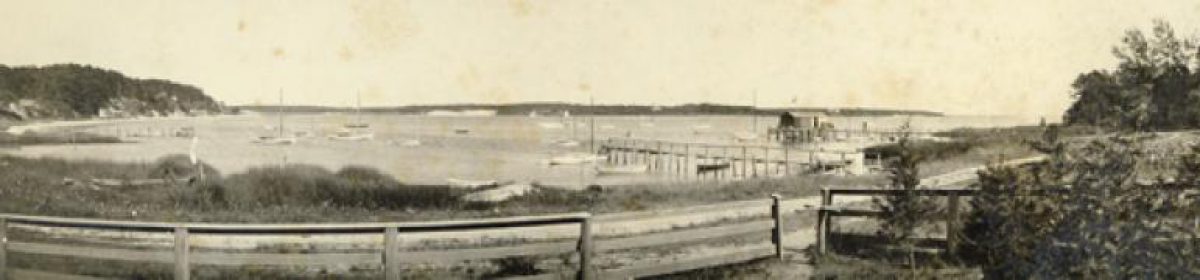
Below the property, on the shoreline, Ebenezer Crocker built the first pier on the shores of Cotuit Port. It was a “crib pier” located adjacent to the present dock of the Cotuit Mosquito Yacht Club. There Ebenezer’s son, Braddock Crocker, built a small shop that served the growing fleet of packet sloops that departed from the cove bound for Edgartown and Nantucket.
The Crocker Pier, c. 1910 by Edward Darley Boit
The new owner wants to move the two-and-a-half story structure to the field to the north where the former farm’s grand barn stood until it was demolished in 2017. On Tuesday, August 19, 2025, at 4 PM, the Barnstable Historic District will conduct a public hearing on the following application:
“Popolo, Joseph Victor Jr. TR, 49 Putnam Avenue, Cotuit. Map 036, Parcel 004001, Built 1783 Partial demolition & relocation. Demolish the ells of existing dwelling. Relocate the dwelling to the parcel across the drive owned by the same over or to 555 Main Street, Cotuit.”
The application, filed on behalf of the owners by Jennifer Birnstiel of the Plymouth, MA firm of Archiplicity, LLC (dated April 17, 2025) is addressed to Ben Haley, National Register Director of the Massachusetts Historical Commission and states the reason for the move is:
“The move of the structure is being proposed to create a better connection between the owners existing home on an adjacent property and the outdoor living space. This move will create a better visibility for The Ebenezer Crocker Jr. house in the Town making it a more prominent landmark. The current house location is not visible from the street. It is located on a turn and shrouded by trees. The new location is an adjacent grassy field of the same original property where the structure of the original barn once stood.”
The letter further states under the heading of “Appropriateness of the New Setting:”
“The new site is adjacent to the existing house location. The property was originally one property and was divided at a later date into separate lots. The move of the house will have no affect on the historical significance of the property as it was originally a singular property. The move is wholly appropriate as the current building location and the proposed were originally the same property. The visibility in the field adds to the visibility of the property as a whole.”
Under the heading of “Impact on Historic Significance,” the architect states:
“The Ebenezer Crocker Jr. House will continue to be located on the original property which was historically one and will remain adjacent to the buildings in the original listing (The Ropes Ice House c 1851 and the Ropes Workshop c. 1855). There is therefore no impact as the listing will remain constituent to the current listing with the joined properties.
“The building will be moved and relocated on a concrete foundation. We will repurpose stones from the original barn as part of the new foundation. In this regard the building shall still be considered eligible for retaining its National Register Historic status.”
It should be noted that the property that the owner wishes to move the house onto has been under a conservation restriction (Barnstable County Registry of Deeds, book 12934 page 41) since 2000:
“The purpose of the Restrictive Covenant is to assure that the Restricted Area will be retained in perpetuity predominantly in its natural, scenic, and open condition and to prevent any use of the Restricted Area that will significantly impair or interfere with the conservation values of the Restricted Area. The public benefits resulting from conservation of the Restricted Area include, without limitation: protection of a field, that together with the field on the opposite side of Putnam Avenue, preserves the scenic and historical rural character associated with this area of Cotuit for the benefit of the public.”
The conservation restriction may be why the agenda item states an alternative location for the house could be 555 Main Street, Cotuit (north of the driveway to the Cotuit Elementary School).
The late Prof. Jim Gould wrote about the house in the June 29, 2012 edition of The Barnstable Enterprise. A copy is on his blog, where he describes how Samuel Hooper came to own the house and become Cotuit’s first summer resident:
“The story behind the purchase of the house is that Samuel Hooper could find no captain to go to China for him since all had gone off to California. He heard there might be an available captain in Cotuit, and approached the postmaster Captain Alexander Scudder. Captain Scudder was attracted by Mr. Hooper’s generous offer to take a ship to China but asked who would take care of his house and farm. Mr. Hooper paid for the farm and house, and became the first summer resident of Cotuit, and perhaps of Cape Cod.”
Samuel Hooper, Cotuit’s first summer resident
The Barnstable Historic Commission will meet on Tuesday, August 19th at 4 PM in the Selectmen’s Conference room on the second floor of Town Hall, 367 Main Street, Hyannis. The application concerning 49 Putnam Avenue is last on the agenda.
The 75-page filing submitted to the Commission can be read online.
The Historical Society of Santuit and Cotuit’s monograph about “The Crocker-Hooper-Lowell-Ropes House 1793-1957” is below.
Part One described the start of the restoration of the Snafu II, a 78 year-old Cotuit Skiff built by my grandfather, Henry Chatfield Churbuck in 1947 for my father Tony. The first phase focused on removing the old paint from the hull so I could get a good look at the underlying problems; the removal of the coaming that had started to crack at the apex of the forward port curve; and stripping the canvas off of the deck which had torn in several places.
Henry Chatfield Churbuck
When the paint was peeled off with a heat gun it revealed some bad rot in the lower portion of the white oak transom near the lower gudgeon, or hinge point for the rudder. That became the first priority and involved some careful surgery to remove the plank and refit a new piece without compromising the shape of the hull
A new Dynel deck was laid on, followed by the steaming and screwing in place of a new ash coaming. A coat of custom “Churbuck yellow” paint from the George Kirby Jr. Paint Company in New Bedford was applied over a coat of two-part TotalBoat primer, followed by the shaping and installation of new white oak rubrails. As temperatures dropped in late November, work ceased for the winter.
The Worklist
Coaming: refasten the screws and drill deeper holes so the screw heads may be bunged and varnished; consider cutting down the top edge of the coaming about 1/2”-1” to make it easier on the backs of the crew and skipper’s thighs; install a 6” long piece of bronze half-round into the forward starboard edge of the coaming where the halyards will chafe; shape and merge the bottom edge of the coaming where the fore and aft sections are butted together; finish the coaming with 4 to 6 coats of varnish.
Rub rails: fit starboard rub rail , bed in Dolfinite and fasten to boat, shape and sand transom pieces, set bungs and vanish 2 coats.
Deck hardware: install the bow chock, mooring cleat, pad eye for centerboard pennant, order and install new towing cleat on starboard quarterdeck, frame the mast hole with bronze strips
Centerboard thwarts: remove existing pine seats and replace with cedar or mahogany
Cockpit: Strip varnish from centerboard trunk, re-finish trunk. Cut and install knees under thwarts and under deck forward of the centerboard trunk.
Rough out the spars: cut down 9”x8/4×16’ Sitka Spruce limber into two 4” slabs; glue and clamp, then mark with spar gauge (need to make a spar gauge), and build a jig to plan the corners off. Cut down 9”x8/4×14’ Sitka Spruce to make gaff and boom (to be scarfed) into a 17 ½’ length
Taper and shape spars, sand, cut tenon into the base of the mast, make white oak spreader and install spar hardware.
Make the sail track for the mast. I DESPISE gaff jaws and lacing and prefer the old “Senior” track as used on the Wianno Senior and #36 when I raced her. That means cutting a narrow piece of hardwood and routing two grooves along the aft edges to accept bronze sail slides, and placing a 1/8” bronze bar on the upper end of the track where the gaff fitting will be attached and most of the pressure will be focused. The gaff and boom will use standard bronze sail track which is $20 a foot and hard to find.
Stern seat – drill and bolt lower gudgeon, make shoe-socket for boom crutch from oak and epoxy to keelson; cut rectangle into stern seat to accept boom crutch, reassemble stern seat, finish boom crutch
Tiller – make new tiller from 8/4 oak or spruce – use original tiller for template; cut out with jig saw, round off and shape with a spokeshave plane.
Materials
I’m a curmudgeon when it comes to wooden boats and hate to see traditional designs trashed by cheap stainless steel fittings and multi-colored synthetic ropes. As one bronze supplier quipped, “It’s like wearing running shoes with a tuxedo.” I tried to use only bronze for this restoration. Alas, the old manufacturers of the great traditional fittings went out of business long ago. Bronze blocks (pulleys), cleats, forestay turnbuckles, sail slides and tracks, mast hoops, goosenecks, and other assorted fussy little parts are nearly impossible to find, and when they can be located are priced at the level of boat jewelry. I have a collection of some bronze hardware scavenged from other boats, and others that were cast by my grandfather when he was building boats after WW II.
Fortunately J.M. Reineck & Son, a Halifax, MA company, has revived the original Herreshoff Manufacturing Company’s bronze designs as well as some of the lamented hardware by the defunct Merriman Company. I ordered a block for the throat halyard from Reineck and will add additional hardware in the years to come as my budget allows.
All lines (ropes) for the halyards, mainsheet, centerboard pennant and outhauls I’ll bought from R&W Rope in New Bedford. I can’t say enough nice things about R&W. Visiting the shop is always an adventure as they stock everything from rock climbing rope to tugboat hawsers. I used double-braided Novabraid XLE in a traditional tan color that mimics the old manila hemp lines the skiff came with when I sailed the boat as a boy.
Wood is a challenge. Marine plywood I can pick up from Plywood Specialties in Hyannis, but boat lumber is all but impossible to find in the local lumberyards which only seem to stock pine, some poplar, and western red cedar. There are some fantastic lumber supply houses: Boulter Plywood in Medford is one option. Condon’s in White Plains, NY is amazing. But the best discovery throughout the entire restoration was Reader’s Hardwood Supply in East Taunton, a mere 45 minute drive over the Bourne Bridge off of Route 25 on Route 44. There I was able to source a 16-foot 8/4 plank of Sitka Spruce for the spars along with some great white oak and clear ash for the coaming.
Spars
My first experience working in a boat shop happened when I was 12 years old and made some spars for Optimist Prams in my grandfather’s shop for friends who broke their masts, booms and sprits in the yacht club’s sailing program. That involved cutting fir banister rails with a handsaw, drilling a hole through the top for the sprit rope, and screwing on the old cleat and bronze pad eyes from the broken mast. I think I charged $5 for the complete mast, varnished of course.
I made one skiff boom years ago — a “T” boom fashioned from two pieces of fir — but never a round mast, gaff or boom. After watching a few how-to videos on YouTube and building a nifty spar gauge based on some plans I found in the archives of WoodenBoat Magazine, I headed to Reader Hardwood Supply and bought an expensive 16-foot plank of Sitka Spruce for the mast and boom, and a ten footer for the gaff. The spar gauge was based off one used by a spar maker at Mystic Seaport, and was designed to precisely scribe two parallel lines to guide the shaping of the spar into an octagon. I could (but won’t) go on and on about the week’s work that went into making the gauge. It was a challenge and involved cutting stainless steel bolts length-wise, drilling them for screws, and resulted in a tool I am inordinately proud of.
Spar gauge
I ripped the 16-foot plank of spuce down into two 4″x2″ pieces and then epoxied the two together in a sandwich to made a 4″x4″ square cross section. The 2″ wide off-cut was saved for the boom.
I ran the spar gauge down the four sides of the mast timber, scribing two parallel lines on all four faces with the tips of two bronze screws (golf pencil tips break off too easily). I clamped the piece to a pair of sawhorses in a crude jig and with a power plane whittled off the four corners, creating a massive pile of shavings that are still blowing all over the back yard and which get stuck between the toes of my bare feet and follow me inside of the house. Mrs. Churbuck is to be praised for never once complaining about such a mess.
The top third of the mast tapers from 4″ to 2″ inches, so with the power plane whining away I whittled the spar down to a rough octagon, finishing the shaping with a reversed 60-grit belt sand belt attached to a roller drum with a handle set into the chuck of a cordless drill. The mast took about six hours of careful planing (both power plane and hand plane). The boom needed to be lengthened to 17 1/2 feet, so I cut a 12-to-1 scarf in the end, and epoxied a second piece to get it to the right length. Skiff booms are over 17 feet long, giving them their distinctively over-sized gaff rig.
Shaping the mast
I overbuilt the gaff in the belief it is the weakest of the three spars. I tapered the throat end down to a wedge shape to accept a bronze gooseneck fitting donated by Conrad Geyser. Given my hatred of gaff-jaws (they chew up the mast by grinding against it) and laced-on sails, I went with the original “Senior track” configuration to attach the gaff and the luff of the sail to the mast and scavenged bronze sail track to attach the head and foot of the sail to the gaff and boom respectively. For the mast track I cut a 1/4″ dado into a seven-foot length of white oak and epoxied it to the aftside of the spar, taking care to make the slots the right size to accept the bronze gooseneck fitting and the five U-shaped bronze sail slides. I made a spreader for the forestay out of white oak, spliced a loop into the end of a 3/16ths length of stainless steel wire rope (splicing wire rope is NOT fun), wormed and parceled the loop, and fashioned the forestay through the uppermost pad-eye for the peak block at the top of the mast. Getting the goosenecks onto the boom and the gaff were an opportunity to learn how to peen 1/4″ bronze rods into “rivets” with smooth heads as opposed to cluttering up the end of the gaff and boom with a series of bolts and nuts.
“Senior-style” bronze gaff gooseneck fitted to the mast track
Bronze turnbuckles are hard to find and the best price I could find for a new one was a staggering $250, so I turned to eBay and discovered the used bronze market has caught onto the shortage of bronze boat fittings with prices far over what they should be. I ordered two turnbuckles, but they were over-sized and will collect cobwebs in the shop for the foreseeable future. In the end I scavenged a bronze forestay turnbuckle off of another spar, along with a lot of old sail track which is priced at an eye-watering $15 a foot new .
The spars all received eight coats of Epifanes varnish. The first coat was thinned 50-50, the second 25-75, the third 15-85 and the last five were all full strength with 400 grit wet sanding and acetone wipe downs in between coats until the spars looked like candy apples.
Hardware
The devastating impact of West Marine on the small marine hardware suppliers can’t be overstated. A trip to the local stores is always an exercise in futility. There is no bronze. The staff knows very little about anything nautical. And the prices are absurd. Taken together with the decline of wooden boat production in the 1960s when soulless fiberglass took over, a lot of traditional parts suppliers have gone out of business, most notably when it comes to bronze hardware. Learning how to cast bronze is on my list of future projects, but until then I’ve resorted to pilfering hardware from old boats and spars to meet my needs.
Stainless steel hardware and the disposable dreck carried by West Marine simply looks terrible on an old wooden sailboat. There are a few mail order/online sources but the prices of bronze are hard to swallow. Davey & Company in the U.K. produces beautiful work, as does JM Reineck & Son in Halifax, Mass.. There are some outstanding foundries that do custom work, notably the Port Townsend Foundry in Washington state. Bronze fasteners used to be readily available on Cape Cod from chandleries at local boat yards, but alas, stainless steel has taken over and my go-to source for bronze screws, nails, bolts, and washers is Fairwind Fasteners in Newport, Rhode Island who make excellent hardware and have outstanding customer service.
Fortunately for my wallet I had a good collection of bronze cleats and the original hardware from the Snafu II to work with.
The final weeks of the project before launching were spent carefully fastening blocks, chocks, and cleats back onto the hull and the new spars. The amount of “fiddly” work involved tried my patience, but I took my time and made multiple orders from Fairwind Fasteners rather than compromise and head to the local hardware store for stainless steel facsimiles.
Over 150 of these little suckers were hand-screwed into the boom and gaff to pin down the sail track. My hand is still cramped from the ordeal.
Paint
I used to hate painting but after getting into half-models and learning a lot from the master of boat painting — Malcolm Crosby, the former head of the paint shop at the Crosby boatyard in Osterville — from his daughter Betsey Crosby Thompson’s excellent series on YouTube, I find painting to be the most zen and rewarding aspect of boat restoration.
After giving the new spars their eight coats of varnish I turned to the hull and used a laser level to strike a line for a new boot top over the waterline. I painted the hull with the custom yellow sourced from George Kirby Jr. Paint (it required four coats to cover all the underlying dark spots, some of which still peek through), the bottom with Petit Vivid antifouling White, and the boot top with green Epifanes waterline paint. The boot top leaves a lot to be desired — I need to invent a parallel masking tape contraption to keep an even spacing between the top and the bottom of the line )assuming someone hasn’t already invented one).
The final steps included rebuilding the stern seat from planks of western red cedar, fitting the boom crutch and the new tiller, and repainting the interior of the boat with Seattle Grey.
Centerboard trunk and keelson stained and varnished, with new (vintage) bronze halyard and centerboard pennant cleats installed.
Rigging
A few days before the Fourth of July I gathered sons and son-in-law and carried the boat out to the yard where I stepped the mast, cut the forestay to the proper length, and rigged the halyards, sheets, outhauls and sail to be sure everything was more or less ready to launch. Bitter lessons from the past have taught me to get everything adjusted before loading the boat onto the trailer and launching it, as working on the beach is a nightmare of tools and parts falling into the water, dying batteries on cordless drills, and many trips up the hill to find a missing shackle or piece of light line in the boat shop.
I mounted the centerboard, easily found the right holes and banged the bolt through with a rubber mallet, backed the fender washers with leather washers slathered with silicone goop, and then turned my attention to the trailer, giving the tires a blast of air before unrigging everything and getting the boat lifted onto the trailer.
I launched on the morning of the 4th of July. In between killing a dozen horseflies taking biopsies of my calves and ignoring the Joe Dirt Jet Ski armada loading up for an afternoon of intoxication at the bird sanctuary, I had the boat on the mooring in time to make the parade. That afternoon I finally found a few minutes to row out to the boat and take her for a sail, the first time I’ve been behind the tiller in more than three decades. Alas, there was very little wind, so I bobbed around looking for a puff to fill the sails so I could see what needed adjusting to get it to set perfectly.
The next morning a very sporty breeze was blowing from the southwest, so I went out again and had a nervous sail that tested the strength of the new spars and revealed a serious crease along the battens that means I must tighten the gaff bridle to get the peak up a few more inches. Other than that, and a little leaking, she looks very pretty. Next up: another one of my grandfather’s skiffs, the old Dolphin owned by my cousin Peter. That can wait until the fall.
As I finished the second draft of my book about the wreck of the Nantucket whaling bark Phoenix I turned my attention to the proposal for submission to literary agents in hopes of landing one to represent me in selling the book to a publisher. Book proposals are the literary equivalent of a business plan, especially for the narrative non-fiction genre. They are structured documents that can range as long as 50-pages and include a summary of the story, author’s biography, table of contents with a brief description of the chapters, a section describing the author’s “platform” (social media presence, credentials of authority, etc.) and a discussion of recent books that are comparable to the work.
The shipwreck/survival genre is popular, and the recent best-seller status of David Grann’s The Wager is one indicator of a strong market for maritime history. In my comps I focused on relatively recent titles such as: The Wager; Andrea Pitzer’s Icebound (about the 1596 voyage of William Barents to the Arctic Circle in search of a northeastern passage over Russia to China); and Hampton Sides’ Wide Wide Sea (about the Pacific voyage of exploration by Captain James Cook).
Hampton Sides is the author of eight non-fiction books. The first I read by him, Ghost Soldiers, is about the rescue of American POWs from a Japanese prison camp in the Philippines. Hellhound On His Trail is about James Earl Ray, the man who assassinated Martin Luther King at the Lorraine Motel in in Memphis in 1968.
The third Sides’ book I’ve read (and just finished) is In the Kingdom of Ice: The Grand and Terrible Voyage of the U.S.S. Jeannette. It was published in 2014 by Doubleday.
Literary agents and publishers tend to prefer recent titles in a proposal’s comp section, but the parallels between my book — The Marginal Sea: Shipwreck and Survival on Siberia’s Sea of Okhotsk — and In the Kingdom of Ice are too close to ignore, so even though the book is nine years old I believe it should be included.
The story begins in 1879 when the U.S.S. Jeanette, a ship named for the sister of its benefactor, New York Herald publisher James Gordon Bennett (see my previous blog post about the history of the Mohawk disaster and Bennett’s role in that tale), sailed from San Francisco bound for the Bering Straits in search of a sea route to the North Pole. The ship had been rebuilt and reinforced to withstand the rigors of the arctic ice pack, and was under the command of the U.S. Navy officer George Washington DeLong who was accompanied by a crew of 32 men under the auspices of the US Navy.
The Jeanette searched for, and found the rumored Wrangel Island northwest of the straits, but became icebound and drifted with the ice pack for over a year, eventually sinking 300 miles off the coast of Russia in June, 1881 after the ice crushed her hull and left her crew on the ice with a pack of sled dogs, the ship’s small boats, and a stack of provisions.
DeLong led the crew over the torturous ice pack over the brief summer, a miserable slog that Sides brilliantly describes based on his research into the expeditions’ accounts and logs. After hopscotching between the New Siberian Islands they took to the three boats to cross 100 miles of open sea at Semyonvsky Island.
The three boats became separated in a late summer gale. Two made landfall on the delta of the Lena River. The third was lost without a trace. DeLong’s boat landed at the northern extremity of the insanely convoluted and unmapped delta. The second boat to make it to land, commanded by the Jeanette’s engineer, George Melville, came ashore on the southeastern side of the delta.
Then, as the Russians would say, “things got worse.”
I won’t spoil the story, but heartily recommend In the Kingdom of Ice as a classic in maritime survival literature. I first became aware of the Jeanette expedition during my research on the Marginal Sea via George Kennan’s Siberia and the Exile System, and that explorer’s description of being in the Sakha Republic when the Jeanette’s dead were being carried out of the wilderness for eventual interment in New York City.
The writing is superb, the scene setting and descriptions of the various personalities associated with the Jeanette are masterfully executed. All in all I would rank In the Kingdom of Ice up there with Alfred Lansing’s Endurance: Shackleton’s Incredible Voyage as a must-have for any section of a book shelf devoted to Arctic survival.
I had the opportunity this week to talk to David Rose, founder of the Cambridge, MA startup LOOKOUT and chief operating officer Howie Hecht. The company is the inventor of the LOOKOUT, the AI camera system for boaters who could use an extra set of eyes while on the water.
Consisting of three cameras — as 360-degree 4K camera, a forward-facing 4K high-res daylight camera, and a forward-facing low light camera — affixed to the highest point on the vessel, the system uses a $9,995 Nvidia processing unit to identify, in real-time, what’s going on around the boat while underway.
Bell buoys, other vessels, floating logs, lobster pots, jet skis bent on mayhem …. if it’s on the water or near the water, LOOKOUT detects it and flags it on a multi-function screen mounted beside the helm. Add in integration with a digital chart plotter, an AIS (Automatic Identification System) receiver, GPS and night-vision (FIR) cameras and the result is transformational, especially for novice boaters who aren’t familiar with the perils and challenges of operating a boat in a chaotic unforgiving busy harbor.
LOOKOUT’s augmented reality display shows a 360 degree panorama across the top with a compass heading indicator below. Icons with identifiers tag the identity of other vessels, along with their speed, heading, and estimated convergence time if they are steaming on a course that intersect the user’s. Depth and speed are prominently displayed along the bottom of the display, and the interface control icons live on the right.
Rose is an augmented reality expert — he was in charge of AR at eyeglass maker Warby Parker — and a boater. His inspiration was the question — why don’t boaters have the same intelligent displays they’re used to using in their motor vehicles? After all, most every new car comes with a video screen and backup camera that displays what is happening behind the vehicle, and overlays some graphical guidance to stop the driver from backing over junior’s tricycle or heaven forbid junior themselves.
The conversation with Rose and LOOKOUTs chief operating officer took me back to 1992 when I wrote a story for Forbes Magazine, “Smart Charts” about the first digital navigation charts and their integration with the then brand new global positioning satellite (GPS) system. After spending a day on Vineyard Sound with Woods Hole Oceanographic Scientist Arthur Gaines aboard a converted motor yacht with blacked out windows and portholes staring at a high end workstation with one of the first digital charts — a technology known as ECDIS (Electronic Chart Display and Information System) — I came away astonished at the great leap forward yachting was about to take by doing away with the old analog world of paper navigational charts, sextants, bearing compasses, and the crude art of dead reckoning. LOOKOUT is every bit as big a deal today as ECDIS was 33-years ago.
LOOKOUT isn’t cheap at $13,990– but most decent marine electronics aren’t. The system works with existing IP cameras, so if the vessel is already equipped with a FLIR, such as the very pricey ($24,000) FLIR m364c for infrared night vision, it’s vision capabilities can be even further enhanced. Prices of FLIR cameras are coming down, so like most smart electronics, the price of the components are likely to come down over time. Available since last summer (2024), the system is available at getalookout.com
Installation can be done by the sailor with a few tools, but as with any piece of marine electronics, the best option may be to ask a qualified marine electronics technician to set it up for you. It works on both sailboats (mast-top placement) and motor yachts.
The demos of the product are incredible. Here’s one from YouTube that shows LOOKOUT at work.
I’ve long maintained that the most powerful application of artificial intelligence is machine vision, and LOOKOUT bears this out with an elegant interface and an implementation model that puts the required processing power onboard (as opposed to suffering from the latency and lag of a network model). With further iterations and an integration with an autopilot and radar, it’s not inconceivable that LOOKOUT’s technology could be used for collision avoidance, and dramatically reduce the high risks of the high seas. LOOKOUT may not lead sailors to the marine equivalent of a driverless car, but for some single-handed boaters it definitely will take away some of the anxiety that comes with ducking down below for a moment and taking one’s eyes off of the waters for even a second.
In which I use tools to transcribe primary sources and use Google Earth to map and outline a book about whaling.
During the course of my research into the mid-19th century bowhead whaling fishery in Russia’s Sea of Okhotsk I’ve depended on the archives of the Nantucket Historical Society, the New Bedford Whaling Museum, and the Providence, Rhode Island public library for access to their collection of ship’s logs.
When I started the project ten years ago, access to those collections was much the same as it was when I was a college student 50 years ago in the late 1970s — I showed up, talked your way past a librarian into the stacks, and if I was lucky and the librarian was in a good mood, I was allowed to touch some primary source material — aka original documents — if I promised not to write on them with ball point pens or eat my lunch while poring over the spidery Spencerian script penmanship.
When I narrowed my research down to two ships — the Massachusetts and the Phoenix of Nantucket — I made several research trips across Nantucket Sound on the Hy-Line ferries to spend the day at the Nantucket Historical Association’s archives in the former Quaker meeting house on 7 Fair Street reading whatever I could about the two ships and their voyages of 1856.
The first few visits were very unproductive. Because I was making a day trip, I had about six hours of reading time in the library, and initially thought I could read and transcribe from the old log books enough information to enlighten me about the events that transpired over the summer whaling season of 1858 around the wild Shantar Islands.
Alas, being unfamiliar with the format of the typical ship’s log, and totally bewildered by the handwriting of the “keeper” (the log was “kept” by the first or chief mate, who thus was referred to as the “keeper) and the abbreviations, conventions, and actual situation of the ship as described in entries such as the one below from the 1856-58 voyage of the whaling ship Massachusetts:
Thankfully, the kind librarians at the NHA were very helpful and helped me decipher some of the more inscrutable words. They began by telling me that, no, my great great grandfather Thomas Chatfield, captain of the Massachusetts was not the “keeper” of the logbook, but that it had been “kept” by chief mate William Folger of Nantucket.
The example above is the entry for Wednesday March 3, 1858. The header of the page reads “Bound to the Sandwich Islands March /58” — situating the ship in the Pacific on its way to the Hawaiian Islands after cruising off the coast of Baja California and Cabo San Lucas the previous three months.
In the left margin is the day and date “Wednesday 3d.” The entry then begins (as nearly all entries begin) with “Comd” — an abbreviation for “Commenced”. Reading on, Folger writes:
Learning to decipher such a entry takes practice and building some familiarity with the keeper’s handwriting.
“Comd with a moderate trade from ENE Steering W by S at 5 AM made the Isl of Owhyhee bearing W 10 miles dist Middle part light air from the SEd at daylight got the anchors ready at 9 AM took a pilot latter part standing in for the Bay at meredian the harbor bearing WSW 5 miles dist”
For the last few years I have been helping the Nantucket Historical Association transcribe logbooks of various whaling voyages. Because I need the transcript of the Massachusetts for my book on the wreck and rescue of the Phoenix, I was happy to learn the NHA had posted the full scans of the Massachusetts’ 1856 log book on a service called From the Page: “a crowdsourcing platform for archives and libraries where volunteers transcribe, index, and describe historic documents.”
Every morning I wake up and transcribe four pages of log book entries on the From the Page website. The web interface shows the scan of the original log in one window, and a transcription window to the right. When I log on go the project page for the Log of the Massachusetts and look for pages that need transcription.
Seeing that page 118 of the 182 page project needs to be transcribed, I select it and begin deciphering the script. The first line is the page header where the keeper always writes the name of the vessel of the left page and the general situation and year — “Bound for the Sandwich Islands /58” on the right.
The header on page 118 the reads, “Remarks while at Hilo S I / 58” Typing in the transcription box, I write “Remarks while at Hilo” then pause, and zoom in on the scan of the original log to try to decipher this puzzling abbreviation:
Because I’ve already spent about 40 hours puzzling over Mr. Folger’s penmanship I know the first cursive letter is an “S” and the second is an “I” and the underlined superscript beside the S is his way of noting things are plural. Deducing from previous pages that the ship has arrived at the Sandwich Islands, I put in square brackets and all-capitalized letters my interpretation of the “S” to mean “[SANDWICH]” and beside the “I” I guess “[ISLANDS]”. The diagonal slash and number “58” is how Folger notes the year. In this case 1858.
If I’m unsure of my guess, I would have added a question mark after the capitalized word and checked off the box “Needs Review” — a flag for the NHA’s librarians to please check my work and double check my interpretation. If I am completely stumped by Folger’s scrawl, I would insert three question marks in brackets after the mysterious word in question: [???]
After transcribing the header text, I zoom the view of the scan out, hit a carriage return to insert a blank line, and start transcribing the first entry for Sunday the 7th of March, 1858.
Most log entries at sea end with the position of the ship noted as “Lat by Obs” or Latitude by Observation and “Long by Chr” or Longitude by Chronometer, with the cartesian coordinates expressed in degrees and minutes.
Because the narrative structure of my book depends on knowing where the two ships are, especially when they come together for a “gam” or conversation between the two captains who are the book’s protagonists, I take the coordinates from the log book and enter them into Google Earth.
By placing a new placemark, I can enter in the latitude and longitude and then copy the transcribed text from the logbook into the description space. I can also add images of the original log, photographs of any landmarks or relevant equipment, and insert links to web pages — especially Wikipedia entries describing specific landmarks.
Google Earth is an exceptionally useful tool for a maritime historian. Because my book is set in the Sea of Okhotsk, and because the New England whalers usually sailed that body of water without the benefit of accurate charts (maps), they tended to give landmarks nicknames of their own that bear no relation to their actual Russian names.
Here’s how I keep track of the two ships as they work along the ice pack in the Sea of Okhotsk in the months of May and June 1858.
Because Google Earth does a terrible job identifying geographic features, I took it upon myself to label the names of the islands with both the whaler’s English nicknames and the appropriate non-cyrillic Russian names in use today.
The yellow push pins show the location of the Phoenix. The light blue show the position of the Massachusetts.
Note at the bottom of the screen shot above is an yellow icon for May 25 when the two ships came together for the first time since leaving Cape Cod and Martha’s Vineyard in the fall of 1856. There the two captains — Bethuel G. Handy of the Phoenix and Thomas Chatfield of the Massachusetts — and “double” brothers-in-law (each married the other man’s sister) spent an afternoon together catching up on the news and having a little Cotuitport “reunion” 15,000 miles away from the Cape Cod village they called home.
The power of Google Earth in helping me track the position of the two ships and gain some understanding of what they saw and experienced can’t be understated. Take for example the log entry of the Phoenix for June 4, 1858. Taking the text from the official transcript (as transcribed by volunteers using “From the Page” and archived on the Nantucket Historical Association’s website, I created a placemark with an anchor icon to note the ship’s position in the anchorage of Fabius Island.
In the placemark’s description I copy over the relevant transcription of the log, and rolling over the icon a popup tells me “Friday 4th Begins calm ship laying at ancker [ANCHOR] off Fabius harbor. [T]hree boats off after whales. [S]aw a few but did not strike. [L]atter part one boat getting wood”
Good to know. As I write about that in the book, I’m able to say with confidence that the winds were calm and the crew was off hunting whales with one of the ship’s boats ashore gathering firewood. But curious about Fabius Island, I turn to Wikipedia where an amazing savant with the username “ST1849” has described a whaling camp established on Fabius over the summer of 1858 by two American whaling ships. To remind myself to include this information in the book, I add a link to the Wikipedia entry for Fabius Island. I also make a note to find the logbooks for the New Bedford whaling ship Cicero and the Fairhaven ship Sharon so I can read the logbook entries from those ships and learn more about the summer whaling camp they established there.
I also have learned the Russian name of the island (Ostrov Nedorazumeniya) and its translation to the wonderful “Island of Misunderstanding” because some Russian cartographers forgot to add it to an early map.
Wondering what the actual island looks like and despairing of ever getting an opportunity to actually travel to the Sea of Okhotsk to see and experience those waters and stark landscape, I went searching for pictures of the Island of Misunderstanding. Finding one, I added an image link to the Google Earth placemark as seen above.
More later about these new powerful tools that are transforming how I research and write my maritime history projects. The potential to integrate the power of Google Earth’s maps with historical imagery and primary source material has me now thinking the final output of my project, The Wreck and Rescue of Captain B.G. Handy is not a traditional book but some hybrid e-book integrated with a “follow-along” guide that replaces the classic model of footnotes and illustrations with something far more interactive and visual.
I’m open to suggestions. The publishing landscape at present is iffy and I have yet to find a literary agent willing to take this project on and pitch it to the usual suspects in publishing. But passion projects being what they are, I continued to persevere and write away to tell the improbable story of two young men who came together across three of the biggest events of their generation– the Gold Rush, the final years of whaling, and the Civil War.
With a gale in the forecast, temperatures in the teens, and a very good friend who is captain of a freight boat to Martha’s Vineyard, what better time to go boating than 4 am in early January aboard a sturdy little newspaper & bread boat?
I was feeling very landlocked after New Year’s, surrounded by sick people, smug in my vaccinated cocoon of invincibility but itchy to get outside and away from the winter of discontent. Walking the schnauzer on the beach, my gaze went to the horizon and I thought about a ferry ride to Nantucket to read some whaling logs at the historical society. But then I remembered Captain Jeff and the Quickwater, so I wrote an email and asked if I could be supercargo some morning.
This morning was that morning and it was awesome, bouncing over Vineyard Sound across the narrowest stretch between the Cape and Martha’s Vineyard in a howling northwest gale, rolling over unseen waves, the spray freezing on the railings, searchlight casting for the channel cans and day markers on the end of the jetty in Oak Bluff.
I snubbed the spring line, helped unload the papers into a waiting van, and for all of 120 seconds stood on Martha’s Vineyard before we cast off and headed right back to Falmouth where the daily bread waited.
Cousin Pete dropped off a bucket of quahogs yesterday. So what was a guy to do on a sunny November Friday afternoon but sit outside on the back steps with a clam knife and open them them up for a nice batch of chowder? Pure bliss. Even the schnauzer was into it.
After shucking about six dozen clams into a bowl, taking care to reserve their juices — or “liquor” as my grandfather called the precious gray essence de clam — I drove up to Stop & Shop to buy a bag of potatoes, some yellow onions, a couple of cans of evaporated milk and a hunk of salt pork.
Salt pork used to be in the meat case near the linguica and other processed pig products, but alas none was to be found. I asked the nice man re-stocking the chicken bin if there was any hiding in back but he shrugged and informed me the stuff is now banned in Massachusetts.
Banned? Are you shitting me? On what grounds? This was the protein of choice for Cape Cod whalemen, packed in barrels for the long ride to the Pacific. Glistening squares of white pig fat encrusted with handfuls of salt. A cardiac surgeons annuity. The second most important ingredient in a true clam chowder after the clams.
So I searched and sure enough I learned that last year the goo-goo’s on Beacon Hill banned the sale of salt pork and some other pig products thanks to a moronic referendum passed in 2016 by the tree huggers and dirt worshippers among us.
F#&k that noise! I can learn how to make my own just like I make my own pancetta and bacon and sausage. So off to the cookbook shelf to find Michael Ruhlman’s Charcuterie, where he writes:
“Salt pork was one of the most important cured items in Europe, especially so in the age of great exploration because, properly handled, it would last in its brine for up to two years (or even longer, according to some sources) at room temperature. When the cook wanted to use it, he simply removed a piece from its brine, soaked it in water, and simmered it long and slow.”
Salt pork is an essential ingredient for a true Cape Cod clam chowder. It’s diced, fried, and removed for use as a garnish on the finished product. It imparts a wonderful flavor to the onions and potatoes and there is no substitute (in my case I had a nice piece of home-made pancetta which will have to do for now.)
Imagine if the voters of the Commonwealth had banned this stuff in the 1830s? There would have been riots on the docks of New Bedford and Nantucket.
Here’s a link to my disquisition on the topic of a proper clam chowder from 20o7. I’m so pissed off I might even write a letter to RFK Jr. and beseech our new health czar to make Cape Cod chowder great again.
In which I learn how to steam wood, re-canvas a deck, and perform boat surgery.
Background
My grandfather Henry Chatfield Churbuck built a dozen Cotuit Skiffs in 1948. At the time they were the latest additions to Cotuit’s fleet of the 14-foot “flatiron skiff” gaff-cat rigged racing boats designed by local boat builder Stanley Butler in the early 1900s. One of Henry’s twelve boats, the Snafu II, was reserved for my father, who raced her for a few years before selling it to the Wright family in the mid-1950s.
When I was ten years old the old boat was bought back from the Wrights — and I sailed and raced her up until my early 30s.
She has been rebuilt and repaired several times since she was first built. A fiberglass deck was put on in the early 70s, but rotted the decking beneath it and was replaced by local builder Dick Pierce in the late 70s in a major refit that included a new centerboard trunk, keelson, and coaming.
In the late 80s a cracked hull strake was repaired and a new mast step installed along with a plywood bottom by an utter hack of a boat builder at the Cape Cod Maritime Museum. He used stainless steel lag bolts and left the heads exposed on the bottom, and somewhere along the way the coaming cracked and began to split.
Diagnosis
The boat hasn’t been sailed for two decades, so last summer my son and I put her into the shop and started to remove layers of yellow paint to get an idea of how much rot, iron sickness, and other hidden issues were hiding. The rub rails were removed, the canvas deck stripped off, and the old ash coaming pried off of the deck beams and carlins. Out came the heat gun and many hours of peeling paint which revealed a little rot under the gunwale amidships in the old white cedar, and some serious rot on the white oak transom.
White oak is strong but prone to rot.
I ordered a bolt of Dynel (synthetic canvas) for the deck, and drove off Cape to a specialty lumber supplier in Stoughton for two ten-foot lengths of ash for the coaming, and white oak for the transom and rub rails.
The transom
The transom was made from two pieces of white oak held together with bronze rods. I cut out the bottom, rotten piece with a rotary saw and set to work dealing with the rotten hood ends of the strakes where the old iron boat nails had leached into the surrounding cedar. I drilled out the nails and filled the voids with pieces of hardwood dowels impregnated with penetrating epoxy (TotalBoat CPES)
A new transom was cut on the miter saw, coated with penetrating epoxy and glued in place with WEST System epoxy thickened with microballoons.
I added an oak stern post — per the plans, to strengthen the two transom planks and avoid the challenges of drilling long 18″ holes through the edges of them to accept new bronze rods. I want to learn how to do bronze rod plank work, but I figured the combination of the beefy stern post and the epoxy would do the job of holding the stern together and withstanding the considerable force of the rudder’s pintles in the gudgeons.
I fit some chine logs along the corner of the bottom and transom with pieces added up along the ends of the cedar strakes. Everything will eventually be secured with bronze screws driven up through the bottom and into the side strakes. The seat will be rebuilt with a slot cut through it for a boom crutch.
Deck covering
After dealing with the transom replacement I turned to the deck. The underlying plywood installed by Dick Pierce was in excellent shape, so I cut the Dynel into two pieces (the deck is too wide for a single roll to cover), painted half the deck with a thin skim layer of WEST epoxy, then laid out the fabric, troweling onto the surface another thin layer of epoxy until the weave was impregnated and the cloth was solidly tacked down with no bubbles or wrinkles. I used an electric stapler with Monel staples to lock down the edge along the gunwale and the inside of the cockpit. When the first half of the deck cured, I repeated the process on the other half, this time taking care to lay down a straight seam from the mast hole back to the cockpit between the two halves of Dynel.
Half of the deck covered and epoxied in place.
When the decking was in place I trimmed the excess with a hot knife and finished with a thinned coat of platinum grey marine paint.
I cut down a piece of 1/2″ white oak into 1″ rub rails, drilled and countersunk the strips, coated with penetrating epoxy and then, over the course of a nice warm week, gave them six coats of varnish. I’ll wait until the hull is faired, primed, and painted before installing them, probably next spring.
After priming the hull with two-part epoxy primer from TotalBoat, I faired the dings and scratches with Swedish Putty from Fine Paints of Europe. It’s hard to see all the flaws in the hull until it’s primed and sanded and the TotalBoat epoxy goes on thick but sands down beautifully with 220-grit sanding discs on an oscillating sander.
The steamy part
Then came the moment I was dreading. Steaming the ash coaming. My son Fisher ordered some steel five-gallon jerry cans from eBay and while they were en route I began studying everything I could about steam boxes and the arcane science of bending wood. Because I was going to steam a ten-foot plank I was looking at constructing a 12-foot long box out of plywood. Then someone writing on Woodenboat’s forum suggested foam insulation panels and that seemed like the way to go until I remembered a YouTube video from Louis Sauzedde’s excellentTips from Shipwrightseries where he steamed wood in a plastic bag. Having just used my vacuum food sealing machine to seal up five pounds of Canadian bacon I smoked in the smoker, I had a 50-foot roll of food bag material which can be used for sous vide cooking. I figured if I could boil food in the bag, then I could boil wood in it too. So it was off to West Marine for a four foot length of heavy duty exhaust hose, and I was in business.
I pre-drilled two holes in the center of the plank to align it with the centerline of the boat, slid it into a 12-foot piece of bag, and suspended it with clothes line from two saw horses. The hose was taped into the center of the bag, the burner was lit, and within 15 minutes steam started to flow.
The rule of thumb is an hour of steaming for every inch of thickness, so with a half-inch thick plank I set a timer for 30 minutes and while I waited smeared a bead of Dolfinite bedding compound around the inside of the deck frame.
There was some debate about giving the plank 45 minutes of steam, but having read that the lignin (the compound is akin to the natural “glue” that binds wood together) could be overcooked, I decided to pull the plank at 35 minutes.
Time was of the essence. So, with my son and best friend assisting me, and everyone wearing work gloves, we slit the end of the bag, slid the plank out, and rushed it to the waiting boat.
Tik Tok courtesy of Dan DelVecchio
For some reason I had it in my mind that the plank would be like a noodle and fairly easy to bend to fit. It was not. It fought us for an hour, bending into the boat with some muscle but feeling like it wanted to explode into splinters at any moment. Clamps wouldn’t pull the plank flush with the deck, and whoever the genius was that smeared Dolfinite around the opening deserved a failing grade, leading my son to dub the brown goo “boat diarrhea.” Just as we were about to give up and head to the lumber yard for a new piece of ash I wished out loud for a comealong strap to crank the stubborn plank into place. “One second, ” said my son, who went to his truck and grabbed a ratchet strap.
With one end of the strap anchored to a screw driver inside of the mast step, and the other end hooked around the aft end of the plank, we cranked it into place, whacked it with a rubber mallet to get it aligned just so, and with high-fives all around, finally declared victory after an hour of struggle and swearing.
The following day I cut and shaped the aft ends of the coaming, cutting the curves and notching them to fit into the transom. The screws were driven, the holes bunged with plugs, and the edges chamfered with a hand plane.
The curved piece will be joined to the two end pieces by butt blocks screwed to the inside and outside of the coaming.
That concludes the woodworking part of the restoration (until I make new spars this winter). With a few days in the high 60s, I’ll finish fairing the hull with fairing compound, Swedish putty, and another coat of two-part epoxy primer, then sand it all down with 220-grit sandpaper and try to get a coat of the custom yellow paint I had made up by George Kirby paint in New Bedford.
All in all a very therapeutic exercise in ancestor worship. Once this project is finished I’m going to turn my attention to another Churbuck-built skiff, number 42, the Dolphin.