The application seeking to move the Ebenezer Crocker house from its current location at 49 Putnam Avenue has been withdrawn from consideration by the Cape Cod Commission as a development of regional impact by its owner. In August the Town of Barnstable Historical Commission voted unanimously to impose an 18-month demolition delay and automatically referred the owner’s notice of intent to the Cape Cod Commission as is the case for any building listed on the National Register of Historic Places.
Cotusions may have seen one of the many “Stop the Move” signs around the village, and the Historical Commission received a record number of letters from concerned residents who opposed the planned move to a new location either on the site of the former, now-demolished barn at the old Crocker farm, or to 555 Main Street next to the entrance to the former Cotuit Elementary School.
What the owner of the nearly 250 year old home intends to do with the property is unknown.
Cotuit Oyster Company prevails against “No-Oyster” Harbors NIMBYs
Loyal readers of this blog may recall an effort two years ago by a group of Oyster Harbor residents to block the Cotuit Oyster Company from using rafts of floating bags in the Cotuit Narrows.
The “Neighbors of Cotuit Narrows” — a group of plaintiffs who live along the Osterville side of the Narrows — filed suit in Barnstable Superior Court to overturn the renewal of the Cotuit Oyster Company’s aquaculture license, renewed by Barnstable’s town manager in the winter of 2024.
Earlier this month (October 2025), Barnstable Superior Court Justice Elaime M. Buckley denied the plaintiff’s motions and upheld the counter motion filed by the Barnstable Town Council, Town Manager, and town Marine and Environmental Department.
The town’s approval of the Cotuit Oyster Company’s aquaculture license was affirmed.
Please note the judge took into account the many letters submitted by the oyster company’s supporters in making her ruling:
“….in approving COC’s license renewal application, the Town plainly disagreed that the COC’s usage of above-water equipment violated the Barnstable Aquaculture License Regulations…..In connection with the hearing, the town received a number of submissions from residents taking a position contrary to Plaintiffs’ — that COC’s activities in Cotuit Bay do not impede recreational uses or scenic views.”
The proposal to move the Ebenezer Crocker house at 49 Putnam Avenue to a new location has revived questions about what can be done to preserve the unique historical character of Cotuit and what regulations are now in place to protect the village’s old homes.
Here’s the bottom line:
The National Register of Historic Places (49 Putnam Avenue is on the register) is mainly a honorary designation and generally applies protection when federal funds, licenses, or permits are involved. None of those conditions apply to 49 Putnam.
If a building permit is requested from the town of Barnstable to demolish, move, or renovate a structure 75 years or older, it automatically gets referred to the town’s seven-member Historical Commission which can order an 18-month “demolition delay” during which time a way might be sought to save a threatened structure either by persuading the owner not to proceed, or to move the structure to a new location.
If a project involves the demolition or substantial alteration of a building listed on the National Register, then it must be referred to the Cape Cod Commission as a candidate to be reviewed and designated a “Development of Regional Impact” (DRI). The project is reviewed in light of the Regional Policy Plan, which sets out the standards for protecting historic buildings, landscapes, and archaeological resources. The Cape Cod Commission has the authority to block or modify the demolition or alteration of historic structures.
The strongest level of protection to preserve old houses is a Local Historic District (not to be confused with the Cotuit Historic District listed on the National Register). These are districts established under Chapter 40C of the state’s housing laws, with their own regulations and review board. They are unpopular due to their reputation of being overly strict and fussy. Cotuit attempted to create such a district in the mid 1990s but neighborhood opposition killed the plan. The Old King’s Highway District that covers Route 6A from Sandwich to Brewster, is an example of a Local Historic District. Nantucket, Beacon Hill, Concord …. are some other notable examples. There are more than 200 local historic districts across the state. If Cotuit had enacted such a district, then the 49 Putnam Avenue proposal could be denied without the involvement of the town Historical Commission or the Cape Cod Commission.
The National Register of Historic Places
First, a little history lesson into historical preservation. The Federal Historic Preservation act of 1966 was enacted when urban renewal and other federally funded projects were erasing important historic landmarks. A great example of why the act was passed was the extension of Route 18 in New Bedford in 1963 which obliterated much of that city’s historic waterfront. The Preservation Act established the National Register of Historic Places, the official federal list of “sites, buildings, structures, districts, and objects deemed worthy of preservation for their historical significance or great artistic value.”
There are over 1.5 million properties on the National Register. Of those, 95,000 are listed individually and the rest are contributing resources within historic districts. The National Park Service administers the register. Inclusion on the register does not guarantee protection as it places few if any restrictions on what a private property owner can do with their property, up to and including demolition.
The Massachusetts Secretary of State oversees the Massachusetts Historic Commission (MHC) which inventories historic properties within the Commonwealth and acts as the state-wide arm of the National Park Service. The MHC reviews properties submitted for inclusion on the National Register. Submissions follow an inventory format that are created by local historic commissions, historical societies, and volunteers.
Cotuit was the subject of such an intensive inventory effort in the 1980s led by the late Professor James Gould, the Town of Barnstable Historical Commission, and several volunteers who catalogued over 100 properties. That led to the creation of the Santuit and Cotuit Historic Districts, both of which are listed on the National Register of Historic Places.
As of now, the following houses/properties in Cotuit and Santuit are listed in the National Register of Historic Places. Keep in mind there are two “historic districts” — Santuit and Cotuit — that encompass a large number of historic homes. Santuit encompasses eight homes along Route 28 in the original colonial settlement; the Cotuit district includes 107 buildings, “and encompasses the areas historically known as Cotuit Port and Cotuit Highground. Boundaries were selected to encompass the areas of densest 19th century development, when this part of Cotuit assumed the leading village role from the inland area of Santuit.”
The listing for the Santuit Historic District states: “The boundaries for the Santuit Historic District include 8 buildings, 2 of which are modern and non-contributing. The boundaries were selected to encompass the remaining dwellings of the important Santuit family, the Crockers.”
Cotuit’s seven stand-alone listings on the National Register are structures that fall outside of the two districts.
Cotuit Historic District, defined as “Main St., Lowell & Ocean View Aves. bounded by Osterville Harbor, Nantucket Sound, & Popponessett Bay”
The Town of Barnstable Historical Commission is a seven member board (one alternate) appointed by the Town Council. Its powers are defined by Section 241-22 of the town bylaws. Any application to demolish, modify, or renovate a historic structure (older than 75 years) is submitted by the building department to the BHC who convenes a public hearing to either grant or delay the proposed changes.
“The Historical Commission surveys and compiles a listing of all historical sites and buildings within the Town, public and private; determines the functions and structures of all historical organizations within the Town; and holds correlative seminars with historical organizations. It further determines the requirements for repair, reconstruction, and protection of historical landmarks and assists and cooperates with public commissions in the conduct of public historical events. The Historical Commission is an advisory committee of the Town.”
The town bylaws governing “Protection of Historic Properties” (Section 112) states “This article is enacted to promote the public welfare and safeguard the Town’s historical, cultural and architectural heritage by protecting historical resources that make the Town a more interesting, attractive and desirable place in which to live. This article aims to protect and preserve historic properties within the Town by encouraging their owners to seek alternatives to their demolition and by providing the Town an opportunity to work with owners of historic properties in identifying alternatives to their demolition.”
The Town Historical Commission defines a “significant building” as:
Any building or portion thereof, which is not within a regional historic district or a local historic district subject to regulation under provisions MGL c. 40C but which has been listed or is the subject of a pending application for listing on the National Register of Historic Places, or has been listed on the Massachusetts Register of Historic Places, or is over 75 years of age and which is determined by the Commission to be a significant building as provided by § 112-3D of this article, either because:
A. It is importantly associated with one or more historic persons or events, or with the broad architectural, cultural, political, economic or social history of the Town or the Commonwealth; or
B. It is historically or architecturally important (in terms of period, style, method of building construction, or association with a famous architect or builder) either by itself or in the context of a group of buildings.
The by-law goes on to state that if the Historical Commission determines an applicant’s notice of intent to demolish a significant building “would be detrimental to the historical, cultural or architectural heritage or resources of the Town, such building shall be considered a preferably preserved significant building” then:
Upon a determination by the Commission that the significant building, which is the subject of the application for a demolition permit, is a preferably preserved significant building, the Commission shall notify the applicant, the Building Commissioner, and the Town Clerk, and no demolition permit may be issued until 18 months after the date of such determination by the Commission is filed with the Town Clerk.
The Cape Cod Commission
The Cape Cod Commission has a mandatory “development of regional impact” (DRI) review for any proposed demolition or “substantial alteration” of a building listed in the National Register of Historic Places or the State Register of Historic Places. 49 Putnam Avenue qualifies for mandatory Commission review.
Referral to Cape Cod Commission, if necessary:
In cases where the Historical Commission finds a proposed project constitutes a “substantial alteration,” or when full demolition of an historic building is proposed, the building inspector/commissioner or other appropriate municipal agency (including the select board/town council) shall refer the project to the Cape Cod Commission for mandatory DRI review. In these cases, the DRI review will be limited to issues related to the “cultural heritage” goal of the Regional Policy Plan (RPP).
The Cape Cod Commission, once it takes over the review of the proposal from the town Historical Commission, can designate it a development of regional impact. The Commission’s enabling legislation grants it the following powers over a DRI:
The commission may approve, approve with conditions, or disapprove the development of regional impact. If the commission disapproves the development of regional impact no further work may be done on the development. A development of regional impact which has been approved, or approved with conditions shall be valid and effective, and municipal development permits may be issued pursuant thereto for seven years following the date of the written determination.
What’s next?
On August 19 the Town of Barnstable Historic Commission voted unanimously to impose an 18-month demolition delay on 49 Putnam Ave.
Chairman Robert Frazee noted in his time serving on the commission he could think of no project which received as many letters of opposition as 49 Putnam (39) with no indications of support.
After hearing from the applicant’s architects and taking testimony from more than a dozen concerned Cotusions, the commission voted to impose the 18-month delay and refer to the application to the Cape Cod Commission for its review as a possible Development of Regional Impact (DRI) .
The criteria for referring a project for DRI review varies, but the CCC’s regulations specifically call out as mandatory “any proposed demolition of substantial alteration of an historic structure listed with the National Register of Historic Places or the Massachusetts Register of Historic Places, outside a municipal historical district or outside the Old Kings Highway Historic District.”
Because 49 Putnam meets that criteria, the Barnstable Historic Commission was bound by law to send a mandatory DRI referral form by certified mail or hand delivery to the clerk of the Cape Cod Commission.
Once the clerk receives the referral, “the Commission may, at a meeting, accept the referral for review as a development which may have regional impacts and which presents one or more of the concerns listed in Section 12(b) of the Act. The Commission may delegate to its regulatory committee, the Executive Director, or to the Commission Staff the responsibility to meet and make a recommendation to the Commission as to whether the Commission should accept a discretionary referral.“
The Cape Cod Commission is required to conduct a public hearing within 60 days of receiving the DRI referral from the town. [As of August 25, 2025 such a hearing has not appeared on the Commission’s online calendar.] The official page for CCC meeting notices is https://www.capecodcommission.org/meeting-notices/
Written comments may be submitted by mail to the Cape Cod Commission, P.O. Box 226, 3225 Main Street, Barnstable, MA 02640 or online using the form located at https://capecodcommission.org/comment
Documents submitted to the Commission for its review of the project as potential Development of Regional Impact will be archived and available to the public.
When all is said and done, the Commission “may disapprove the development of regional impact. If the commission disapproves the development of regional impact no further work may be done on the development.”
In the future I’ll write about the effort led by the late Professor Jim Gould in the 1990s to establish a Local Historic District in Cotuit.
One of the oldest and most prominent homes in Cotuit is the Ebenezer Crocker house that has presided for close to 250 years over the bay above Hooper’s Landing on the curve at 49 Putnam Avenue since 1783. The house was built that year by Ebenezer Crocker, Jr., descendant of the colonial Crocker clan who founded Cotuit. In 1849 it was bought by Samuel Hooper, the village’s first summer resident. Hooper and his descendants lived there and entertained prominent guests such as Harvard historian Henry Adams (grandson of President John Quincy Adams), Hooper’s niece: the pioneering photographer Marian “Clover” Hooper Adams, U.S. Senator and abolitionist Charles Sumner, and a parade of prominent political and cultural figures of the late 19th and early 20th century.
Below the property, on the shoreline, Ebenezer Crocker built the first pier on the shores of Cotuit Port. It was a “crib pier” located adjacent to the present dock of the Cotuit Mosquito Yacht Club. There Ebenezer’s son, Braddock Crocker, built a small shop that served the growing fleet of packet sloops that departed from the cove bound for Edgartown and Nantucket.
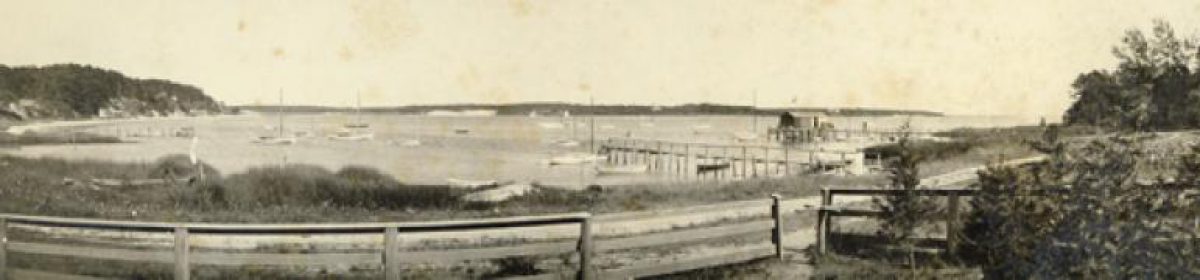
The Crocker Pier, c. 1910 by Edward Darley Boit
The new owner wants to move the two-and-a-half story structure to the field to the north where the former farm’s grand barn stood until it was demolished in 2017. On Tuesday, August 19, 2025, at 4 PM, the Barnstable Historic District will conduct a public hearing on the following application:
“Popolo, Joseph Victor Jr. TR, 49 Putnam Avenue, Cotuit. Map 036, Parcel 004001, Built 1783 Partial demolition & relocation. Demolish the ells of existing dwelling. Relocate the dwelling to the parcel across the drive owned by the same over or to 555 Main Street, Cotuit.”
The application, filed on behalf of the owners by Jennifer Birnstiel of the Plymouth, MA firm of Archiplicity, LLC (dated April 17, 2025) is addressed to Ben Haley, National Register Director of the Massachusetts Historical Commission and states the reason for the move is:
“The move of the structure is being proposed to create a better connection between the owners existing home on an adjacent property and the outdoor living space. This move will create a better visibility for The Ebenezer Crocker Jr. house in the Town making it a more prominent landmark. The current house location is not visible from the street. It is located on a turn and shrouded by trees. The new location is an adjacent grassy field of the same original property where the structure of the original barn once stood.”
The letter further states under the heading of “Appropriateness of the New Setting:”
“The new site is adjacent to the existing house location. The property was originally one property and was divided at a later date into separate lots. The move of the house will have no affect on the historical significance of the property as it was originally a singular property. The move is wholly appropriate as the current building location and the proposed were originally the same property. The visibility in the field adds to the visibility of the property as a whole.”
Under the heading of “Impact on Historic Significance,” the architect states:
“The Ebenezer Crocker Jr. House will continue to be located on the original property which was historically one and will remain adjacent to the buildings in the original listing (The Ropes Ice House c 1851 and the Ropes Workshop c. 1855). There is therefore no impact as the listing will remain constituent to the current listing with the joined properties.
“The building will be moved and relocated on a concrete foundation. We will repurpose stones from the original barn as part of the new foundation. In this regard the building shall still be considered eligible for retaining its National Register Historic status.”
It should be noted that the property that the owner wishes to move the house onto has been under a conservation restriction (Barnstable County Registry of Deeds, book 12934 page 41) since 2000:
“The purpose of the Restrictive Covenant is to assure that the Restricted Area will be retained in perpetuity predominantly in its natural, scenic, and open condition and to prevent any use of the Restricted Area that will significantly impair or interfere with the conservation values of the Restricted Area. The public benefits resulting from conservation of the Restricted Area include, without limitation: protection of a field, that together with the field on the opposite side of Putnam Avenue, preserves the scenic and historical rural character associated with this area of Cotuit for the benefit of the public.”
The conservation restriction may be why the agenda item states an alternative location for the house could be 555 Main Street, Cotuit (north of the driveway to the Cotuit Elementary School).
The late Prof. Jim Gould wrote about the house in the June 29, 2012 edition of The Barnstable Enterprise. A copy is on his blog, where he describes how Samuel Hooper came to own the house and become Cotuit’s first summer resident:
“The story behind the purchase of the house is that Samuel Hooper could find no captain to go to China for him since all had gone off to California. He heard there might be an available captain in Cotuit, and approached the postmaster Captain Alexander Scudder. Captain Scudder was attracted by Mr. Hooper’s generous offer to take a ship to China but asked who would take care of his house and farm. Mr. Hooper paid for the farm and house, and became the first summer resident of Cotuit, and perhaps of Cape Cod.”
Samuel Hooper, Cotuit’s first summer resident
The Barnstable Historic Commission will meet on Tuesday, August 19th at 4 PM in the Selectmen’s Conference room on the second floor of Town Hall, 367 Main Street, Hyannis. The application concerning 49 Putnam Avenue is last on the agenda.
The 75-page filing submitted to the Commission can be read online.
The Historical Society of Santuit and Cotuit’s monograph about “The Crocker-Hooper-Lowell-Ropes House 1793-1957” is below.