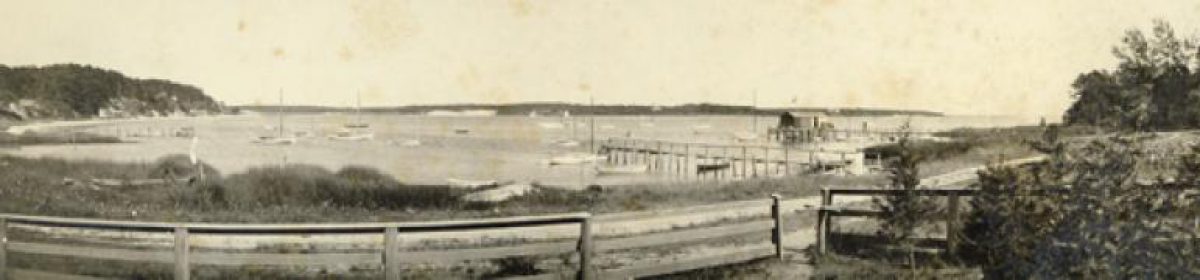

Every afternoon the dog appears beside my desk and starts nudging my thigh with his snout. His daily walk along the shore is all that matters to him. It makes all the difference between a dismal and a joyous dog day. Deny him and he mopes around all evening, casting hurt looks from beneath the dining room table. But if the tide is right and I’m not on deadline, I usually accede and heave myself out of my chair and out the door with a tennis ball hidden in my pocket and a wriggling schnauzer taut on the end of his leash.
We walk down Old Shore Road, taking our time so he can micturate on every pole and interesting looking tuffet, kicking up a flurry of dead leaves in satisfaction, obsessing on patches of ivy that are, to him, the canine equivalent of catnip. An embarrassed poop by the boat ramp, dutifully collected in a green bag for depositing in the poo bin at Hooper’s Landing, and we proceed at a good clip to cross the marsh on the arched footbridge, pausing to sniff the reeds and hispid bank of mussels poking out of the peat.
Across the yacht club beach, stopping to drop off the warm bag of dog doo I prefer to call a “Cotuit Handwarmer,” the leash is unclipped, the ball is fished out of my pocket, and the real joy begins. I huck the ball down the berm and he sprints after it, grabbing it, shaking it, then carrying it above the wrack of the high tide line to hide it in the tick infested spartina grass.
We amble along the gentle curve of the cove, beneath the sagging bluff, walking on a beach with a twinge of guilt that has lingered since the 1960s when it was strictly forbidden to ever walk there because mean Mrs. Ropes forbade the yacht club sailors from taking the shortcut to Harriett Cabot’s finger pier. Past the dark combe and its steps to Mrs. Cabot’s former home, a refuge where a shy great blue heron spends the winter, leaving its pterodactyl foot prints on the sand and occasionally squawking its coarse complaint if the dog and I disturb its solitude.
The dog loses interest in the ball and roots along the base of the bluff, peeing on the collapsed black locust trees that fell during a fierce southerly gale on a king tide a few falls ago.
The walk ends at Little River, the stream that connects Cotuit Bay to Lovell’s Pond, wending through the woods and a buggy saltmarsh beside Handy Point and the quaint hamlet arrayed around the Cotuit Oyster Company. At the turnaround beside the sluggish steam the dog approaches for a pat on the head and some kind words before we head back home.
In the mud on each bank of the “river” pokes two parallel row of old cedar posts. Someone, sometime, more than a hundred years ago, built a footbridge over the river to spare the inhabitants of the house on Handy Point from walking the long way around on Old Post Road and up Putnam Avenue beside the cemetery to get to the village of Cotuitport. Did Mary Nickerson Handy, widow of James Harvey Handy, use that bridge to visit the stores in the village in the middle of the 19th century? Or was it built after she sold the house and moved to the center of the village at the end of the Civil War?

There are no pictures of the bridge, just the salt-preserved caries of the cedar posts on either side of the stream near a granite post that evidently marks a corner of the old Handy homestead. Yet there was a footbridge there until the 1930s at least, probably destroyed in either the hurricanes of 1938 or 1944.

The house on Handy Point was owned by Mark Antony deWolfe Howe, the Pulitzer-prize winning biographer and assistant editor of The Atlantic Monthly. His daughter Helen Howe wrote a memoir of the family’s summer life in Cotuit in her 1965 book, The Gentle Americans. In a chapter entitled; Cotuit — The Calm of the Oyster Beds, she describes the bridge and one of its users, Harvard President Abbott Lawrence Lowell:
“President Lawrence Lowell of Harvard manifested himself on our children’s horizon in the shape of a periodic Sunday afternoon call. We would sight him approaching on foot, across the tiny wooden bridge that spanned Little River, in his Sunday blue-serge suit, low stiff white collar, and large-bowed bow tie, head under its white leghorn hat bent forward, and leaning on his tall, rough wooden staff that would have done credit to Wotan. He was followed by his reigning cocker spaniel whose trademark was a waving plume of unclipped tails — first Mowgli, then Phantom — and by his wife (who was also his second cousin), Anna Cabot Lowell Lowell.”

A. Lawrence Lowell, 1935 -by Lawrence Wills Baker
The Howes and the Lowells were good friends. Mark deWolfe Howe accompanied Lawrence Lowell to the Brahmin’s woodlot on Canaumet Point on Mashpee-Wakeby Pond, where they would chop wood for exercise in the morning. Lowell, who died childless in 1943, bequeathed the 135 acres in Mashpee to the Trustees of Public Reservations, where it is known today at the Lowell Holly Reservation. During the summer, the Lowells and the Howes would dine together at least twice — Once at Lowell’s mansard mansion atop Lowell Point, once chez Howe on Handy Point — each couple walking the half-mile of shoreline and crossing the footbridge if the tide was low enough to permit them to. On Sundays, both families worshipped at the Federated Church, for “They all felt they owned it to the community to “stand for” churchgoing.” After the services, still wearing “his Sunday blue-serge suit,” Lowell would walk to Handy Point with his wife (and second cousin) Anna to spend the afternoon conversing with the Howe’s.
Helen Howe recalled, “As for dinner parties — once a summer Mother and Father walked along the beach at low tide, or through the woods at high by the light of an electric lantern, to dine with the Lawrence Lowells approximately a mile away; and once a summer the Lowells dined with them.”

Mark Antony deWolfe Howe, portrait by Polly (Ethel) Thayer
In the early 20th century Cotuit was then known as the “Summer Harvard” because Lowell had attracted, like a social magnet, a coterie of professors who came to Cotuit because, as Helen Howe wrote, “There was no club at Cotuit — yacht, country, or golf; there were no cocktail parties and no lunch parties.” The absence of anything other than catboat sails over the oyster beds of Cotuit Bay and the chopping of wood in Mashpee was prized by the professors, who wanted their children out of their hair while they spent their summer vacation working on their next academic paper or book,
“Of all the inhabitants of Cotuit who passed the summer months in a state bordering on somnambulism only two groups were active: the small children and the Harvard professors. Each professor had his own little shed or shanty in which he spent many hours a day absorbed in his own particular scholarly pursuit. President Lowell called his “The Caboose.” – Helen Howe
Today there are no Howe descendants living in Cotuit (that I know of), but the Lowell name continues to live on in the village the clan adopted as its summer home for generations, giving the village its ball park, library, and park.
