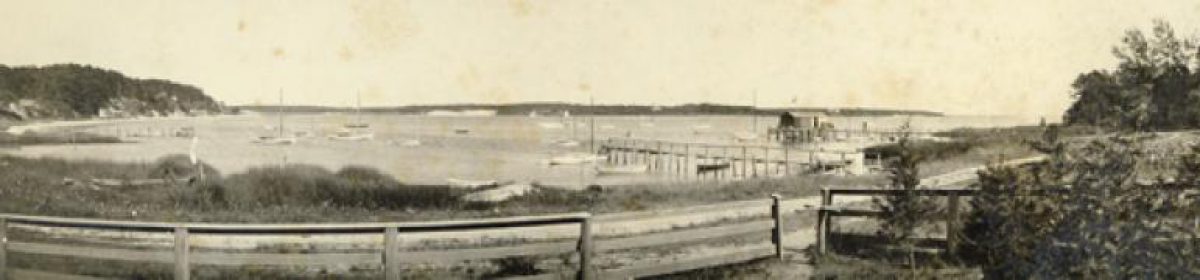
Photo by The Register, 12/86 In December 1986 the Cotuit Inn was demolished to make way for ten new condominiums. The building came down despite the best efforts of a group of villagers who banded together as the Cotuit Inn Appeal Group who hired a lawyer to challenge the Zoning Board of Appeals’ approval of … Continue reading “The Struggle for Historic Districts in Cotuit: Lessons Learned”
Photo by The Register, 12/86
In December 1986 the Cotuit Inn was demolished to make way for ten new condominiums. The building came down despite the best efforts of a group of villagers who banded together as the Cotuit Inn Appeal Group who hired a lawyer to challenge the Zoning Board of Appeals’ approval of the project. Ultimately the permit to convert the 150-year old inn into residential apartments was upheld by Barnstable Superior Court and finally, by the state Appeals Court. When the building was found to be in disrepair with no viable foundation, the demolition was approved.
That battle to save the old inn kicked off a movement in the village to preserve Cotuit’s remaining open space and historical character. It was a movement of both conservation and preservation that sparked the founding of the Barnstable Land Trust, and the saving of Crocker Neck and Bell Farm. It also inspired the political activism of several villagers, four of whom went on to represent Cotuit on the newly formed town council. It also sparked an effort in 1987 by local historians to inventory Cotuit’s historic homes and place them on the National Register of Historic Places.
The threatened loss of the inn also revived the moribund Cotuit-Santuit Civic Association.
In April 1985, the Barnstable board of selectmen appointed seven members to a Cotuit-Santuit historic study committee. In all probability that study committee was the basis of the 1987 inventory of the village’s historic homes that led to their inclusion on the National Register of Historic Places. The members were:
Paul Noonan, chairman
Paul Grover, representing the Cape Cod Board of Realtors
Harriet Ropes Cabot. a professional architectural historian
Frederic Claussen, Barnstable County Registrar of Deeds
Anne Lloyd,
Beatrice K. Williams, president of the Historical Society of Santuit and Cotuit
Henry Walcott, former president of the HSSC
John Klimm was the board of selectmen’s representative to the committee.
In July of 1986, the Barnstable Patriot reported the board of selectmen had “renamed…members of the Cotuit Historic District study committee.” The outcome of that committee’s work is unclear. It was the first of many historic study committees to take a swing at persuading the village of the benefits of a Local Historic District.
1991
The purpose and fate of the 1986 group is unknown but in July of 1991 the town council approved the formation of a new Cotuit local historic study committee:
The Register, August 1, 1991 p. 9
1992
Less than a year later in March, 1992, at a public meeting convened at Freedom Hall, the study group, chaired by Edson Scudder, went down in flames when “A straw vote held at the end of the evening to give an indication to the amount of support, or lack of, gained all but a few opposed and no more than five registering in favor.”
Carol Lyall, a member of the study committee said, “If it’s going to create divisiveness in the community, it’s not going to go much further … the study committee isn’t interested in fighting it out.”
The Patriot wrote that the formation of the study group was “based on a positive response to a 1988 survey indicating a desire for the formation of a historic district.” Later the paper would report the initiative failed because “no guidelines were prepared and people had no idea what was being considered.
The village’s two town councilors — Jaci Barton and Paul Noonan — were split on the idea (Barton for/Noonan opposed), leading the Patriot to write: “With the two from Cotuit cancelling each other out, the decision would be left to other councilors not associated with the village.”
1993-1996: The study group regroups
After quickly going down in flames in 1992, the historic district study group added new members, “two of whom had been very opposed to the initial presentation.” In 1993 the revived study group convened a similar public meeting, one that “met with a much more favorable response…..paving the way for the study committee to draft up formal guidelines for a district” (BP 1996.08.01).
In 1995, the study committee seemed to be making progress. The Patriot’s David Still II wrote on January 19, 1995: “In stark contrast to the overwhelming opposition voice to the idea three years ago, the give and take at the Santuit/Cotuit Civic Association on a proposed historic district for that village raised concerns that the study committee had not gone far enough.”
“The plan discussed Tuesday night focused on the village center and left untouched the Route 28 corridor, which many in attendance at Freedom Hall considered a major oversight.”
Around this time I was named to the study group, invited to join by Jim Gould.
In 1996 the study committee held two public meetings. Committee member Carol Lyall told the Patriot, “that there were three general attitudes toward the district: those who want it, those who agree with the concept but have concerns about the details, and those against it.”
The committee created some literature about the proposal, trying to head off some of the most hot-headed opponents by saying a district would increase property values, decrease the involvement of the Cape Cod Commission on historic issues, and place control of the village in the hands of the villagers.
Because one opponent had stood up at a public meeting and defiantly proclaimed he’d paint his house pink just to exercise his First Amendment right to free expression, the committee’s literature stated:
Our concern isn’t if a house is painted pink or where the tulips are planted, but what happens to a house when it changes hands. For that’s when houses get torn down.”
Then your’s truly gets quoted by the newspaper talking out of both sides of my mouth:
Committee member David Churbuck, who was opposed to the historic district concept back in 1993, said that the issue of houses being torn down seems to be one of the major issues. On whether or not a historic district comes to pass in Cotuit, Churbuck says he remains ambivalent, but he is reserving judgement on the proposed guidelines until he has more of an opportunity to discuss them with his fellow committee members.
Barnstable Patriot, August 1, 1996, page 8
A week after that story was published — in the August 8, 1996 edition of the Patriot — came the news that the study committee had pulled the plug on the idea and was disbanding.
Barnstable Patriot, August 8, 1996
The Aftermath
With no Local Historic District, the village has depended on the Town of Barnstable Historical Commission and the Cape Cod Commission to preserve the village’s historic homes. The results have been mixed.
Cotuit Parsonage
In 2005 the Cape Cod Commission approved the demolition of the first Cotuit Parsonage, built in the early 1800s (located across the street from the Historical Society of Santuit and Cotuit at 1151 Main Street), after the Souza family made the case for a hardship exemption to demolish the structure due to the deleterious impact of moisture trapped by vinyl siding. Both the town and the CCC approved the request with the request that the new building conform to mid-19th century architectural styles.
Hezekiah Coleman House
In 2006, the Hezekiah Coleman House at 756 Main Street (across from the east end of Coolidge Lane), was declared a “development of regional impact” by the Cape Cod Commission. The original building was mostly demolished. The CCC’s decision is worth reading to gain a sense of what factors the Commission takes into account when handling a demolition or major renovation of a building listed on the National Register of Historic Places.
Located at 35 Little River Road, this classic example of a Cape was slated to be demolished in 2009, but after a six-month demolition delay was imposed by the Barnstable Historic Commission, the house was saved by the new owners.
Bonnie Haven
In 2012, the new owners of “Bonnie Haven” applied for a permit to demolish the former home of whaling Captain Seth Nickerson. Jr., preferring to build a contemporary home overlooking Nantucket Sound.
“BONNIE HAVEN Barnstable Historical Commission has received an application to demolish a Cotuit landmark known as Bonnie Haven, one of the last surviving homes of Cotuit whaling captains. Bonnie Haven is on lower Main Street below Loop Beach, overlooking Nantucket Sound. It was built in 1837, probably by the village housewright Quaker Samuel Dottridge, whose home houses the Historical Society of Santuit and Cotuit. At the core, Bonnie Haven is a classic Cape Cod cottage, which was expanded to accommodate the growing family. The well-preserved house is an excellent survival of vernacular architecture of the early nineteenth century.”
It appears the buyer of the property reconsidered demolition in the face of village opposition and went before the Historical Commission with a plan to move the old building elsewhere on the property.
The caption of a August, 3, 2012 Barnstable Patriot photo of then-chairperson Jessica Rapp-Grassetti holding a photo of the building reads :
The buyer in a purchase and sales agreement sought a certificate from the commission to demolish the house, but returned to the board on July 30 with a plan to save a major portion and relocate it on the same site, where it would be more visible from the road, and use it as a guest house. The buyer plans to build a new house on the original site, and the separation of the longstanding home from its original location saddened some members. Others appeared to consider it an acceptable compromise.
The future
I doubt Cotuit can ever enact a local historic district, even one crafted with the most lenient bylaws and standards. Every time the village gets up in arms over a tragedy like the Cotuit Inn, Bonnie Haven, or some other venerable home overlooking the water, the same question gets asked: “Isn’t there anything we can do?”
A lot of people have tried to do something and weren’t capable of enacting a local historic district. That’s not say the village is powerless. When neighbors fought the Harborview Club pier in the 1960s, they succeeded in having the 150-foot pier demolished. A few years later, when the village fought the Sobin pier, it failed and the pier was built. After that fiasco, the late Rick Barry — Cotuit’s former town councilor — battled the pro-development/real estate lobby and was able to impose a dock-moratorium (zoning overlay) over much of Cotuit’s shoreline. That didn’t stop a waterfront property owner from trying to build a new one, but that effort was blocked.
The demolition of the Cotuit Inn was the match that ignited a wave of pro-preservation/pro-open space conservation in the village. The good that came out of that tragedy in the mid-1980s was that it did a huge amount to preserve Cotuit and led to the formation of the Barnstable Land Trust, the saving of Crocker Neck, and revival of the civic association.
So why did the historic district study committees fail over the past 40 years? I think several factors doomed the efforts. None of which are unique to Cotuit because remember, Centerville also tried to enact a local historic district in the 1990s and the study group also backed off in the face of opposition. In its place Centerville persuaded Cape Cod Commission to declare the village a District of Critical Planning Concern (DCPC) and slapped a total moratorium of new development.
Local historic districts have a bad reputation as a bureaucracy of picky neighbors empowered to judge paint color, lighting fixtures, and landscaping. They can turn into imperious fiefdoms. On the positive side they are very effective in preserving historical culture and put prospective buyers on notice that they will have a fight on their hands if they decide they’d like a skylight on their roof.
The 80/20 rule. I would estimate 70 to 80% of the people in Cotuit who would be affected by a historic district — those of us who actually live in old houses — would be in favor of some bylaw that would deter new arrivals from tearing down antiques to they can build something better suited to New Seabury or the Hamptons. The killers of the concept are the vocal 20 percent who oppose any new government regulation as a violation of their god-granted libertarian rights to do whatever they want. Cotuit is too nice. In the mid-90s we could have restricted public comment to only those people affected by the proposed district, but instead we were inclusive and tried to achieve a village-wide consensus that was impossible to reach.
The power of a Real Estate Economy. The Cape’s year-round economy is dominated by the building trades and a broad web of realtors, attorneys, architects, engineering firms, banks, lumberyards, surveyors, house cleaners, landscapers, septic installers — all who need to make a living in a saturated market. Ever wonder why a dozen landscaping trucks are parked on the village sidewalks every Friday afternoon making you slalom around them praying you don’t take out a dog walker or a kid on a bike? If there are no new houses to build, then you put down your hammer and pick up a leaf blower. If you can’t build on open land, then tear down an existing home and build a new one.
Growth is Good and infinite. The town is a business that benefits from rising property values, transaction fees, and the cascade of cash from beach stickers, dump stickers, dinghy stickers, mooring stickers that help the town avoid Proposition 2 1/2 overrides…… Realtors want inventory. Now that the Rape the Cape era of subdivisions is finished, we’ve entered the Teardown Era as the affluent are priced out of Martha’s Vineyard, Nantucket, the Hamptons and have come to Cotuit looking for a waterview where they can build a trophy temple to their success. Now that the era of quarter-acre subdivisions is over, expect the town to bless more and more four-story grey apartment/condos. Town leadership has a tradition of selling its soul for revenue. The notion that we’ve reached capacity offends them.
All things must pass. Not to be a nihilist, but very few houses last forever, and of those that do, who would want to live in one? Ever visit the Hoxie House in Sandwich (c. 1675) or tour the Richard Sparrow House in Plymouth? (1640) and think “Wow, what an awesome pad! I wish I lived here”? I live in a house that is nearly two centuries old and it looks nothing like it did in 1830. It’s been added on and modified to the point where the original house is almost completely concealed by dormers, wings, bay windows, outdoor showers, decks, and old boat sheds and sail lofts. Owning it is an honor because my family has owned it since 1860 and I’ll don’t want to be the guy who sells it or tears it down. I’m a caretaker more than an owner. The floors creak, the roof leaks, but it’s my heritage and I’m proud of it. I would never presume a new arrival in the village to move into a house of similar vintage to have the same irrational reverence for the past that I do. Central air and new appliances, like modern dentistry, are good things.
In closing, change is constant and inevitable. We’re a village filled with old houses that were dismantled in Nantucket and reassembled here. The norm in Cape Cod architecture is to keep adding on and on. Cotuit hasn’t changed as much as most of the Cape, but change it will.
Sometimes change is for the good, sometimes not. If you want to save something, then say something. Be vigilant and be paranoid. Read the public meeting notices, show up at meetings, send letters, tell other people …. but whatever you do, don’t wring your hands for the good old days and expect a return to the past. Throw your hat in the ring and get appointed to a town committee. Let the politicians and committee members know your feelings. And every time a house changes hands in the old part of the village, assume the new owner bought it expecting to move it or tear it down. You won’t be surprised when they do.
The proposal to move the Ebenezer Crocker house at 49 Putnam Avenue to a new location has revived questions about what can be done to preserve the unique historical character of Cotuit and what regulations are now in place to protect the village’s old homes.
Here’s the bottom line:
The National Register of Historic Places (49 Putnam Avenue is on the register) is mainly a honorary designation and generally applies protection when federal funds, licenses, or permits are involved. None of those conditions apply to 49 Putnam.
If a building permit is requested from the town of Barnstable to demolish, move, or renovate a structure 75 years or older, it automatically gets referred to the town’s seven-member Historical Commission which can order an 18-month “demolition delay” during which time a way might be sought to save a threatened structure either by persuading the owner not to proceed, or to move the structure to a new location.
If a project involves the demolition or substantial alteration of a building listed on the National Register, then it must be referred to the Cape Cod Commission as a candidate to be reviewed and designated a “Development of Regional Impact” (DRI). The project is reviewed in light of the Regional Policy Plan, which sets out the standards for protecting historic buildings, landscapes, and archaeological resources. The Cape Cod Commission has the authority to block or modify the demolition or alteration of historic structures.
The strongest level of protection to preserve old houses is a Local Historic District (not to be confused with the Cotuit Historic District listed on the National Register). These are districts established under Chapter 40C of the state’s housing laws, with their own regulations and review board. They are unpopular due to their reputation of being overly strict and fussy. Cotuit attempted to create such a district in the mid 1990s but neighborhood opposition killed the plan. The Old King’s Highway District that covers Route 6A from Sandwich to Brewster, is an example of a Local Historic District. Nantucket, Beacon Hill, Concord …. are some other notable examples. There are more than 200 local historic districts across the state. If Cotuit had enacted such a district, then the 49 Putnam Avenue proposal could be denied without the involvement of the town Historical Commission or the Cape Cod Commission.
The National Register of Historic Places
First, a little history lesson into historical preservation. The Federal Historic Preservation act of 1966 was enacted when urban renewal and other federally funded projects were erasing important historic landmarks. A great example of why the act was passed was the extension of Route 18 in New Bedford in 1963 which obliterated much of that city’s historic waterfront. The Preservation Act established the National Register of Historic Places, the official federal list of “sites, buildings, structures, districts, and objects deemed worthy of preservation for their historical significance or great artistic value.”
There are over 1.5 million properties on the National Register. Of those, 95,000 are listed individually and the rest are contributing resources within historic districts. The National Park Service administers the register. Inclusion on the register does not guarantee protection as it places few if any restrictions on what a private property owner can do with their property, up to and including demolition.
The Massachusetts Secretary of State oversees the Massachusetts Historic Commission (MHC) which inventories historic properties within the Commonwealth and acts as the state-wide arm of the National Park Service. The MHC reviews properties submitted for inclusion on the National Register. Submissions follow an inventory format that are created by local historic commissions, historical societies, and volunteers.
Cotuit was the subject of such an intensive inventory effort in the 1980s led by the late Professor James Gould, the Town of Barnstable Historical Commission, and several volunteers who catalogued over 100 properties. That led to the creation of the Santuit and Cotuit Historic Districts, both of which are listed on the National Register of Historic Places.
As of now, the following houses/properties in Cotuit and Santuit are listed in the National Register of Historic Places. Keep in mind there are two “historic districts” — Santuit and Cotuit — that encompass a large number of historic homes. Santuit encompasses eight homes along Route 28 in the original colonial settlement; the Cotuit district includes 107 buildings, “and encompasses the areas historically known as Cotuit Port and Cotuit Highground. Boundaries were selected to encompass the areas of densest 19th century development, when this part of Cotuit assumed the leading village role from the inland area of Santuit.”
The listing for the Santuit Historic District states: “The boundaries for the Santuit Historic District include 8 buildings, 2 of which are modern and non-contributing. The boundaries were selected to encompass the remaining dwellings of the important Santuit family, the Crockers.”
Cotuit’s seven stand-alone listings on the National Register are structures that fall outside of the two districts.
Cotuit Historic District, defined as “Main St., Lowell & Ocean View Aves. bounded by Osterville Harbor, Nantucket Sound, & Popponessett Bay”
The Town of Barnstable Historical Commission is a seven member board (one alternate) appointed by the Town Council. Its powers are defined by Section 241-22 of the town bylaws. Any application to demolish, modify, or renovate a historic structure (older than 75 years) is submitted by the building department to the BHC who convenes a public hearing to either grant or delay the proposed changes.
“The Historical Commission surveys and compiles a listing of all historical sites and buildings within the Town, public and private; determines the functions and structures of all historical organizations within the Town; and holds correlative seminars with historical organizations. It further determines the requirements for repair, reconstruction, and protection of historical landmarks and assists and cooperates with public commissions in the conduct of public historical events. The Historical Commission is an advisory committee of the Town.”
The town bylaws governing “Protection of Historic Properties” (Section 112) states “This article is enacted to promote the public welfare and safeguard the Town’s historical, cultural and architectural heritage by protecting historical resources that make the Town a more interesting, attractive and desirable place in which to live. This article aims to protect and preserve historic properties within the Town by encouraging their owners to seek alternatives to their demolition and by providing the Town an opportunity to work with owners of historic properties in identifying alternatives to their demolition.”
The Town Historical Commission defines a “significant building” as:
Any building or portion thereof, which is not within a regional historic district or a local historic district subject to regulation under provisions MGL c. 40C but which has been listed or is the subject of a pending application for listing on the National Register of Historic Places, or has been listed on the Massachusetts Register of Historic Places, or is over 75 years of age and which is determined by the Commission to be a significant building as provided by § 112-3D of this article, either because:
A. It is importantly associated with one or more historic persons or events, or with the broad architectural, cultural, political, economic or social history of the Town or the Commonwealth; or
B. It is historically or architecturally important (in terms of period, style, method of building construction, or association with a famous architect or builder) either by itself or in the context of a group of buildings.
The by-law goes on to state that if the Historical Commission determines an applicant’s notice of intent to demolish a significant building “would be detrimental to the historical, cultural or architectural heritage or resources of the Town, such building shall be considered a preferably preserved significant building” then:
Upon a determination by the Commission that the significant building, which is the subject of the application for a demolition permit, is a preferably preserved significant building, the Commission shall notify the applicant, the Building Commissioner, and the Town Clerk, and no demolition permit may be issued until 18 months after the date of such determination by the Commission is filed with the Town Clerk.
The Cape Cod Commission
The Cape Cod Commission has a mandatory “development of regional impact” (DRI) review for any proposed demolition or “substantial alteration” of a building listed in the National Register of Historic Places or the State Register of Historic Places. 49 Putnam Avenue qualifies for mandatory Commission review.
Referral to Cape Cod Commission, if necessary:
In cases where the Historical Commission finds a proposed project constitutes a “substantial alteration,” or when full demolition of an historic building is proposed, the building inspector/commissioner or other appropriate municipal agency (including the select board/town council) shall refer the project to the Cape Cod Commission for mandatory DRI review. In these cases, the DRI review will be limited to issues related to the “cultural heritage” goal of the Regional Policy Plan (RPP).
The Cape Cod Commission, once it takes over the review of the proposal from the town Historical Commission, can designate it a development of regional impact. The Commission’s enabling legislation grants it the following powers over a DRI:
The commission may approve, approve with conditions, or disapprove the development of regional impact. If the commission disapproves the development of regional impact no further work may be done on the development. A development of regional impact which has been approved, or approved with conditions shall be valid and effective, and municipal development permits may be issued pursuant thereto for seven years following the date of the written determination.
What’s next?
On August 19 the Town of Barnstable Historic Commission voted unanimously to impose an 18-month demolition delay on 49 Putnam Ave.
Chairman Robert Frazee noted in his time serving on the commission he could think of no project which received as many letters of opposition as 49 Putnam (39) with no indications of support.
After hearing from the applicant’s architects and taking testimony from more than a dozen concerned Cotusions, the commission voted to impose the 18-month delay and refer to the application to the Cape Cod Commission for its review as a possible Development of Regional Impact (DRI) .
The criteria for referring a project for DRI review varies, but the CCC’s regulations specifically call out as mandatory “any proposed demolition of substantial alteration of an historic structure listed with the National Register of Historic Places or the Massachusetts Register of Historic Places, outside a municipal historical district or outside the Old Kings Highway Historic District.”
Because 49 Putnam meets that criteria, the Barnstable Historic Commission was bound by law to send a mandatory DRI referral form by certified mail or hand delivery to the clerk of the Cape Cod Commission.
Once the clerk receives the referral, “the Commission may, at a meeting, accept the referral for review as a development which may have regional impacts and which presents one or more of the concerns listed in Section 12(b) of the Act. The Commission may delegate to its regulatory committee, the Executive Director, or to the Commission Staff the responsibility to meet and make a recommendation to the Commission as to whether the Commission should accept a discretionary referral.“
The Cape Cod Commission is required to conduct a public hearing within 60 days of receiving the DRI referral from the town. [As of August 25, 2025 such a hearing has not appeared on the Commission’s online calendar.] The official page for CCC meeting notices is https://www.capecodcommission.org/meeting-notices/
Written comments may be submitted by mail to the Cape Cod Commission, P.O. Box 226, 3225 Main Street, Barnstable, MA 02640 or online using the form located at https://capecodcommission.org/comment
Documents submitted to the Commission for its review of the project as potential Development of Regional Impact will be archived and available to the public.
When all is said and done, the Commission “may disapprove the development of regional impact. If the commission disapproves the development of regional impact no further work may be done on the development.”
In the future I’ll write about the effort led by the late Professor Jim Gould in the 1990s to establish a Local Historic District in Cotuit.
On Tuesday, August 19, at 7 PM, at the Cotuit Federated Church’s Hamilton Hall, the Cotuit Santuit Civic Association and the Cotuit Fire District Board of Water Commissioners will host (as part of the civic association’s annual meeting) a panel discussion with five experts on the topic of wastewater management in Cotuit.
Last spring the board of water commissioners asked the civic association to convene the forum to build awareness of the issues, technologies, and deadlines surrounding the complex topic of wastewater management.
The panelists are:
Zenas “Zee” Crocker, Executive Director of the Barnstable Clean Water Coalition and a member of the Town of Barnstable Comprehensive Wastewater Management Plan Ad Hoc Committee
Scott Horsley, Cotuit Fire District Water Commissioner and Chair of the CWMP Ad Hoc Committee
Anastasia Rudenko, water resources engineer at the civil engineering firm GHD
Rob Steen, Assistant Director of the Town of Barnstable Department of Public Works
Sara Wigginton, deputy director of the wastewater division and program manager at the Massachusetts Alternative Septic System Test Center
We hope to answer questions such as:
What is driving the issue of wastewater treatment?
How will the changes made in 2022 by the state department of environmental protection to the Title 5 septic regulations affect Barnstable and Cotuit?
Where does Cotuit stand in the town’s Comprehensive Wastewater Management Plan?
Is Cotuit ever likely to see a municipal sewer system?
What are the available options, benefits, drawbacks, and costs of: sewer, I/A septic systems, satellite or “cluster” wastewater treatment, urine diversion, composting toilets or other solutions?
Which of these options will protecting the drinking water supply; reduce nutrient contamination of the estuaries and ponds?
What are some short term solutions for wastewater pollution? What actions can we take now to reduce contamination?
In 1957 the Santuit-Cotuit Historical Society circulated a petition to change the name of “East Main Street” to “Old Shore Road” and “inasmuch as Samuel Hooper gave the land to the town in the early 1800s, that the name of “Hooper’s Landing” be restored in that the present sign of “Ropes Beach” This to be presented to the Selectmen of Barnstable for the 1958 town meeting.”
Barnstable Patriot July 25, 1957.
In March of the following year, 1958, at the annual town meeting of the Town of Barnstable, the Patriot reported:
“Adopted [was…] Article 113, which changes the name of East Main Street in Cotuit to Old Shore Road and of Ropes Beach in the same village to Hoopers Landing.
“The meeting was told that these changes “to keep the old salty flavor” were desired by the Cotuit Historical Society and had been approved by a majority at a meeting of the Santuit-Cotuit Historical Society.
“Opponents argued that to change the name to “Old Shore Road” would be to encourage tourists to drive down along the waterfront and create a traffic hazard to the many small children in the beach area.”
I guess someone forgot to tell the town DPW’s sign czar that it ain’t “Ropes Beach” but has officially been “Hooper’s Landing” since 1958.
In 1970, Mrs. Nita M. Crawford, curator of the Historical Society of Santuit and Cotuit wrote the editor of the Barnstable Patriot to correct his reference to the public beach at the landing as “Ropes Beach” (after the Ropes family who lived there in mid-20th century, not because of the floating rope corral the once delineated the swimming area before the town gave up on the beach and let it turn into a muddy mess).
“Dear Mr. Hornig,”
I have read with great interest your article “Cotuit’s Beach Needs” (Aug. 27 issue). This was a subject that my late husband. Calvin D. Crawford, was deeply interested in. It is to be hoped that you will have started the ball rolling and that now real positive work will start.
Now I must tell you that you should say “Hooper’s Landing” (sometimes called “Ropes Beach”).
The present Ropes house was purchased in 1849 by Samuel Hooper of Boston along with much land even into Little River. At his death in 1874 he left the beach below this house to the Town of Barnstable. Then it was called “Hoopers Landing.”
However the house, which had changed hands several times, was finally willed to Prof. and Mrs. James Ropes in 1898. The beach then began to be called “Ropes Beach.”
At the March 1958 town meeting a petition was presented to change the name of East Main Street to Old Shore Road and Ropes Beach back to the original name of Hoopers Landing. This was so voted and the sign names changed.
As a Historical Society we like to keep to the old original names. I hope you understand.
One of the oldest and most prominent homes in Cotuit is the Ebenezer Crocker house that has presided for close to 250 years over the bay above Hooper’s Landing on the curve at 49 Putnam Avenue since 1783. The house was built that year by Ebenezer Crocker, Jr., descendant of the colonial Crocker clan who founded Cotuit. In 1849 it was bought by Samuel Hooper, the village’s first summer resident. Hooper and his descendants lived there and entertained prominent guests such as Harvard historian Henry Adams (grandson of President John Quincy Adams), Hooper’s niece: the pioneering photographer Marian “Clover” Hooper Adams, U.S. Senator and abolitionist Charles Sumner, and a parade of prominent political and cultural figures of the late 19th and early 20th century.
Below the property, on the shoreline, Ebenezer Crocker built the first pier on the shores of Cotuit Port. It was a “crib pier” located adjacent to the present dock of the Cotuit Mosquito Yacht Club. There Ebenezer’s son, Braddock Crocker, built a small shop that served the growing fleet of packet sloops that departed from the cove bound for Edgartown and Nantucket.
The Crocker Pier, c. 1910 by Edward Darley Boit
The new owner wants to move the two-and-a-half story structure to the field to the north where the former farm’s grand barn stood until it was demolished in 2017. On Tuesday, August 19, 2025, at 4 PM, the Barnstable Historic District will conduct a public hearing on the following application:
“Popolo, Joseph Victor Jr. TR, 49 Putnam Avenue, Cotuit. Map 036, Parcel 004001, Built 1783 Partial demolition & relocation. Demolish the ells of existing dwelling. Relocate the dwelling to the parcel across the drive owned by the same over or to 555 Main Street, Cotuit.”
The application, filed on behalf of the owners by Jennifer Birnstiel of the Plymouth, MA firm of Archiplicity, LLC (dated April 17, 2025) is addressed to Ben Haley, National Register Director of the Massachusetts Historical Commission and states the reason for the move is:
“The move of the structure is being proposed to create a better connection between the owners existing home on an adjacent property and the outdoor living space. This move will create a better visibility for The Ebenezer Crocker Jr. house in the Town making it a more prominent landmark. The current house location is not visible from the street. It is located on a turn and shrouded by trees. The new location is an adjacent grassy field of the same original property where the structure of the original barn once stood.”
The letter further states under the heading of “Appropriateness of the New Setting:”
“The new site is adjacent to the existing house location. The property was originally one property and was divided at a later date into separate lots. The move of the house will have no affect on the historical significance of the property as it was originally a singular property. The move is wholly appropriate as the current building location and the proposed were originally the same property. The visibility in the field adds to the visibility of the property as a whole.”
Under the heading of “Impact on Historic Significance,” the architect states:
“The Ebenezer Crocker Jr. House will continue to be located on the original property which was historically one and will remain adjacent to the buildings in the original listing (The Ropes Ice House c 1851 and the Ropes Workshop c. 1855). There is therefore no impact as the listing will remain constituent to the current listing with the joined properties.
“The building will be moved and relocated on a concrete foundation. We will repurpose stones from the original barn as part of the new foundation. In this regard the building shall still be considered eligible for retaining its National Register Historic status.”
It should be noted that the property that the owner wishes to move the house onto has been under a conservation restriction (Barnstable County Registry of Deeds, book 12934 page 41) since 2000:
“The purpose of the Restrictive Covenant is to assure that the Restricted Area will be retained in perpetuity predominantly in its natural, scenic, and open condition and to prevent any use of the Restricted Area that will significantly impair or interfere with the conservation values of the Restricted Area. The public benefits resulting from conservation of the Restricted Area include, without limitation: protection of a field, that together with the field on the opposite side of Putnam Avenue, preserves the scenic and historical rural character associated with this area of Cotuit for the benefit of the public.”
The conservation restriction may be why the agenda item states an alternative location for the house could be 555 Main Street, Cotuit (north of the driveway to the Cotuit Elementary School).
The late Prof. Jim Gould wrote about the house in the June 29, 2012 edition of The Barnstable Enterprise. A copy is on his blog, where he describes how Samuel Hooper came to own the house and become Cotuit’s first summer resident:
“The story behind the purchase of the house is that Samuel Hooper could find no captain to go to China for him since all had gone off to California. He heard there might be an available captain in Cotuit, and approached the postmaster Captain Alexander Scudder. Captain Scudder was attracted by Mr. Hooper’s generous offer to take a ship to China but asked who would take care of his house and farm. Mr. Hooper paid for the farm and house, and became the first summer resident of Cotuit, and perhaps of Cape Cod.”
Samuel Hooper, Cotuit’s first summer resident
The Barnstable Historic Commission will meet on Tuesday, August 19th at 4 PM in the Selectmen’s Conference room on the second floor of Town Hall, 367 Main Street, Hyannis. The application concerning 49 Putnam Avenue is last on the agenda.
The 75-page filing submitted to the Commission can be read online.
The Historical Society of Santuit and Cotuit’s monograph about “The Crocker-Hooper-Lowell-Ropes House 1793-1957” is below.