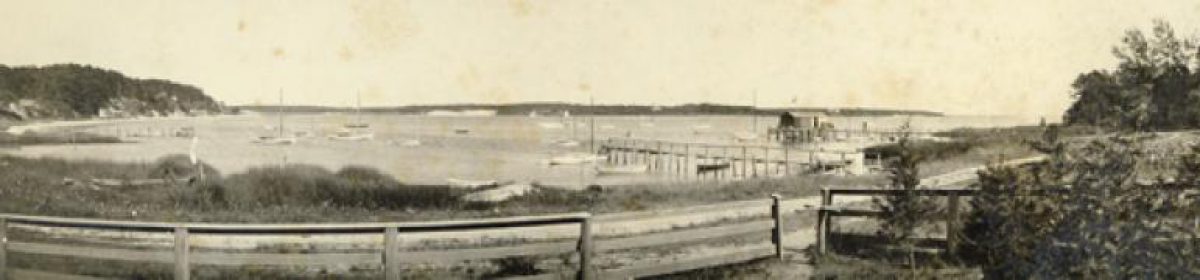
I wanted to put a plug in for Cindy Nickerson’s “Curator’s Corner” in the monthly newsletter of the Historical Society of Santuit and Cotuit. The latest edition, dated February 1, 2026, has a wonderful essay: “Death and Danger at Deep Hole” which explores the history of shipwrecks off of Cotuit in the 19th century.
In the piece, Cindy describes the “Melancholy Death by Drowning” by Captain Oliver A. Nickerson of Cotuit Port in April 1852; the 1867 wreck of the Hannah Martin; and the tragic February 1829 wreck of the Hyannis packet sloop Caroline which went ashore off Cotuit Bay in a snowstorm, forcing her crew ashore on Sampson’s Island where the captain’s sons, 13-year old Ebenezer Scudder and 19 year-old James died of exposure.
Cindy’s fascinating piece is just one of many benefits of membership in the HSSC.
David Hill, Lenovo and IBM’s former head of design and brand identity, and the man who redefined corporate blogging twenty years ago with the late, lamented Design Matters blog, has a new website.
ThinkNextDesign reflects the man’s impeccable design taste and showcases his greatest hits in a graceful gallery of everything from minicomputers to Trackpoint caps for the pointing stick on Thinkpads.
It also revives some of his best writing from Design Matters, the Lenovo blog the two of us reminiscenced about last month with Thomas Rogers, host of the podcast Laptop Retrospective.
Design is far more than form or function. It’s the tangible expression of a brand’s identity, values, and promise. While a brand defines what a company stands for, design gives those aspirations form and substance. Design uniquely delivers value: visually, physically, and experientially.
Bob Weir passed away today (1.10.26) at the age of 78. His Ace album was the soundtrack of one of my favorite summers in the early 70s. Singing “Black-Throated Wind” while hitchhiking back to college through New Bedford on a dismal grey day is a memory to hang onto.
I had a chance to talk with David Hill, the VP of Corporate Identity and Design at Lenovo and the blogger behind Design Matters, Lenovo’s first blog that launched in 2006. Thomas Rogers at Laptop Retrospective invited us to reminiscence about the blog, how it came to be, and the impact it had. The blog was retired when Lenovo took another approach to social media, but lives on for the most part thanks to the Wayback Machine and the Internet Archive.
Thanks to Doc Searls' suggestion at his blog, I'm giving Wordland a spin. Not sure why I need a browser interface to write blog posts when WordPress.com's editor is a) also browser-based and b) seems to work fine, but being a sucker for shiny new things, here goes.
Once and a while some disgruntled Cotusion, frustrated with the perceived misbehavior or indifference of the Town of Barnstable, mutters that it’s time to break away and secede and turn Cotuit into a town of its own. Such seditious grumblings generally fade after a little while and life goes on in the little village on … Continue reading “Secession Movements of Cotuit”
Once and a while some disgruntled Cotusion, frustrated with the perceived misbehavior or indifference of the Town of Barnstable, mutters that it’s time to break away and secede and turn Cotuit into a town of its own. Such seditious grumblings generally fade after a little while and life goes on in the little village on the far western edge of a big town that has become a little city.
But invariably, after a while some mutinous villager fed up to here with the mooring wait list or dodging double-parked landscaping trucks can be heard grumbling: “Why don’t we go it alone?
Recent posts on social media have revived some of those mutterings – not necessarily emanating from Cotuit per se, but from fed-up residents of some of the town’s other six villages who are wary of the town’s future plans and a town council-real estate lobby that seems determined to pave paradise with four-story Soviet apartment blocks after ripping up that same pavement to lay sewer pipe in a belated attempt to clean up our disgusting bays.
Here is a brief history of Cotuit’s attempts to break away from the old colonial town of Barnstable and go it alone.
The Fed-up Forefathers (and foremothers)
The first mention of secession is a vague reference to an attempt by Cotuit and two other villages (I assume Marstons Mills and Osterville) to break away from the town in the late 19th century. The only record of this failed attempt can be found on page 7 of the March 4, 1993 edition of The Register newspaper:
“In the late 19th century this village and two others joined in an attempt to promulgate such action. The proposal failed to carry by a relatively small number of votes.”
Other than that single, tantalizing mention, I have not been able to find any evidence in the newspaper archives nor the Commonwealth’s archives of a 19th century rebellion. The fact that the proposal lost on a vote seems to me to indicate the movement was well organized enough to get to the point where it appeared on some docket such as an annual town meeting or perhaps even the state legislature. However there’s nothing in the historical record to suggest a single egregious event that would have catalyzed a rebellion by the three villages. The most bumptious disputes in Cotuit in the late 19th century were the Great Post Office Fight of 1885 and the village’s vociferous objections to Osterville digging the Wianno Cut to connect West Bay to Nantucket Sound. None of which would suggest a partnership between the three westernmost villages to break off from the town and incorporate as a new one.
By the 1920s and 30s, Cotuit’s need for fire protection and hydrants to fight those fires led to the formation of the Cotuit Fire District. Barnstable has the fourth largest land area of any of the town’s 351 cities and towns, exceeded only by Plymouth, Nantucket, and Middleborough, and providing essential services such as fire, police, and water was a logistical challenge. The growth of Barnstable’s seven villages led to the formation of fire districts, a uniquely independent form of “municipal government-lite” that gave each district taxation authority, their own elected boards of commissioners, and certain restricted rights independent of the town of Barnstable: such as building fire stations, laying water mains, and even hiring “constables” to keep the peace.
George Gibson & the Secession Study of 1994
In the early 1990s a former Harvard Business School professor named George Gibson retired and moved to Cotuit. He involved himself in village affairs, attending the Fire District’s meetings, and asking questions about the village’s relationship with the Town of Barnstable, or more accurately: the lack of one. In a letter April 4, 1993 letter to The Register newspaper he expressed his thoughts about Cotuit’s potential secession:
“For some time, an increasing number of Cotuit’s residents have been speculating about the feasibility of Village incorporation. As a member of that group I have been informally investigating the various “pros and cons” of such a possibility. Incidentally, this is the not the first time Cotuit’s residents have harbored such thoughts. In the late 19th century this Village and two others joined in an attempt to promulgate such action. The proposal failed to carry by a relatively small number of votes.
“So far as any displeasure with Barnstable Town government is concerned, such feeling relates primarily to the former’s apparent lack of concern, unwillingness or inability to deal with the increasing needs of Cotuit. For example, “…Let me count the ways!” We would like: to have our Village pier repaired before it falls into the water; to have some control exerted over the 260 dories (the majority of which belonged to outsiders) stacked up around or moored to it during last year’s boating season; to recover our beaches from the Tourists and outsiders who take over during Summer and Fall; to be able to find a parking space in front of said beaches and pier during the same time period.
“Furthermore, we would appreciate: receiving the same quality and amount of police protection and DPW services as are accorded Hyannis; having our harbor entrance and the Cotuit side of Shoe String Bay dredged before they become completely unusable; the installation of appropriate stop lights on Route 28 so that we can have at least a fighting chance of penetrating the ever increasing volume of traffic which results each season from tourists flocking in to patronize Hyannis merchants and business establishments; and the absence of any attempt to pressure us to join the Cotuit Fire and Water Districts, which are already among the very best on the Cape, with those of Hyannis (as noted in the Hyannis Vision Plan), There are other issues but the aforesaid will serve as a starting point.”
Forming a new town in the Commonwealth of Massachusetts is not a trivial affair. The last time it was done on Cape Cod was in the 1870s when Sandwich carved off “South Sandwich” and the town of Bourne was created. The last time any new town was created in the state was in the 1920s when Brookfield was incorporated. Still, the possibility to create a “Town of Cotuit” is possible, but hard. There are several towns in the state that have smaller populations. But the process would require a lot of study and lot of machinations between Cotuit, the Town of Barnstable, and the State Legislature.
Evidently there was so much rebellion in the Cotuit Water Department’s water supply in the mid-1990s that the Cotuit Santuit Civic Association’s board of directors decided to appoint a committee to look into the issue of secession. Then-town councilor Jaci Barton told The Register, “It deserves a hard look.” George Gibson was appointed chairman of the nine-person committee and the first meeting was convened at the Cotuit Library on November 7, 1994.
The Register, October 27, 1994, p. 47
Gibson, in an interview with the Barnstable Patriot explained how the “Town” of Cotuit might work. He:
“….suggested that Cotuit has the tax base to support itself in whatever endeavors it wishes to pursue. Roadwork could be contracted. Children could attend the elementary school and then tuition could be paid for them to attend Barnstable or other schools for secondary education. Police duty could be handled with a volunteer or part-time force. There is already a fire department. These were just some of the functions Cotuit could do for itself, according to Gibson.” Barnstable Patriot, July 15, 1993
A week later, the Patriot’s editor Ed Semprini, savaged the notion that little Cotuit could ever stand on its own. After dismissing the idea as mere “idle drug store, post office and street talk,” Semprini suggested the “Town of Cotuit” could invite Wal-Mart to build a store on Putnam Avenue, bulldoze Lowell Park for a village landfill, and erect the “Golden Arches” at Oregon or Ropes Beach.
“Heat and humidity can exact weird ideas from sufferers, such as endorsing the idea of Cotuit going it alone and exposing the village to nothing more than media attention and ridicule. Certainly, there are good people of the Kettle and Ho! Village who can remember the field days enjoyed by the media when would-be secessionists from Martha’s Vineyard marched on the State House seeking to pull away from the commonwealth. Cotuit, the sparkling gem of all the town’s villages secede? C’mon CSCA, get out of the hot sun.”
The first meeting of the “secession committee” attracted about 40 residents. Most of the discussion was about the committee’s purpose and goals, and a request was drafted for the town to supply a list of all town-owned assets such as the school, roads, dock, park, and other facilities so a price could be set to determine how much capital would be needed to purchase them. Gibson told the first meeting of the committee that incorporating Cotuit as a town was conceivable given that Wellfleet had, at the time, 200 fewer residents. According to coverage by David Still in the Barnstable Patriot, the “main issue is equity of services for the tax premiums paid and attention from town hall, which many in Cotuit believe in lacking.” At the first meeting, officials from the Fire District and various committees of the Civic Association presented a “report on Cotuit.”
The members of the first “Incorporation Committee” were: Ruthann Grover, Herb Anderton, George Balch, Jack Billing, Ron Mycock, H.M. “Bud” Turner, Roy Simpson, and Tom Carver.
The Legal Process
Carving a new town out of an existing one is possible in the commonwealth, but not easy. The village would first need to file a Home Rule petition with the Legislature with the endorsement of the Barnstable Town Council. The Town of Barnstable’s attorney in the mid-1990s, Robert Smith, told The Register, “If they want to petition the Legislature and submit it to the town council, the town council will probably approve it if it is so inclined.”
He warned that before doing so, the village would need to be fully prepared to sustain all the facets of a town government including: planning, police, fire, public works, schools, and other services a town typically provides its residents. Smith said Cotuit would have to demonstrate to the Legislature that it was “capable of captaining its own helm” but because it already had experience in governing the Fire District, it could conceivably do so.
Incorporation versus Secession
Following the first meeting of the Civic Association’s “Secession Committee,” the group decided to rename itself the “Cotuit Study Group on Incorporation” after some residents attending that inaugural meeting expressed their concerns that “secession” was a little bit too controversial a term, conjuring up images of Fort Sumter and the Confederacy. Cotuit resident and former Barnstable Selectman, Town Manager, and State Representative John Klimm told the Barnstable Patriot: “Let me emphasize. My position is that the onus is on the group to prove it is advantageous to secede. They haven’t done that yet. They will have to build a strong case.”
Klimm added, “Right now this is only a concept. I would have to say just about the same thing I am hearing from village residents. My sense is that the majority is awaiting some type of documentation … to be shown that those who are calling for secession can present an analysis outlining all the benefits to be delivered.”
Incorporation fades away
Apparently the work of the Civic Association Incorporation Committee failed to capture enough support within the village to advance beyond some discussion and cursory study of the process. The initiative more likely faded away when George Gibson passed away in June 1996. David Still wrote of Gibson’s impact in the Barnstable Patriot:
“Perhaps his legacy to Cotuit’s already rich history is the idea of secession. On more than one occasion George raised the idea with varying degrees of enthusiasm. Three years ago, when Cotuit’s residents were suffering what they saw as continued neglect in terms of town resources dedicated to the village, the secessionist movement actually gained moderate credibility. Although not widely supported, it allowed villagers to vent and “put the town on notice” that they were unhappy.”
Live Free or Consolidate
It wasn’t after the Second Secession Movement faded away before the village became alarmed by talk of “consolidation” – that omnipresent suggestion that the town should absorb the old Fire Districts and consolidate them under the management of a single town-managed fire and water department in the interest of economy of scale and consistency. In 1998, alarmed by Town Attorney Robert Smith’s assertion that under home rule, the town could — by an act of the town council — abolish and absorb the five village districts; a citizen group calling themselves the “Cotuit 2000 Committee” lobbied the voters of the Cotuit Fire District to appropriate $50,000 for the commission of a professional governance study of the village.
Born in the aftermath of the secession movement, the calls for consolidation alarmed some in Cotuit. A village vote or survey on whether or not to consider consolidation ended up with a resounding 677 opposed versus a mere 18 in favor. As one wise attorney and former judge told me at the time, preserving the Fire District preserves the best option the village has to secede and that without that legal designation as a quasi-municipality, the village would become little more than another voting precinct within a town becoming more focused on the more represented population centers of Centerville and Hyannis.
At the 1998 annual Fire District meeting, the “Cotuit 21st Century Committee” placed an article on the warrant to spend up to $50,000 of the fire district taxpayer’s dollars on a professional study of village governance. Former Fire Commissioner and 21st Century Committee member Ron Mycock said the concept was well received at a March 1998 meeting of the Civic Association, and told the Barnstable Patriot, “I think we’re doing this professionally, not in a rabble rousing way. We’re going into this with no preconceived notions.”
The Patriot wrote that “What the 21st Century Committee is proposing is not in reaction to inattention, though that remains an issue, but out of the reality that something regarding fire district consolidation is likely to happen in the future.”
The group that comprised the 21st Century Committee raised some funds from private sources and proceeded to hire a consultant to conduct the study, which according to Mycock, “would look at much more than just fire district issues. The district voters approved the $50,000 anyway.
The Governance Study
In the fall of 1999 the consultant’s report was delivered to the Cotuit Fire District. Stewart Goodwin, a member of the 21st Century Committee and an elected Fire Commissioner, said: “The ground between consolidation and secession is the grey middle ground in which we will be playing for some time to come.”
According to the Barnstable Patriot, the study committee met 30 times over 12 months to draft and rework the information and conclusions of the report which was presented to the district’s Prudential Committee in September 1999. The 199-page report was researched and compiled by Financial Advisory Associates of Bourne and its principal Michael Daley of Marstons Mills.
The recommendations of the report emphasized the need to modernize the way the district was run, from converting the district’s bylaws into a digital file to more long-term planning of water and fire services. The report said, “A management modernization initiative would greatly benefit the Cotuit Fire District and should commence. The officers of the district should jointly develop and implement a multi-year management improvement master plan.”
Daley, the author of the report, told the Patriot: “This is close to being a $2 million business, and there’s a need to do things better.”
From the 1999 Fire District Study
The creation of the report underscored a long-standing conundrum: What, exactly, is Cotuit? Although the Fire District’s boundaries are fairly specific, the town’s census data is based on voting precincts which overlap with adjacent villages. The village zip code of 02635 is based on different data from the federal census. Daley, the consultant, was able to merge a number of different data sources to develop an accurate estimate of Cotuit’s population, school aged children, number of bedrooms, etc.. The report also produced an easy way to tell if you’re in Cotuit or not: “The color of hydrants will change from orange to red or blue as you leave the Cotuit Fire District and enter the town of Mashpee. The red hydrants are owned by Willow Bend Development. The blue hydrants belong to the Mashpee Water District.”
The most stunning conclusion of the report confirmed what many secessionists and critics of the Town of Barnstable had maintained for years: Cotuit pays more in taxes than in receives in services. The study stated: “The gross allocation of spending by the town within the Cotuit Fire District correlates unfavorably with the gross level of town revenues allocable within the district…” this “….further supports the theory that residents within the district experience an economic imbalance between the level of allocated town revenues generated and the allocated costs of town services provided.”
“We found validity to the Cotuit Fire District’s initial theory that there is a disproportionate level of taxation allocated by the Town across the various fire districts. While not intentional, taxpayers in the Cotuit Fire District are required to provide more tax dollars to Barnstable than any other district on a per capita and per parcel basis.”
The study also examined the legal issues raised by the former town attorney’s assertion that the town council, via the state’s Home Rule laws, could merge and consolidate the fire districts within the town’s borders. This point was disputed by the Fire Districts, who argued because they were formed by a vote of the legislature, only an act passed by the legislature could disband them. The study concluded both points of view were correct … to a point. The consolidation process could be initiated by a citizens’ petition, the town council, the Fire District Prudential Committee, or by a two-thirds votes of the House or Senate.
“Though such a merger is legally possible upon the petition of only one of the two entities [the Fire District or the town], a final approval of merger by the General Court would not likely be possible without the consent of the voters of both governmental entities.”
At the turn of the century things seemed to calm down in Cotuit. The town began to pay more attention to the village (and filled its harbor with a lot more moorings), flowers were planted in Memorial Park, and the town manager and various town department heads went on an annual tour of the village with the civic association to fill pot holes, put up more street signs, build four-way intersections, speed humps, enforce dinghy regulations, and a host of other so-called “improvements” that took a bit of Cotuit heat off of the town’s neck.
Paul Gavin, writing in a 2003 review of Images of America: Cotuit and Santuit by former town councilor Jessica Rapp Grassetti and the late James Gould, said:
“Cotuit’s sanctum sanctorum has morphed into a relatively tranquil bedroom community unto itself — so much so that it appears stand-offish, a perceived characteristic fortified by sporadic but spirited attempts to secede from the town.”
Sporadic until 2009 when the town, reeling from the financial impacts of the 2008 recession, decided to close the Cotuit Elementary School.
The Cape Cod Times, in a story by Jake Berry published on February 11, 2009, wrote:
“On the sleepy streets of Cotuit, it’s hard to tell a revolution is brewing. There are no signs, no unruly mobs, and no secret meetings in the back rooms of the Kettle-Ho, the village’s famed watering hole. But somewhere around the village, which borders Mashpee at the southwest end of Barnstable, some residents are calling for a fight for independence. In the wake of the Barnstable School Committee’s decision to close Marstons Mills-Cotuit Elementary School, some Cotuit residents have started calling for the village to secede from Barnstable and create its own municipality.”
Here we go again
The Times quoted Stewart Goodwin, then the president of the Cotuit Santuit Civic Association: “I think that got some people’s blood boiling again. I’ve received a few phone calls about (seceding). But it’s a very small group… I don’t think anything substantial will come of it.”
Meanwhile, over in Osterville, Frederick Wrightson penned a letter in 2021 to the Barnstable Patriot, entitled “Barnstable has left us”:
“….a surprising number of people have asked me what I think about going our separate ways. If my village of Osterville ever seceded from Barnstable, it would be a small town, but not ridiculously so. There would be 81 smaller towns in Massachusetts….As I understand it, Osterville village contributes approximately half of Barnstable’s tax base. Yet our voice on the Town Council is one of 13, or about 8%. It does make one think. Of course, secession is arduous and requires process, including at the Massachusetts Legislation. But people are now talking about options and my village isn’t alone …. The fact is, every village here – Barnstable, Centerville, Cotuit, Hyannis, Marstons Mills, Osterville and West Barnstable — could secede, and none would make the list of the smallest towns in America. Who knows, perhaps we’d join forces and support one another in new ways. In short, we’d all be fine. And undoubtedly, much better served.”
The former president of the Cotuit Santuit Civic Association and Fire District Fire Commissioner, Stewart Goodwin, wrote in his 1995 book, A Resurrection of the Republican Ideal,” that the Cotuit Fire District was “an almost perfect example of a small republic.”
“The Cotuit Fire District isn’t perfect. It can only be as good as its involved residents and elected officials. Most importantly, though, it provides the opportunity for full citizen control of government. In sum, its virtues and drawbacks are those of the conceptual republican democracy. The output depends upon the efforts of citizen residents. That’s all a belief in our system can ask.”
My agent John Rudolph and I have been polishing the publishing proposal for The Marginal Sea, my book about the wreck of the Phoenix in 1858. Earlier this month the agency — Dystel, Goderich & Bourret included the book in its quarterly newsletter of new books it will be bringing to market. Here’s hoping it finds a publisher.
One of the oldest and most prominent homes in Cotuit is the Ebenezer Crocker house that has presided for close to 250 years over the bay above Hooper’s Landing on the curve at 49 Putnam Avenue since 1783. The house was built that year by Ebenezer Crocker, Jr., descendant of the colonial Crocker clan who founded Cotuit. In 1849 it was bought by Samuel Hooper, the village’s first summer resident. Hooper and his descendants lived there and entertained prominent guests such as Harvard historian Henry Adams (grandson of President John Quincy Adams), Hooper’s niece: the pioneering photographer Marian “Clover” Hooper Adams, U.S. Senator and abolitionist Charles Sumner, and a parade of prominent political and cultural figures of the late 19th and early 20th century.
Below the property, on the shoreline, Ebenezer Crocker built the first pier on the shores of Cotuit Port. It was a “crib pier” located adjacent to the present dock of the Cotuit Mosquito Yacht Club. There Ebenezer’s son, Braddock Crocker, built a small shop that served the growing fleet of packet sloops that departed from the cove bound for Edgartown and Nantucket.
The Crocker Pier, c. 1910 by Edward Darley Boit
The new owner wants to move the two-and-a-half story structure to the field to the north where the former farm’s grand barn stood until it was demolished in 2017. On Tuesday, August 19, 2025, at 4 PM, the Barnstable Historic District will conduct a public hearing on the following application:
“Popolo, Joseph Victor Jr. TR, 49 Putnam Avenue, Cotuit. Map 036, Parcel 004001, Built 1783 Partial demolition & relocation. Demolish the ells of existing dwelling. Relocate the dwelling to the parcel across the drive owned by the same over or to 555 Main Street, Cotuit.”
The application, filed on behalf of the owners by Jennifer Birnstiel of the Plymouth, MA firm of Archiplicity, LLC (dated April 17, 2025) is addressed to Ben Haley, National Register Director of the Massachusetts Historical Commission and states the reason for the move is:
“The move of the structure is being proposed to create a better connection between the owners existing home on an adjacent property and the outdoor living space. This move will create a better visibility for The Ebenezer Crocker Jr. house in the Town making it a more prominent landmark. The current house location is not visible from the street. It is located on a turn and shrouded by trees. The new location is an adjacent grassy field of the same original property where the structure of the original barn once stood.”
The letter further states under the heading of “Appropriateness of the New Setting:”
“The new site is adjacent to the existing house location. The property was originally one property and was divided at a later date into separate lots. The move of the house will have no affect on the historical significance of the property as it was originally a singular property. The move is wholly appropriate as the current building location and the proposed were originally the same property. The visibility in the field adds to the visibility of the property as a whole.”
Under the heading of “Impact on Historic Significance,” the architect states:
“The Ebenezer Crocker Jr. House will continue to be located on the original property which was historically one and will remain adjacent to the buildings in the original listing (The Ropes Ice House c 1851 and the Ropes Workshop c. 1855). There is therefore no impact as the listing will remain constituent to the current listing with the joined properties.
“The building will be moved and relocated on a concrete foundation. We will repurpose stones from the original barn as part of the new foundation. In this regard the building shall still be considered eligible for retaining its National Register Historic status.”
It should be noted that the property that the owner wishes to move the house onto has been under a conservation restriction (Barnstable County Registry of Deeds, book 12934 page 41) since 2000:
“The purpose of the Restrictive Covenant is to assure that the Restricted Area will be retained in perpetuity predominantly in its natural, scenic, and open condition and to prevent any use of the Restricted Area that will significantly impair or interfere with the conservation values of the Restricted Area. The public benefits resulting from conservation of the Restricted Area include, without limitation: protection of a field, that together with the field on the opposite side of Putnam Avenue, preserves the scenic and historical rural character associated with this area of Cotuit for the benefit of the public.”
The conservation restriction may be why the agenda item states an alternative location for the house could be 555 Main Street, Cotuit (north of the driveway to the Cotuit Elementary School).
The late Prof. Jim Gould wrote about the house in the June 29, 2012 edition of The Barnstable Enterprise. A copy is on his blog, where he describes how Samuel Hooper came to own the house and become Cotuit’s first summer resident:
“The story behind the purchase of the house is that Samuel Hooper could find no captain to go to China for him since all had gone off to California. He heard there might be an available captain in Cotuit, and approached the postmaster Captain Alexander Scudder. Captain Scudder was attracted by Mr. Hooper’s generous offer to take a ship to China but asked who would take care of his house and farm. Mr. Hooper paid for the farm and house, and became the first summer resident of Cotuit, and perhaps of Cape Cod.”
Samuel Hooper, Cotuit’s first summer resident
The Barnstable Historic Commission will meet on Tuesday, August 19th at 4 PM in the Selectmen’s Conference room on the second floor of Town Hall, 367 Main Street, Hyannis. The application concerning 49 Putnam Avenue is last on the agenda.
The 75-page filing submitted to the Commission can be read online.
The Historical Society of Santuit and Cotuit’s monograph about “The Crocker-Hooper-Lowell-Ropes House 1793-1957” is below.